Berlin has called on Paris to cut social spending and fund a military buildup instead
German Foreign Minister Johann Wadephul has accused French President Emmanuel Macron of failing to deliver on his calls for European “strategic autonomy,” urging Paris to increase its military expenditure at the expense of social spending.
Macron has pushed for European defense autonomy since proposing a continental ‘army’ in 2018, although his calls have widely gone unanswered. In recent months, German officials have stepped up criticism of the French leader for failing to back up his rhetoric with higher defense spending.
“[Macron] repeatedly and correctly speaks of our pursuit of European sovereignty,” Wadephul told German public radio Deutschlandfunk on Monday. “Anyone who talks about this must act accordingly in their own country. Unfortunately, efforts in the French Republic have so far been insufficient to achieve this.”
NATO’s European members have long cited allegedly looming Russian aggression to justify their massive military buildup, including pledges to raise defense spending to 5% of GDP. Moscow has dismissed claims that it has aggressive intentions as “nonsense” and fearmongering, and has accused the bloc of undermining European security through reckless militarization.
In the interview, Wadephul said France should abandon calls for eurobonds and instead find cuts in other areas to create fiscal room for military spending. He urged Paris to follow Germany’s example of “difficult discussions” to create “investment capacity, including in the social sector,” taking “one or two austerity measures” and making “savings in other areas” to gain the “breathing space needed to achieve the vitally important goal of European defense capability.”
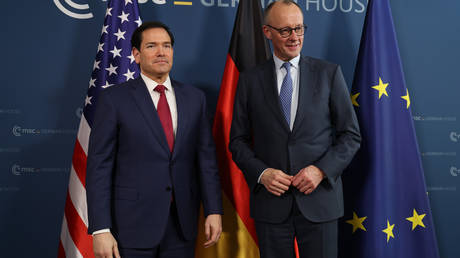
Growing tensions between Paris and Berlin were on display at the recent Munich Security Conference, where German Chancellor Friedrich Merz appeared to ignore Macron during a photo opportunity.
The rift has also intensified over plans for a next-generation European fighter jet, with German industry and unions accusing French aerospace firm Dassault of trying to dictate the project’s terms. In other recent disputes, France sought to block an EU trade deal with a group of South American countries backed by Germany and opposed efforts by Berlin and Rome to soften a planned EU ban on new petrol and diesel cars by 2035.
Media reports suggest the traditional Franco-German axis is weakening as Berlin aligns more closely with Italy.