New Delhi has taken over the presidency of the highly influential and economically powerful grouping for 2026
India has taken over the presidency of BRICS amid sweeping interventions by the Donald Trump administration that have major geopolitical implications spread across the globe.
On December 12, Brazil formally transferred the group’s presidency to India at the BRICS sherpas’ meeting in Brasilia. Brasil’s sherpa, Ambassador Mauricio Lyrio, symbolically handed over the gavel of the BRICS presidency to Indian counterpart, Ambassador Sudhakar Dalela, noting that the object represents both sustainability and the deep roots of cooperation that unite the countries of the group.
Dalela highlighted that the grouping’s priorities during the Indian presidency will remain guided by the fundamental principles of continuity, consolidation, and consensus, “while remaining responsive to emerging global developments and the evolving priorities of the Global South.”
India’s accession comes at a time when the BRICS grouping hopes to expand its footprint. The 2026 presidency will be keenly watched, as US President Donald Trump has made known his aversion to BRICS in no uncertain terms.
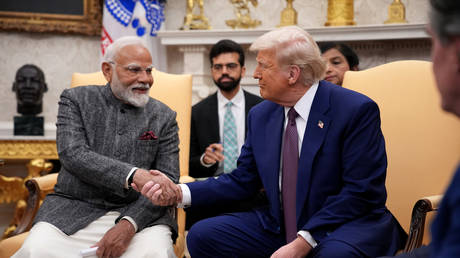
As New Delhi takes over the bloc’s presidency, it is still negotiating a trade deal with Washington. The talks have been thorny since Trump imposed a 50% tariff on Indian goods – half of it as a punitive levy for India’s oil purchases from Russia.
New Delhi’s assumption of the BRICS presidency in the New Year coincided with US forces swooping over the Venezuelan capital of Caracas, and abducting President Nicolas Maduro and his wife.
This has led to vociferous international condemnation, especially from BRICS nations China, Brazil, and Russia.
India was cautious in its response, but in holding the presidency of BRICS, New Delhi will have a tough balancing act to do on such issues.
The Venezuela swoop also offers BRICS nations an opportunity to raise the issue of the perceived failure of global governance, with reference to the United Nations.
A BRICS, with India at the helm, is more equipped to deal with the complexities of charting out a new trade order than a more dominant and assertive China, from the point of view of an antagonistic US.
India’s major task is to steer the economic and political mandate of a bloc of such gigantic proportions. It should, at the same time, hope to balance the geopolitical complexities of dealing with global powerhouses, with interests in diverse spheres ranging from economy and technology to energy and critical minerals.
Trump’s threats
Last July, Trump threatened an extra 10% tariff on countries that align with BRICS. “Any Country aligning themselves with the Anti-American policies of BRICS, will be charged an ADDITIONAL 10% Tariff. There will be no exceptions to this policy,” Trump said in a post on Truth Social.
The US President did not mention any specific policy of the grouping to validate his charge of its “anti-American” stance.
The charge, meanwhile, came after the bloc leaders slammed tariff policies, calling them “unjustified unilateral protectionist measures, including the indiscriminate increase of reciprocal tariffs.”
In August, 2025, Trump imposed a 25% punitive tariff on most Indian imports due to the country’s continued purchases of Russian oil. The levy was in addition to the 25% slapped on the South Asian nation earlier.
In July, Trump issued an Executive Order imposing a 40% ad valorem duty on Brazilian-origin imports, raising the total duty on most Brazilian products to 50%. Tariffs were imposed to punish Brazil over the prosecution of its former president and Trump ally Jair Bolsonaro on coup charges. In November, however, Trump removed his 40% tariffs on Brazilian food products, including beef, coffee, cocoa and fruits, making an effective U-turn on some tariffs that have increased the cost of food in the United States. Brazil, for instance, supplied a third of the coffee used in the US and post-tariff, US retail coffee prices rose over 40%.
Trade as a tool
No doubt trade will be at the core of BRICS in the present geopolitical context as nations across the world pursue their interests, especially for energy and critical minerals.
This is also significant given that New Delhi itself is pursuing free trade pacts with a dozen countries or trading blocs. In 2025, India signed three free trade pacts with the United Kingdom, Oman, and New Zealand.
India’s moves are seen as a bid to diversify from its top export market, the US. For many nations grappling with tariffs, that is a probable indicator of the shape of things to come.
“If you shut off the US to India, by big tariffs, India will have to find other places to sell its exports – like Russia found another place to sell its energy. India will sell its exports – no longer to the US – but to the rest of the BRICS,” a top American economist warned.
That could be a probable trajectory for nations outside the bloc hit by a raft of tariffs.
As tech wars, tariffs, and sanctions occupy the centerstage in the Trump era, the Global South would have to pursue free trade agreements and bilateral pacts to access more trading opportunities. BRICS could be a perfect platform. In May 2025, BRICS members renewed the BRICS 2030 Economic Partnership Strategy and approved a BRICS Declaration on WTO Reform and Strengthening the Multilateral Trading System.
According to the group, reform is necessary to reflect the transformations of the global economy, as Brasil, South Africa, Saudi Arabia, China, Egypt, the United Arab Emirates, Ethiopia, India, Indonesia, Iran, and Russia represent 39% of the global economy and 24% of international trade. The declaration expressed concern over the increase in unilateral tariff and non-tariff measures, as they distort trade and are inconsistent with WTO rules.
Today, collectively, BRICS comprises more than a quarter of the global economy and nearly half the world’s population. In 2024, BRICS reached 4% Gross Domestic Product (GDP) growth, while worldwide growth stood at 3.3%. The combined GDP of the eleven BRICS member countries is projected to exceed the global average in 2025, according to the World Economic Outlook report released in April by the IMF. The data predicts that the grouping will reach 3.4% in GDP, while the world average will be 2.8%.
The collective size of the economies of BRICS is already larger than that of the G7.
BRICS’ share of global GDP measured in US dollars adjusted by purchasing power parity (PPP) grew from 33% to 38% in 2024, and its share of global goods exports from 20% to 23%.
At the same period, in contrast, the G7, comprising the US, Canada, France, Germany, Italy, Japan and the UK, accounted for just 10% of the world’s population, 29% of global GDP measured in PPP-adjusted US dollars, and 29% of global goods exports.
That is too big a factor to ignore.
The biggest expansion of BRICS was in 2024, when Iran, Egypt, Ethiopia, and the United Arab Emirates attended the first summit as full member states in Kazan, Russia.
Indonesia officially joined as a full member in early 2025, becoming the first Southeast Asian member.
It is this resource that India will look to tap into as a way to diversify global trade mechanisms in the aftermath of US-imposed tariffs. The tariff regime imposed by the Trump administration has influenced the outlook of many countries on diversifying from the US as a major trading partner.
The US tariffs had also prompted economists to urge BRICS to replace the “authoritarian US international financial system.”
India’s presidency of BRICS may help attract many nations to the grouping as a necessity in the context of tariffs. The aim would be to enhance the economic potential of such a collective of nations to build appropriate mechanisms for financial, trade, and economic cooperation.
India will have to ensure a balance of varied interests, and at the same time steer clear of diplomatic minefields that may upset major global trading powers, especially the US. Interestingly, the Trump administration sees China as the US’ major economic rival rather than its military competitor.