Why reserve-currency politics are an overrated lens for understanding US intervention – the Trumroe world is cruder
At the core of propaganda lies an intriguing paradox: Sometimes the safest way to bury the truth is to place it in plain sight.
Propaganda 101: Manipulation through manifestation
When an inconvenient fact is openly stated, being printed, televised, or officially acknowledged, it often loses its power to provoke, because the public is inclined to believe that anything truly dangerous would be concealed.
The mechanics of this inversion of trust were prefigured in Hitler’s concept of the “Big Lie”. This is the idea that enormity itself makes a falsehood believable, since popular imagination operates on the premise that no one would dare to invent a colossal lie.
Trust inversion reflects a deeper psychological shift in mass society: Belief is shaped less by evidence than by conjectures about what power would dare to admit.
In a culture saturated with messaging, openness no longer guarantees honesty; it can just as easily signal manipulation. The most effective propaganda, then, is not simply the lie, but the slow engineering of cynicism, until even the truth, spoken plainly, sounds like deliberate misdirection.
Donald Trump appears to have grasped, almost instinctively, this pivotal principle of mass persuasion.The political chameleon skillfully alternates between radical dishonesty and blunt candor, depending on the demands of the moment.
On the one hand, his critics meticulously catalogue his falsehoods, an enterprise that could fill volumes (and itself would require fact-checking case by case). Yet on the other hand, he often “tells it like it is,” not always to conceal, and hence defang, inconvenient truths, but at times simply to extract the political capital accruing from apparent authenticity among his base.
To draw nearer to the truth in any given instance, one must situate Trump along the wide spectrum between fabrication and fact, with logic, coherence, and context as reliable guides. The opening salvo of 2026, the strike on Venezuela that began the year in a burst of furor, invites precisely this kind of bespoke, discerning, and nuanced analysis.
The architecture of conspiracy: The dollar as global monetary fulcrum
Cynical toward all truth claims, especially official accounts, and eager to demonstrate their presumed superior perspicuity compared to rank-and-file journalists, conspiracy-minded commentators predictably mistook disclosure for disguise. By that inversion, they inferred that the US president must have lied about his motives for attacking Venezuela.
In their telling, the avatar of performative politics in the Oval Office concealed the single, hidden cause of the act of war on the soil of a sovereign country: America’s eagerness to preserve the US dollar’s status as global reserve currency.
The ideologues of hidden-hand explanations invoked a familiar pattern: Whenever the dollar, in many quarters idolized as the “green god”, is threatened, US power intervenes. Yet that monocausal reductionism is analytically thin, falling short of fully explaining the headline-grabbing intervention in Latin America.
Stripped of its usual dilettantism and incoherence, and enriched by historical context and technical explanation, the sanitized conspiracist argument, in its fully articulated dissident form, runs as follows:
Since the Second World War, US power has rested not only on military reach but on a global monetary architecture built around the dollar serving as financial fulcrum.
The Bretton Woods system, established in 1944, made the US dollar the center of the postwar monetary order. Other currencies were pegged to the dollar, and the dollar itself was made convertible into gold at $35 an ounce.
This arrangement delivered enormous advantages to the United States: It placed American financial markets at the core of global trade, made the dollar the world’s primary reserve currency, and allowed Washington to finance domestic and overseas commitments on uniquely favorable terms.
But the system carried a built-in dynamic contradiction: As global commerce expanded and US overseas spending surged in the 1960s, large quantities of dollars accumulated abroad. Over time, foreign governments amassed far more dollars than the United States had gold to redeem them. Confidence eroded in convertibility; Gold outflows accelerated.
In 1971, President Nixon finally closed the gold window by severing the dollar’s link to gold, bringing the Bretton Woods system of fixed exchange to an abrupt end. The modern dollar system that followed soon thereafter kept the privilege, but dropped the gold.
In the mid-1970s, Washington sought to reassert the dollar’s centrality within a new regime of floating exchange rates. It reached a series of understandings with Saudi Arabia, tethering American security support, arms sales, and political backing to Saudi oil sales priced in US dollars.
As the world’s leading exporter and OPEC’s linchpin, Saudi Arabia set the standard for the global oil market. Its practice of dollar invoicing quickly became the market norm, pulling the global oil trade into the dollar’s orbit and creating a steady, worldwide demand for US currency even after the abandonment of the gold standard.
Because oil is globally traded in dollars, countries that import it, and even those that export it, must routinely operate in dollars, turning ordinary energy trade into a permanent reason to hold, save, and transact in US currency, both to settle contracts and to insure against price shocks and liquidity crises.
The built-in demand for the US dollar underpins its global reserve status, channeling foreign savings into US Treasury and other dollar-denominated assets, and consequently exerting downward pressure on US borrowing costs.
This allows Washington to fund the full spectrum of government spending on unusually easy terms, and, in particular, to readily underwrite the heavy costs of global military power. Over the longue durée, the “land of opportunity” can sustain levels of deficits and borrowing that would prove existentially destabilizing for most other states.
While the US issues the world’s settlement currency, foreign countries must “earn” it through trade surpluses and the accumulation of net financial claims on the United States, that is, by lending to the US through purchases of Treasury securities and other dollar assets, or through official dollar credit extended via central-bank arrangements.
In other words, the system requires the non-US sector to part with real output in the form of goods and services, or with claims on their own economies or on third parties, in order to acquire dollar-denominated liabilities.
In the anti-mainstream telling, Venezuela’s vast oil reserves gave it unusual leverage: By exploring non-dollar sales, courting BRICS, and experimenting with alternative payment channels, it threatened not merely a trade convention but a system that props up American fiscal freedom, financial dominance, and geopolitical reach.
Iraq’s flirtation with euro pricing and Libya’s talk of a gold-backed oil currency are cited as precedent, testifying to the apodictic claim that efforts to escape the dollar’s orbit inevitably trigger regime change.
Trump’s public justifications for the attack on Venezuela include a familiar quartet of thematic frames: combating transnational criminal networks, restoring regional security, promoting democratic governance, and alleviating economic suffering. Yet these stated reasons are dismissed as mere pretexts by traffickers in conspiracy theories.
The real motive, heterodox commentators argue, is deterrence and enforcementaimed at preserving a monetary order that anchors US power by entrenching global reliance on its currency, dollar-denominated assets, and globally dominant financial markets on American soil.
Geostrategy without illusion: The Petrodollar myth debunked
Conspiracy-minded commentators flatter themselves on being unmaskers of hidden power. Yet they can scarcely be said to have uncovered Trump’s real motives for striking Venezuela, undone as they are by the inversion-of-trust fallacy and by a persistent misreading of the very forces they claim to decipher. Most notably, they routinely underestimate the complex web of geopolitical and geoeconomic factors shaping events.
By contrast, the financial elite advising the US president, whatever else may be said of it, can reasonably be assumed to possess a more accurate understanding of the structural, political-economic mechanisms at play. Precisely for that reason, this inner circle would be unlikely to have fed Trump the rationale for intervention that conspiracists now parade. The irony is sharp: In their rush to expose secret motives, the conspiratophiles miss the obvious one.
In truth, the more plausible inference is also the least flattering to conspiratorial imagination: that Trump acted largely on considerations akin to those he proclaimed, save, perhaps, for his ritually invoked, sanctimonious pledge to bestow freedom and welfare upon Venezuela.
At the bedrock of it all, the unifying impulse behind the violent Venezuela stunt is as crude as oil: It is the unembarrassed, demiurgic creation and shaping of what might be called a “Brave New Trumroe World”.
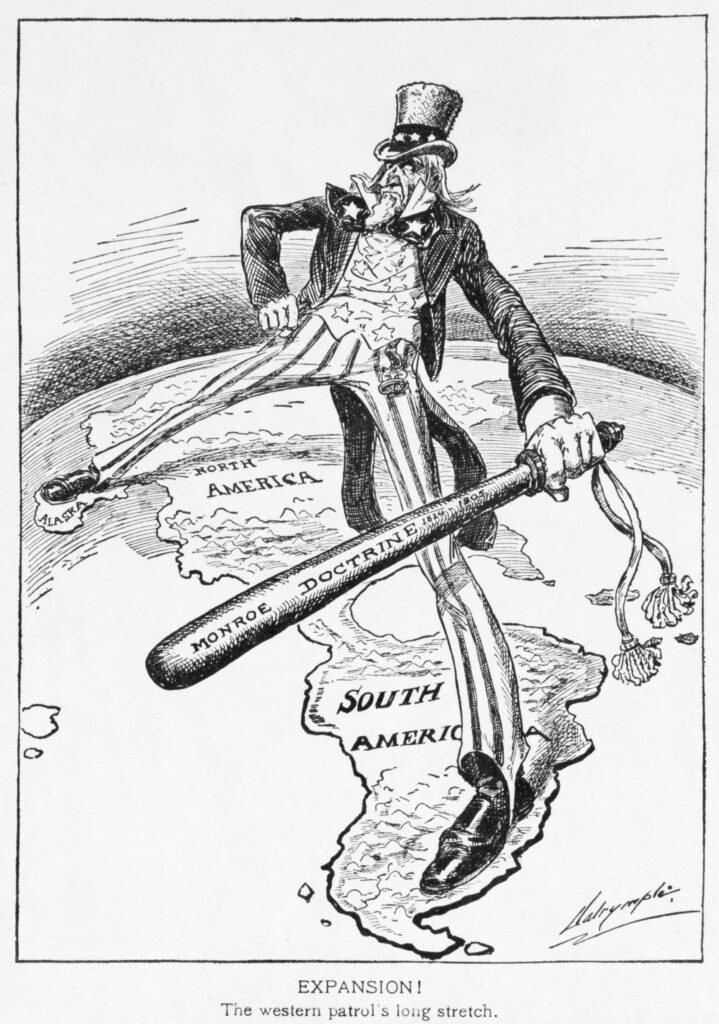
In effect, this formative dispensation amounts to a dystopian order based on a freshly minted “Trumroe Doctrine” in which US might makes right. In that transfigurative vision, the world is openly carved into spheres of imperial influence, in a twenty-first-century resurrection, and aggrandizement, of the Monroe Doctrine of 1823, long consigned to the historical margins.
Cartoon by Louis Dalrymple illustrating the Monroe Doctrine
Before any particulars are considered, the way of assigning cause in this case, typical of conspiracy theories in general, warrants skepticism and scrutiny. Seductive as the petrodollar story may be, it rests on a deterministic, monocausal view of historical development.
In reductionist fashion, the narrative attributes complex outcomes (here, the exercise of US power abroad) to a single, latent, and perpetually recurring driver (in this case, the defense of the petrodollar system). But real-world change is rarely that neat. Instead, transformations usually grow out of a tangle of intersecting, shifting, contingent, and often competing variables.
In geopolitical and geoeconomic terms, the alternative-explanation advocates greatly exaggerate how fragile the dollar system is. The dollar-centered order did not come into being, and is not sustained, primarily through episodic coercion. It rests firmly on mutual consent and persistent coordination, initially catalyzed by the US acting as a first mover and gaining an early advantage. That early lead was then structurally reinforced as dollar pricing diffused into standardized practice.
Standards, once entrenched, acquire an inertia of their own. They are costly to dismantle precisely because they tend to be anchored in habits, contracts, expectations, and legacy infrastructure.
Consider the practical and institutional costs, and the literally profound dislocation, that would attend a switch from Britain’s curiously particular (eccentric, as some would have it) tradition of left-hand driving to the right. Consider, too, how disruptive it would be to abandon the far-from-ideal QWERTY keyboard, on which generations of users have trained and around which entire technical ecosystems have been built.
The persistence of oil pricing in dollars reflects the same logic of path dependence; Maintaining the standard requires far less effort than overturning it. The petrodollar, in this sense, is less a fortress than a convention, and far more resilient than its critics assume.
The petrodollar-first story also breaks down on another front: Its devotees greatly overestimate the extent to which oil pricing in dollars translates into American power. They erroneously cast this standard practice as the master switch of US global dominance, as if power followed mechanically from denomination alone.
Understanding why monetary alchemy proves illusory requires a descent into the intricate economic machinery beneath the myth. Care for a deeper dive?