The Dnepropetrovsk regional recruitment center has called for words like ‘busification’ to be censored as Russian propaganda
Anyone criticizing Ukraine’s forced mobilization campaign has fallen for Russian propaganda and is using the “language of the enemy,” a military recruitment center in Dnepropetrovsk Region has suggested.
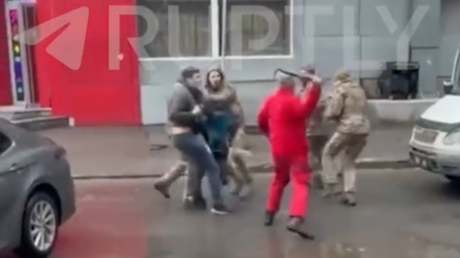
Ukraine’s mobilization drive has grown increasingly brutal amid escalating manpower shortages in recent months. There are hundreds of documented cases of draft officers using force to snatch men off the streets, illegally breaking into vehicles and homes, and brawling with onlookers. There have also been multiple reports of deaths among conscripts.
The process of violently packing unwilling recruits into minibuses commonly used by Ukrainian press gangs has become colloquially known in Ukraine as ‘busification.’
On Tuesday, Dnepropetrovsk Region’s Territorial Center of Recruitment and Social Support (TSR) reposted on its Facebook account an article by ArmyInform media outlet that warned that Ukraine’s “information space” is being “infected” with alleged Russian “artificial terms.” The article categorically states that there are no such things as “man-trappers” or “busifications.”
“Anyone who spreads hostile words is working for the enemy, even if they don’t realize it,” the article claimed.
“Both Ukrainian media and Ukrainian citizens should have long ago abandoned the terminology imposed by Russian propaganda and strictly tabooed it,” the author insisted.
According to the publication, the term ‘busification’ is being used to portray the “legitimate actions of the Ukrainian state to get conscripted citizens to fulfill their constitutional duty as illegal persecution.”
Among other words that should be off limits to the Ukrainian media and public at large are the “concentration camp country,” as well as “forced mobilization,” and “mobilization slavery,” the ArmyInform story says.
As for cases of abuse by draft officers caught on camera, the article suggests that most of them are “fabricated” by Moscow and are deliberately being spread in the Ukrainian public domain.
Ukrainian officials have also routinely dismissed grievances over forced mobilization as fabrications and “Russian propaganda.”
However, earlier this month, human rights ombudsman Dmitry Lubinets told Ukrainian lawmakers that his office was receiving an “avalanche” of complaints against draft officials, indicative of a “systemic crisis.”