


High-resolution satellite imagery analyzed in 2026 reveals the true condition of two long-neglected neighborhoods in central Pyongyang: Tungme-dong in Sonkyo district and Worrhyang-dong in Moran Hill district. Hidden behind the capital’s gleaming main thoroughfares, both areas are defined by densely packed single-story homes, deteriorating low-rise apartment blocks, and basic infrastructure in a state of serious disrepair.
A Daily NK source reports that North Korean authorities have formally launched what is being described internally as a “capital-area dilapidated district renovation project,” also referred to as the “Tungme and Worrhyang-dong residential housing construction project.” The goal, the source says, is to tear down and redevelop the most visually conspicuous pockets of urban decay in central Pyongyang, a move authorities frame as the next stage of the Kim Jong Un era’s capital construction drive.
Satellite imagery shows two worlds inside one city
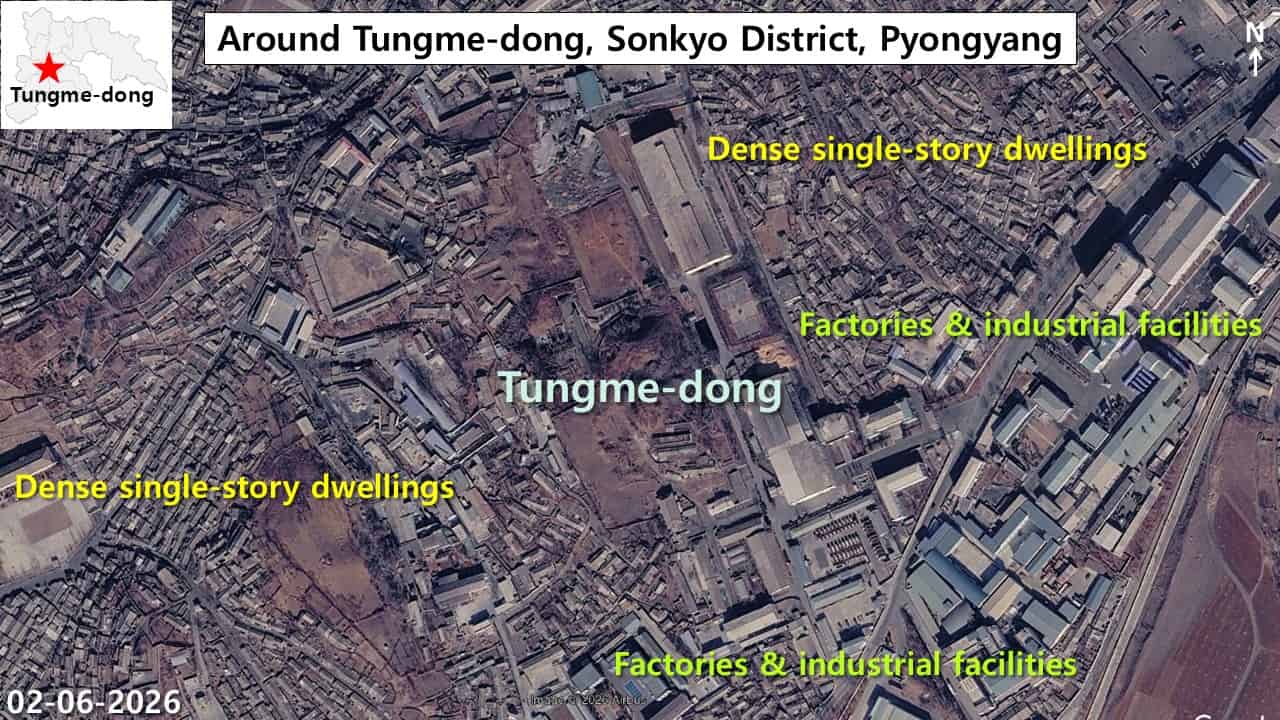
Satellite analysis of Tungme-dong in Sonkyo district shows a neighborhood that has changed little in decades. Single-story homes are packed tightly together across the left-center and upper-right sections of the area, their rooftops nearly touching. Narrow, labyrinthine alleyways run between them, bearing no resemblance to the planned residential blocks found elsewhere in the capital. Large factory sites and long warehouse-style structures are interspersed directly among the housing, with no buffer or separation. Green space is essentially absent, and the density of the old housing stock suggests that road access, sewage, and other basic utilities are severely underdeveloped throughout the district.
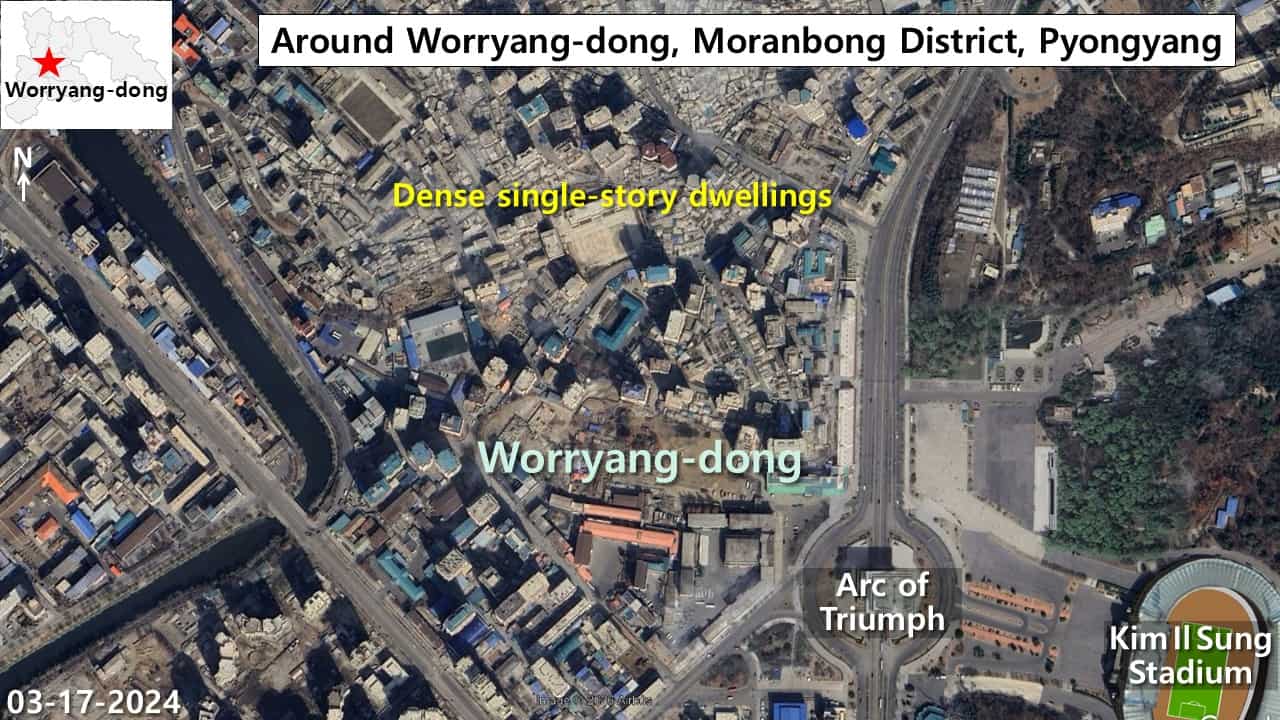
The picture in Worrhyang-dong, in Moran Hill district, is one of sharp contrasts. The right and lower sections of the satellite frame show the Arc of Triumph roundabout and Kim Il Sung Stadium, two of Pyongyang’s most recognizable landmarks, flanked by wide, well-maintained boulevards. Yet just one block back from those main roads, the interior of Worrhyang-dong is packed with faded single-story homes and aging low-rise apartments that appear completely untouched by the redevelopment projects that have transformed other parts of the city. The gap between Pyongyang’s public face and its backstreets is visible from space.
A project tied to Kim Jong Un’s urban image drive
North Korean authorities are framing the renovation campaign as something more ambitious than routine housing upgrades. The project is explicitly linked to the broader ideological drive, known in North Korea as the “people-first principle,” which the Kim Jong Un leadership has used as its central governing slogan. Under that banner, authorities have in recent years built a series of high-profile residential streets including Hwasong Street and Songhwa Street, each styled as a showcase of Kim-era construction achievements. The growing visual contrast between those new developments and the aging districts that surround them appears to have made areas like Tungme-dong and Worrhyang-dong an increasing liability.
The current project appears to have partial roots in an earlier plan from around 2020 that would have created a “Kim Jong Suk Street” in Pyongyang’s central district, combining a new signature thoroughfare with propaganda slogans tied to Kim Jong Un’s late mother. That concept has since been set aside. The current project drops the personalized ideological branding in favor of more functional language focused on housing construction and residential environment improvement, a shift that analysts say reflects the Kim Jong Un administration’s preference for presenting urban development as a practical governance achievement rather than a tribute to the founding family’s revolutionary lineage.
The result is a redevelopment push that is now moving inward. Rather than continuing to expand the capital’s footprint on its outskirts, North Korean planners are now targeting the aging residential core, with the stated aim of giving Pyongyang’s image a comprehensive overhaul.
June 22, 2026 at 02:29AM
by DailyNK(North Korean Media)