


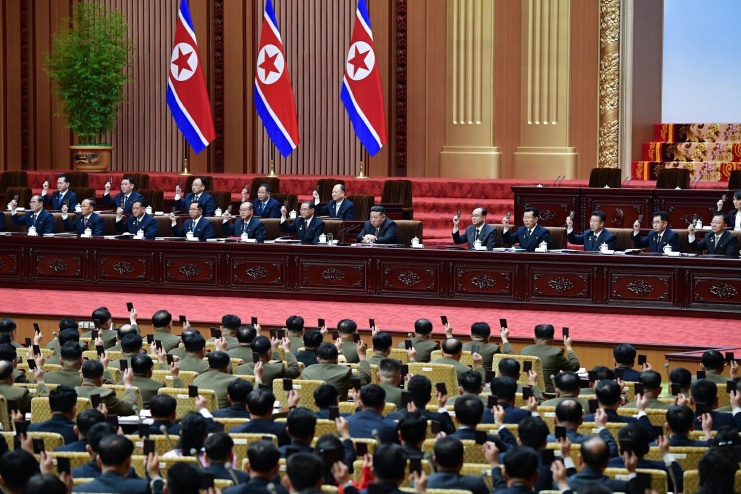
North Korea has launched an intensified cult of personality campaign around leader Kim Jong Un following the Ninth Congress of the Workers’ Party of Korea (WPK), held in February 2026, sidelining the ideological legacies of his predecessors and generating widespread confusion among ordinary North Koreans, a source inside the country told Daily NK on Monday.
Political education sessions held at institutions, enterprises, and neighborhood watch units across the country have increasingly centered on what authorities are calling “Kim Jong Un ideology” and his leadership achievements, according to a source in North Hamgyong province. Lecture materials and study guides distributed after the Ninth Party Congress have shifted away from the teachings and instructions of Kim Il Sung and Kim Jong Il, instead presenting Kim Jong Un’s directives and vision as the sole standard of the current revolutionary era.
Instructors at political sessions have reportedly told participants that Kim Il Sung and Kim Jong Il “remain only as historical symbols of their respective eras, enshrined alongside the immortality towers. All current policy must be grounded strictly in the instructions of Marshal Kim Jong Un.” The shift has left a growing number of North Koreans disoriented.
“Since the Ninth Party Congress, a storm of Kim Jong Un-ism has been blowing,” the source said. “The teachings of the former leaders are being pushed aside and forgotten. The sense of mission demanding absolute obedience to the Marshal’s orders is being hammered home, and it’s causing enormous confusion among the people.”
Donju targeted as private economy crackdown widens
The confusion has been compounded by an economic directive that arrived March 31, ordering that donju (wealthy entrepreneurs who operate semi-independently within North Korea’s informal market economy) and private economic actors be fully brought under state control by Oct. 10, the anniversary of the Workers’ Party of Korea’s founding.
The order, which represents a sharp departure from the tacit tolerance of market activity that has characterized recent years, has sent anxiety spreading through the population. The source said authorities are now framing the affluent merchant class as “remnants of class struggle,” with privately run shops and food service businesses being transferred wholesale into state ownership.
“The move to forcibly incorporate donju into the framework of socialist workers is shocking people,” the source said. “Businesses that were operated with private capital are being absorbed by the state all at once.”
North Korea has long relied on donju and private economic activity as a de facto pillar of economic stability amid chronic shortages, but the post-Ninth Congress policy shift signals the regime’s intent to bring that sector under direct state management.
The tightening grip of political and economic control since the party congress has prompted some North Koreans to express nostalgia for the Kim Il Sung and Kim Jong Il eras.
“During the times of the Great Leader and the General, the state couldn’t solve people’s livelihood problems, but it at least guaranteed the ability to trade and make a living,” the source said. “People say that life was hard then too, but the Marshal’s era is many times harder and more frightening.”
Reporting from inside North Korea
Daily NK operates networks of sources inside North Korea who document events in real-time and transmit information through secure channels. Unlike reporting based on state media, satellite imagery, or defector accounts from years past, our journalism comes directly from people currently living under the regime. We verify reports through multiple independent sources and cross-reference details before publication.
Our sources remain anonymous because contact with foreign media is treated as a capital offense in North Korea — discovery means imprisonment or execution. This network-based approach allows Daily NK to report on developments other outlets cannot access: market trends, policy implementation, public sentiment, and daily realities that never appear in official narratives.
Maintaining these secure communication channels and protecting source identities requires specialized protocols and constant vigilance. Daily NK serves as a bridge between North Koreans and the outside world, documenting what’s happening inside one of the world’s most closed societies.
April 14, 2026 at 06:37PM
by DailyNK(North Korean Media)