


North Korea held a commemorative performance in Pyongyang on July 27, 2026. The event marked the 73rd anniversary of the Korean War armistice, a day the country calls “Fatherland Liberation War Victory Day,” or Victory Day for short.
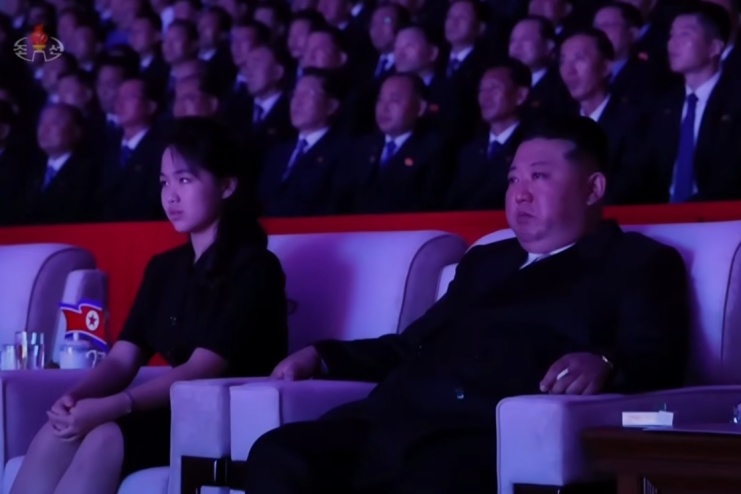
Kim Jong Un watched the performance with his wife, Ri Sol Ju, and his daughter, known internationally as Kim Ju Ae. The family had visited the Revolutionary Martyrs’ Cemetery on Mount Taesong the day before, on July 26. They also visited the Tomb of Patriotic Martyrs of the Fatherland Liberation War. It was the first time Kim Ju Ae had appeared at a Victory Day related event.
North Korea has not officially named Kim Ju Ae as heir. Still, her repeated appearances at major political events could be read as part of a succession process. Even her name and age remain unconfirmed. She is generally believed to be around thirteen years old.
At the event, Kim Ju Ae wore a black skirt suit and high heels, projecting an air of maturity that belied her age. After the performance ended, though, she was seen holding onto a railing while walking down a set of stairs.
Kim Ju Ae stood in the position closest to Kim Jong Un throughout the event. During the performance she kept one hand almost still while applauding with only small up and down movements of the other. Nearby attendees, by contrast, raised both hands to face height and clapped vigorously.
A North Korean defector told me that ordinary North Korean people risk having their loyalty questioned if they applaud that way. The gesture, the defector said, instead reflects the status of a leadership level figure. At the martyrs’ cemetery, Kim Jong Un and Kim Ju Ae bowed their heads only slightly during a moment of silence. Other attendees, by contrast, bent deeply at the waist. The pattern suggests Kim Ju Ae is learning, event by event, the bearing expected of a member of the supreme leader’s family.
There appear to be two main reasons for including Kim Ju Ae in Korean War related events.
The first is to project an image of the Kim family carrying on the legitimacy of the anti-Japanese guerrilla fighters and the Korean War generation. These two groups form the historical and political foundation that has sustained the North Korean system. Paying tribute to them sends a message to their descendants. It also tells the party, government and military elite that the Kim family still values the revolutionary tradition.
The second reason is to prevent an erosion of ideological commitment among younger generations. North Korea regards the inflow of American and South Korean culture as a “cultural infiltration” that threatens the system. Pyongyang uses these fears, and memories of the Korean War, to stoke patriotism and anti-American sentiment among young people.
Ahead of this year’s Victory Day, North Korea invited war veterans and wartime meritorious citizens to Pyongyang. Meetings between veterans and young students were also held across the country, where veterans shared their wartime experiences. North Korean authorities used the events to rally the younger generation around Kim Jong Un.
The market generation’s quiet drift
North Korea’s heavy focus on ideological education for young people reflects the rise of the so-called jangmadang, or market, generation. This generation was born or raised after the Arduous March, the mid-1990s famine that killed hundreds of thousands. It has relied on markets rather than state rations for its livelihood ever since. Its members are used to earning money and buying daily necessities through markets, and many are seen as prioritizing personal livelihood and practical interests over ideology. They are also relatively comfortable using mobile phones and other digital devices, and they respond more openly to outside culture.
So did North Korea’s carefully orchestrated Victory Day propaganda move Kim Ju Ae as deeply as intended?
Korean Central Television, the state broadcaster, aired footage of the performance on July 28. Attendees waved flags and applauded in time with music and visuals evoking the Korean War. Kim Jong Un was seen wiping away tears as he watched the stage. Kim Ju Ae, seated beside him, appeared composed or expressionless for most of the moments captured on camera, though.
At other public appearances, Kim Ju Ae tends to shake hands with attendees but shows little change in expression. Her expression alone cannot reveal what North Korea’s younger generation as a whole is thinking. The supreme leader’s daughter is, after all, growing up in an environment entirely different from that of ordinary North Korean youth.
Still, it is notable that her blank expression stood out even on a stage built for orchestrated emotion and loyalty. Kim Ju Ae, after all, is spoken of as a potential heir. A gap can exist between the emotions propaganda demands and those a person actually feels.
A North Korean defector recalled to me that as July 27 approached during their student years, they were required to submit an application to enlist in the military. Almost no students actually wanted to join the army, the defector said. But nearly all pretended to volunteer willingly, because refusing risked raising doubts about their loyalty.
Kim Ju Ae’s blank expression does not prove that North Korea’s younger generation is drifting away from the system. But it does symbolically illustrate a limit to the state’s power: North Korean authorities cannot fully control people’s emotions, only their behavior. The country’s repeated invocation of the Victory Day generation’s memories may itself stem from an underlying anxiety. Those memories alone, perhaps, are no longer enough to hold the younger generation’s hearts.
Note: The views expressed in this column by an outside contributor may not reflect the editorial position of Daily NK.
August 5, 2026 at 12:21AM
by DailyNK(North Korean Media)