


Satellite imagery of two sites in Kusong, North Pyongan province, captured in early 2026, shows recent changes at facilities linked to suspected nuclear weapons development. The sites, in Yongdok-dong and Panghyon-dong, have drawn renewed attention as a point of contention amid recent friction in South Korea-U.S. security cooperation. Both sites were examined through satellite imagery to assess recent activity and current conditions.
A review of foreign organization reports indicates that the Yongdok-dong facility contains nuclear-suspect infrastructure distributed along a deep mountain valley approximately 4 to 5 kilometers in length, comprising multiple buildings and test facilities. Recent satellite imagery confirms changes within the compound, including roof repairs on existing buildings and the installation of new structures, suggesting the site continues to be maintained as a high-explosives test facility for nuclear warhead development. Given the structure of the underground facilities within the mountainous terrain and the surrounding support buildings, the complex is assessed to have the character of a multi-purpose military installation. Beyond its role as a high-explosives test facility for nuclear detonation devices, the site is also considered a possible location for the underground storage of nuclear materials or nuclear weapons-related equipment.
Yongdok-dong: Nuclear-suspect complex in a mountain valley
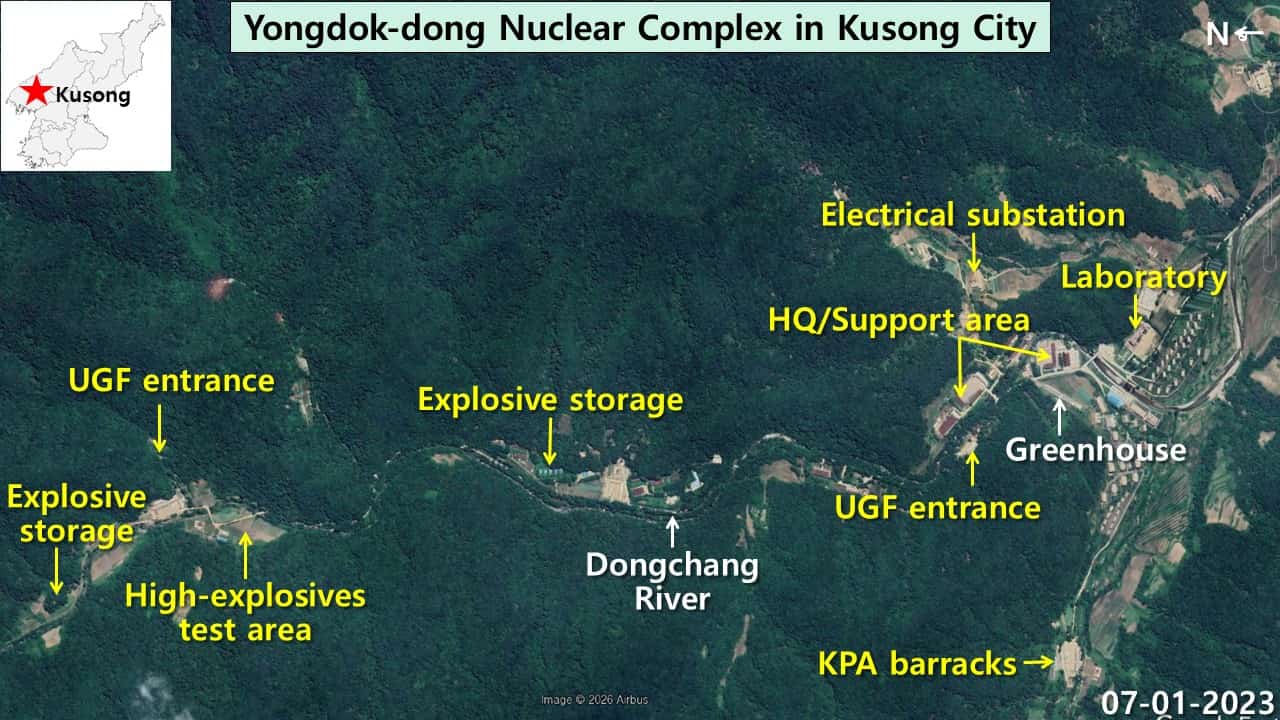
A high-explosives test facility linked to nuclear weapons development is located in Yongdok-dong, Kusong, North Pyongan province. Recent satellite imagery confirms changes within the compound, including building repairs and the installation of new structures. The site is a military zone stretching approximately 4.5 kilometers along a mountain valley and is known as an important hub for nuclear research and development, where high-explosives testing of nuclear warhead detonation devices is conducted. Satellite imagery showing roof repairs and new equipment installations indicates that North Korea continues to maintain the facility and preserve its capacity to conduct nuclear weapons-related testing.
The site has also been identified as a possible location for underground storage of nuclear materials, in addition to its role as a test facility. Underground facilities situated in mountainous terrain are advantageous for evading external attack and satellite surveillance, and the possibility that such facilities are used to store nuclear materials or equipment related to high-explosive detonation devices cannot be ruled out. The above-ground buildings and structures are assessed to serve a dual function, supporting underground facility management and materials movement. The recent facility changes may also reflect North Korean efforts to modernize related infrastructure in order to strengthen nuclear weapons operational capacity.
Yongdok-dong: New construction and structural changes
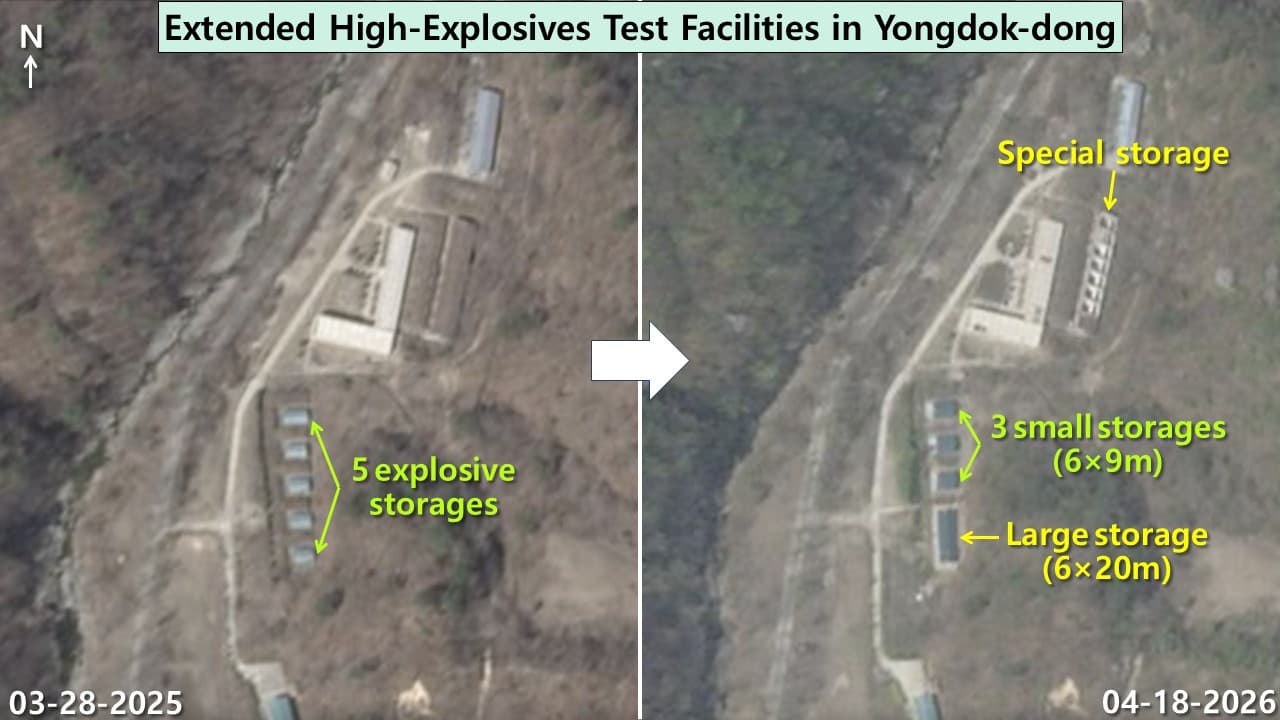
Recent Planet Labs satellite imagery confirms a series of changes within the facility’s explosive storage area. Five structures previously identified as explosive storage buildings, each measuring 6 by 9 meters, were partially demolished: two were torn down first, after which a single larger rectangular structure measuring 6 by 20 meters was built in their place. This consolidation is interpreted as an effort to manage storage space more efficiently and reduce material handling distances within the compound.
An April 18 satellite image captured six new white pit-like structures installed behind the complex’s main L-shaped building, which had not appeared in earlier imagery. These structures are assessed to be either small segregated storage units for dangerous materials or explosive test components, or instrumentation housings for sensors and cameras used to record test events.
Yongdok-dong: Facility repairs
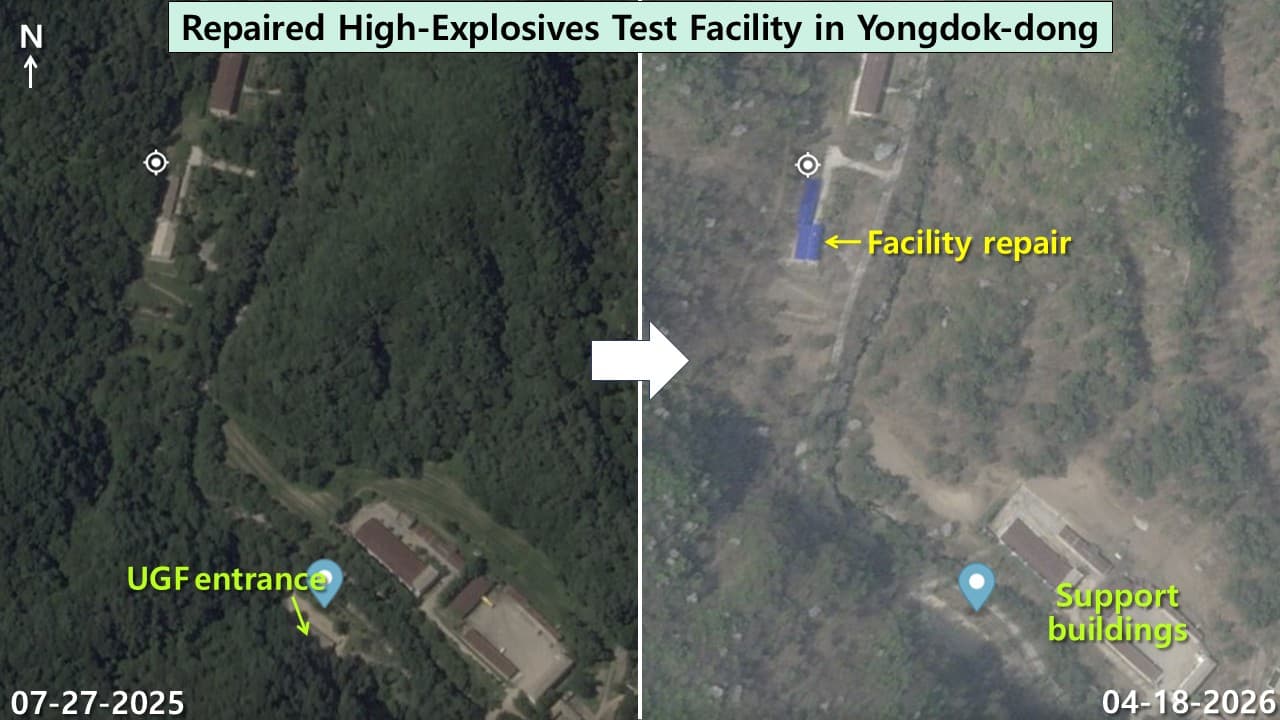
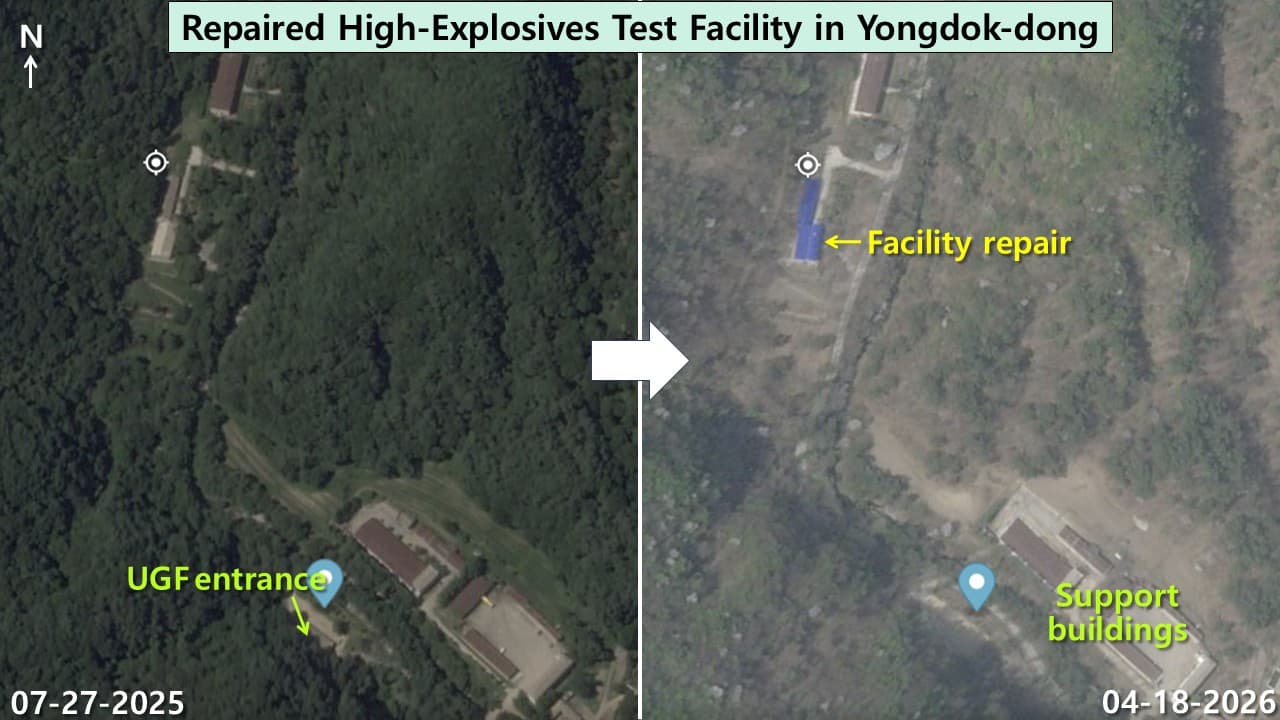
Recent satellite imagery shows that several roofs on buildings within the Yongdok-dong high-explosives test facility have been replaced, with dark-colored original roofing giving way to bright blue metal panel sheeting. The replacement material is consistent with the metal panel roofing North Korea commonly uses when repairing military and public facilities, and the work is understood as maintenance on aging structures.
The Yongdok-dong facility is an outdoor test site for evaluating the performance of nuclear warhead detonation device components. The roof replacement work can be understood as a measure to protect internal equipment from moisture and external environmental factors while improving test conditions. The facility changes and structural modifications identified in satellite imagery indicate that the Yongdok-dong test site remains operational and that nuclear weapons-related research and testing continues there.
Panghyon-dong: Suspected underground uranium enrichment facility
Beneath Janggun-daesan in Panghyon-dong, Kusong, lies an underground facility said to be connected to an aircraft components manufacturing plant. Multiple tunnel entrances and structures that appear to be military-industrial facilities are visible at the foot of the mountain. In July 2016, a U.S. think tank assessed that the underground Janggun-daesan facility was likely used as a conventional munitions factory before being repurposed in the late 1990s and early 2000s as an early centrifuge research and development site, with a small-scale research function involving approximately 200 to 300 centrifuges conducted there at the time.
The mountain sits approximately 45 kilometers west of the Yongbyon nuclear complex, and at its foot is a factory measuring 25 by 145 meters that produces components for drones and other aircraft. The underground facility was originally constructed to manufacture Soviet-era fighter jet components and, situated within a military installation, has a layout that is advantageous for evading external surveillance. The suspected connection to centrifuge technology transfers from Pakistani nuclear scientist A.Q. Khan has led analysts to raise the possibility that North Korea conducted early uranium enrichment research at this location. Whether the underground facility continues to operate as an enrichment site remains unconfirmed. It is assessed primarily as a location of suspicion from a past research and development phase rather than a confirmed active enrichment facility.
May 11, 2026 at 07:30PM
by DailyNK(North Korean Media)