


North Korea passed a sweeping law in 2025 that regulates soil pollution from initial monitoring through investigation, cleanup and punishment of violators. The move marks a rare case of Pyongyang addressing an environmental problem through its own dedicated statute.
Daily NK obtained a copy of the law, called the Soil Pollution Prevention Act. The Standing Committee of the Supreme People’s Assembly, North Korea’s parliament, adopted it on May 29, 2025, as Decree No. 1930. The law spans six chapters and 48 articles, and it took effect on July 1 of that year under a supplementary provision.
The law defines soil pollution as a condition, stemming from artificial contamination, in which harmful substances in the soil exceed a “soil environmental quality standard.” Harmful substances include acids, alkalis, heavy metals, pesticides, persistent organic pollutants such as polychlorinated biphenyls, and disease-causing microorganisms, according to Articles 1 and 2.
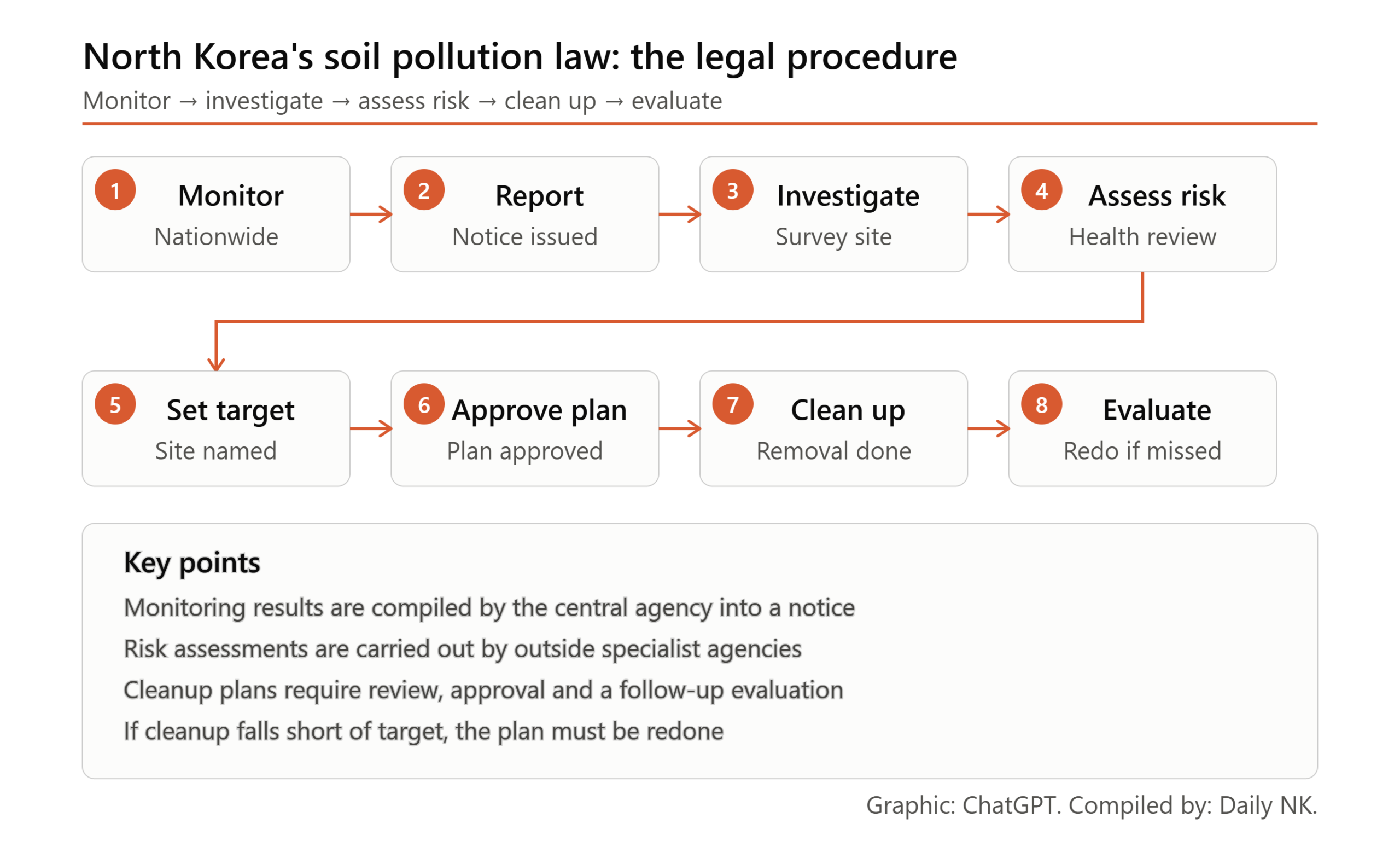
The law goes beyond simply banning soil pollution, building an entire process into a single piece of legislation. That process runs from monitoring and investigation through risk assessment, cleanup plan approval and execution, and follow-up evaluation of results.
The law places the primary cleanup obligation on whoever caused the pollution. If that party cannot be identified, a successor who has taken on their rights and duties must handle it instead. Failing that, the institution that manages or uses the land bears the responsibility. For serious violations, regulators can shut down the offending enterprise and confiscate its facilities and equipment. They can also pursue administrative or criminal punishment against those responsible.
Myeong Soojeong is the Chief Research Fellow of the Korea Environment Institute‘s Natural Environment Division. She said soil contamination threatens ecosystems and human health alike, since soil underpins nearly all life on land. “If soil, which is the foundation for all life on land including humans, becomes polluted, it not only disrupts ecosystems but also directly harms human health,” she said. “The fact that North Korea has paid attention to soil conservation and pollution and enacted a related law carries great significance. This holds true both for environmental protection and for the health of the North Korean people.”
Nationwide monitoring network built around phased investigations
Under the law, a central land and environmental protection guidance agency must form and operate a nationwide soil pollution monitoring network. Regional land and environmental protection agencies must maintain the material and technical means needed for monitoring. They must also report their measurement and analysis results to higher authorities on a regular basis, according to Article 7. Officials set monitoring points, indicators and frequency based on several factors. These include the distribution of pollution sources, land use patterns, and the physical and chemical properties of the soil.
Some areas face stricter, more frequent measurement and analysis under the law. These include land near hazardous-substance facilities and regions where farm produce has shown contaminant levels above the standard. Sites of major pollution accidents also qualify, according to Articles 8 and 9.
Regulators compile measurement results collected nationwide into a “soil pollution monitoring notice.” The notice lists the pollution status of each region along with sites that need further investigation. Authorities then deliver it to the Cabinet, local people’s committees and relevant agencies, according to Article 10.
Suppose a survey finds that a designated site exceeds the soil environmental quality assessment standard. In that case, specialized public health and ecological agencies must evaluate the risk. They assess the danger to people’s health, farm produce safety and the surrounding ecosystem. They must then submit a “risk assessment report” detailing the pollution’s type, scope and severity, along with cleanup targets and methods, according to Articles 11 through 13.
The text obtained by Daily NK does not spell out the soil environmental quality assessment standard itself. Nor does it give the permissible limits for individual harmful substances. It also leaves out the detailed methods for soil sampling, analysis and assessment. Whether monitoring notices actually get produced in practice remains unclear. So does whether unfavorable data on heavily polluted areas or key state enterprises reaches higher authorities without alteration.
Myeong said North Korea’s Soil Pollution Prevention Act and its promoted “nationwide soil environment monitoring system” appear sophisticated on paper. In practice, she said, they are unlikely to function well. “North Korea has the kind of top-down legislative structure typical of a planned economy, so the text of the law itself is systematic and strict,” she said. “But the country lacks the hardware needed to carry it out, such as advanced analytical equipment and precision reagents. It also lacks the software, such as specialized personnel and standardized verification systems.”
She added that soil cleanup and pollution monitoring are technology-intensive fields. They require a stable power supply along with modern equipment and analytical reagents, she said. “Given the chronic shortages of electricity and materials across North Korean industry, it will be structurally difficult for cleanup facilities to operate normally,” she said. She predicted that the legal principle of “preventing pollution ahead of production” will ultimately lose out. Meeting economic plan targets, she said, will take priority instead.
Oversight extends past mines and smelters into everyday pollution sources
The Soil Pollution Prevention Act also touches on environmental problems long reported around North Korean industrial sites. Daily NK reported in June 2025 that an analysis of high-resolution satellite imagery showed wastewater flowing from a settling pond. The pond sits at the Pyongsan uranium concentration plant, in North Hwanghae province, which produces material for North Korea’s nuclear weapons program. The volume had increased compared with the previous October, and the imagery showed black leachate flowing along a drainage channel roughly two meters wide.
Internal sources later said North Korean authorities disciplined officials at the Pyongsan plant after the discharge became publicly known that August. Officials then pursued a modernization plan to upgrade the plant’s wastewater treatment facilities, drainage channels and retaining walls. Whether those disciplinary actions and upgrades came as a result of the newly enacted law remains unconfirmed.
Daily NK also reported in 2022 that aging dust and filtration equipment at the Bukchang Aluminum Factory, in South Pyongan province, which produces materials for uranium-enrichment centrifuges, was allowing dust and pollutants to spread into nearby homes and schools. A source at the time said a growing number of people living near the factory were reporting respiratory illness and skin conditions.
Notably, the law’s scope reaches beyond mines or heavy chemical facilities. It broadly regulates pollution tied to everyday life, including industrial and household waste, agricultural fertilizer and pesticides, livestock manure and wastewater, and irrigation water used in farming and livestock production.
This suggests North Korean authorities view soil pollution as a problem running through both industry and daily life. The law directs particular monitoring toward areas where farm produce shows above-standard contaminant levels. It also requires an assessment of the risk to public health and food safety in those areas. That link suggests Pyongyang now treats soil pollution as a food security and public health issue.
Asked about enforcement priorities, Myeong pointed to heavy metal contamination around mines and smelters with high pollution levels. She also named farmland soil tied directly to food production. “Large-scale mines and coal mines across North Pyongan and the Hamgyong provinces have very likely been exposed for decades to mining wastewater,” she said. “The same goes for the areas around smelters in Hungnam, Hamhung and Chongjin, where heavy metals such as cadmium, lead and arsenic have gone unchecked.”
She also pointed to decades of intensive chemical fertilizer and pesticide use aimed at boosting food production. That practice has caused long-term soil acidification, she said, compounded by soil loss from continued deforestation. “Investigating soil acidification and pesticide residue contamination in farmland is extremely urgent,” she said. “That issue is directly tied to the safety of what North Korean people eat.”
Illness near Pyongsan raises questions about required risk assessments
The law establishes a risk assessment procedure covering public health and farm produce safety. That makes recent reports of unusual symptoms near the Pyongsan uranium concentration plant especially notable.
Citing a source in North Hwanghae province, Daily NK reported on July 24 that people living along a river near the Pyongsan plant had collectively reported troubling symptoms. These included hair loss, vomiting, skin blotches and severe fatigue. Local people reportedly suspected waste or contaminated water from the plant as a possible cause. North Korean authorities are believed to have restricted movement in and around Pyongsan and Sohung counties, and tightened checkpoints on routes leading to Pyongyang.
No objective sample analysis or medical epidemiological investigation has confirmed the cause of the reported symptoms. Whether radioactive material, heavy metals or other plant wastewater is to blame remains unknown. The illness therefore cannot be definitively attributed to radiation exposure or soil pollution. The key question is different: did officials actually carry out the soil measurements, field surveys and public health risk assessments the law requires?
Under the law, areas surrounding hazardous-substance facilities and sites of major pollution accidents face strict measurement and analysis, according to Articles 8 and 9. Specialized public health and ecological agencies must also assess the risk to people’s health and farm produce safety once the soil environmental quality assessment standard is exceeded, according to Articles 11 through 13.
It remains unclear whether officials actually sampled and analyzed soil, river water and groundwater around Pyongsan for hazardous substances. Whether they carried out a formal risk assessment is also unknown. Suppose authorities limited their response to restricting movement and controlling information, without following these procedures. That would expose a gap between the law’s environmental and public health provisions and conditions on the ground.
Polluters bear primary liability, and individual officials can face punishment
The law assigns primary responsibility for cleanup to the party that caused the pollution. Institutions, enterprises, organizations and individuals that caused soil pollution must remove it. If the responsible party changes, or an individual dies, a successor who has taken on the relevant rights and duties inherits that cleanup responsibility. When authorities cannot identify the party responsible for pollution, two institutions must step in instead. The institution managing the land and the institution actually using it must carry out the cleanup, according to Article 30.
Once cleanup is complete, a specialized agency must evaluate its effectiveness. The relevant authority at the provincial or municipal level then reviews that evaluation. If the cleanup falls short of its target, officials must draw up and carry out a new removal plan, according to Article 39.
The law does not spell out how to divide responsibility when the institution present at the time of the pollution differs from the current land user, and it does not specify which party bears what share of cleanup costs.
On legal liability, the law covers several tracks at once. These include compensation for damages, closure of enterprises, and confiscation of facilities and equipment. It also allows administrative or criminal punishment of individual officials. Rather than limiting violations to a simple corrective order, the law links them to the suspension of enterprise operations and punishment of those in charge.
Serious violations of soil pollution prevention rules can lead to the closure of an enterprise and the confiscation of its facilities and equipment, according to Articles 41 and 42. Failing to fulfill cleanup obligations can bring up to three months of unpaid labor or forced labor education. The same applies to failing to prepare measures against the spread of pollution, secondary contamination or emergencies. Longer terms are possible in serious cases, according to Article 45. Officials found responsible for “grave consequences” can face demotion, dismissal or removal from their posts. If the violation rises to the level of a crime, criminal liability can also follow under North Korea’s criminal code, according to Articles 46 and 47.
The law does not specify what counts as a “serious case” that would trigger closure, confiscation or a sentence longer than three months. Nor does it define the “grave consequences” that would trigger demotion, dismissal or removal from a post. The text obtained by Daily NK also contains no procedure allowing an accused party to appeal a punishment. That gap suggests the severity of penalties may hinge on the judgment of individual officials. Land and environmental protection agencies, supervisory and inspection bodies, and judicial authorities would each have their own say.
Enforcement, and international cooperation, will determine the law’s impact
The Soil Pollution Prevention Act treats soil pollution as an independent area of environmental management. It also spells out an accountability structure spanning prevention, investigation, cleanup and punishment. Particularly notable is how the law folds an entire process into a single statute. That process starts with a nationwide monitoring network to identify suspected contamination and runs through measurement, investigation and risk assessment, ending with designating cleanup targets, approving and carrying out removal plans, and conducting follow-up evaluations.
Whether the law will actually protect soil and public health remains uncertain. Effective enforcement first requires specific soil environmental quality assessment standards. It also needs clear permissible limits for individual hazardous substances. Whether regional agencies have the equipment and specialized personnel to collect soil samples and analyze contaminants is also worth watching closely.
Experts say enforcement will also require facilities and technology to excavate, transport, and safely treat or store contaminated soil. It will take measurement data and management records that can trace pollution back to its source. Above all, North Korea’s economy prioritizes production targets and the manufacture of military and nuclear materials. The central question is whether environmental agencies can actually halt operations at major mines, steel mills, chemical plants and nuclear-related facilities. They would also need to require those sites to cover their own cleanup costs.
North Korea’s future record of enforcement will reveal whether the law’s procedures actually function at factories, mines and farmland. It will also show whether state agencies and enterprises face the same standard as everyone else.
Myeong said environmental improvement cannot come through punishment alone, but requires substantial financial investment and advanced cleanup technology as well. “North Korea needs to open its doors to the international community and accept harm reduction-oriented international cooperation projects that introduce environmentally friendly technology,” she said. “At the same time, it needs to shift from a punishment-focused system toward one centered on technical and financial support.”
She added that the monitoring notices and risk assessment reports North Korea produces internally remain a “black box” that outside observers cannot verify. “Independent third-party monitoring, field inspections and joint surveys should be allowed,” she said. “That would be a first step toward securing transparency and reliability in environmental data.”
North Korea’s own monitoring and cleanup capacity is unlikely to be enough on its own. Linking outside technical and financial support through international environmental norms is seen as one possible path forward.
Myeong said no single international treaty deals with soil pollution alone. Still, she said North Korea could pursue cooperation tied to related environmental agreements. These include the Stockholm, Basel and Rotterdam Conventions, which govern hazardous chemicals and waste — a family of treaties addressing the trade and disposal of toxic substances. She pointed to the Convention on Biological Diversity, or CBD, as the most realistic channel for cooperation. Both Koreas are parties to that treaty, and discussions under it are ongoing, she noted.
She highlighted three international frameworks as strong points of collaboration for restoring soil ecosystem health. The first is Target 7 of the CBD’s Kunming-Montreal Global Biodiversity Framework, which calls for reducing pollution risks. The second is UN Sustainable Development Goal 15, which covers the protection of life on land. The third is the concept of “land degradation neutrality” under the UN Convention to Combat Desertification, a treaty aimed at halting soil degradation and drought worldwide. “The Korean Peninsula’s ecosystem is a single interconnected whole,” she said. “Inter-Korean environmental cooperation will be key to restoring the ecological health of the entire peninsula and enhancing the services that healthy soil provides.”
Reporting from inside North Korea
Daily NK operates networks of sources inside North Korea who document events in real-time and transmit information through secure channels. Unlike reporting based on state media, satellite imagery, or defector accounts from years past, our journalism comes directly from people currently living under the regime. We verify reports through multiple independent sources and cross-reference details before publication.
Our sources remain anonymous because contact with foreign media is treated as a capital offense in North Korea — discovery means imprisonment or execution. This network-based approach allows Daily NK to report on developments other outlets cannot access: market trends, policy implementation, public sentiment, and daily realities that never appear in official narratives.
Maintaining these secure communication channels and protecting source identities requires specialized protocols and constant vigilance. Daily NK serves as a bridge between North Koreans and the outside world, documenting what’s happening inside one of the world’s most closed societies.
August 14, 2026 at 08:04PM
by DailyNK(North Korean Media)