


I analyzed satellite imagery from the European Space Agency’s Sentinel satellites throughout August 2026. My goal was to assess the condition of major agricultural reservoirs across North and South Korea. The review found that a summer heat wave and abnormal weather patterns have driven a sharp, widespread reservoir drought. Optical images from the Sentinel-2 satellite showed a clear pattern across three reservoirs supplying North Korea’s grain-producing regions. Each lost more than 17% of its water surface area compared with last year. The affected sites, the Sangjwa Reservoir, the Chongsan Reservoir and the Muan Reservoir, all showed broad stretches of dry lakebed exposed along their edges.
Radar imagery from the cloud-penetrating Sentinel-1 satellite told a similar story south of the border. South Korea’s Jangsong Lake, a critical water source for the Honam plain in South Jeolla province, suffered an even steeper decline. Its surface area shrank by 43.4% over the same twelve-month period. This drought on both sides of the border arrives just as rice enters its critical ripening stage. The timing raises serious concerns about the size of this fall’s harvest. North Korea appears especially vulnerable in this regard, since its aging and poorly maintained irrigation systems leave crops with little buffer against water shortages.
North Korean reservoirs show sharp declines
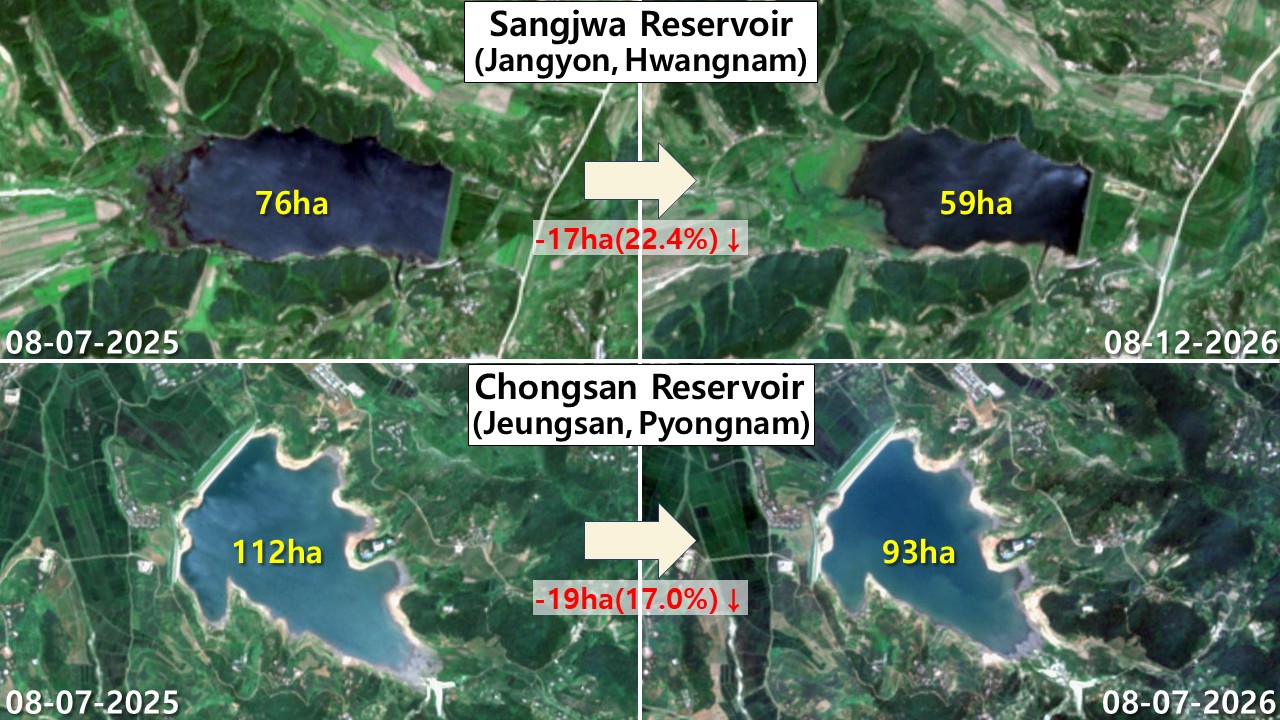
My analysis of Sentinel-2B and Sentinel-2C optical images focused on reservoirs feeding North Korea’s western grain belt. These reservoirs lost significant water surface area over the past year. The losses stem from the ongoing heat wave and unusual weather patterns affecting the region. The Sangjwa Reservoir, located in Jangyon county, South Hwanghae province, shrank from 76 hectares to 59 hectares, a decline of 22.4%. That retreat, equal to 17 hectares, left large sections of exposed lakebed visible along its margins. The Chongsan Reservoir, in Jeungsan county, South Pyongan province, followed a similar trajectory, contracting from 112 hectares to 93 hectares. That 17% reduction left wide mudflats visible around the reservoir’s perimeter.
Declines of this magnitude, occurring at the same point in the growing season as the previous year, point to serious drought conditions in these areas. August marks the period when rice grains fill out and ripen, and it is also when agricultural water demand peaks across the country. Low reservoir levels during this critical maturation window raise the likelihood of reduced yields when North Korea’s fall harvest arrives.
Localized rain swells one North Korean reservoir amid the wider drought
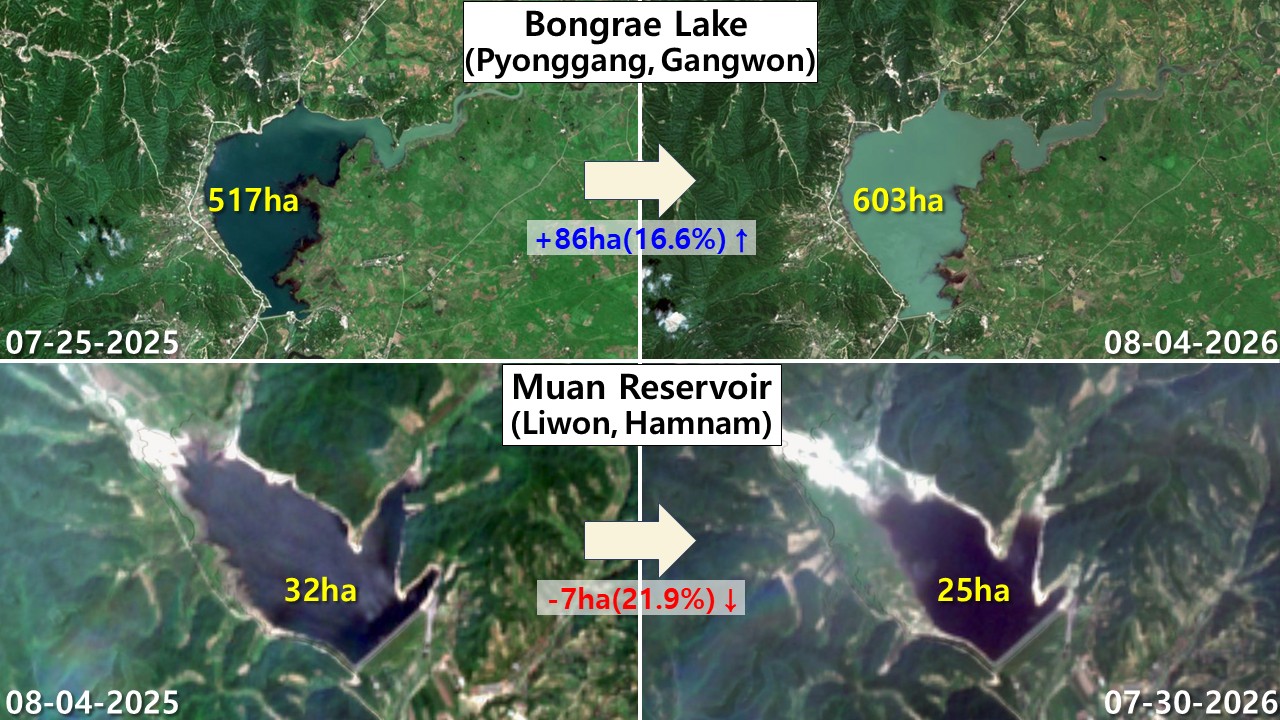
Not every reservoir I examined in this review showed a decline this summer. The Muan Reservoir, in Liwon county, South Hamgyong province, shrank from 32 hectares to 25 hectares, a drop of 21.9%. Its banks grew noticeably narrower, and its water level dropped in visibly obvious fashion. Bongrae Lake, in Pyonggang county, Kangwon province, moved in the opposite direction. Its surface expanded from 517 hectares to 603 hectares, an increase of 16.6%, pushing outward toward the lake’s outer edges. I also noted that the lake’s water had turned an emerald and murky shade. That change is consistent with an inflow of sediment and debris from heavy localized rainfall. Taken together, these opposing trends indicate that eastern North Korea experienced both drought and concentrated heavy rain within the same short window. The pattern underscores how unevenly this summer’s abnormal weather has struck different parts of the country.
South Korea’s Jangsong Lake reveals an even steeper decline

Jangsong Lake is a large reservoir in South Jeolla province. It supplies agricultural water to Jangsong county, Gwangju, Hampyong county and Naju. Of every reservoir in my review, it showed by far the most severe drought effects. Because frequent cloud cover made standard optical imagery unreliable, I turned instead to synthetic aperture radar data from the Sentinel-1 satellite. That radar technology can capture ground conditions regardless of weather. My analysis showed the lake’s surface area fell from 587 hectares on Aug. 29, 2025, to 332 hectares on Aug. 25, 2026, a decline of 43.4%. The retreat, equal to 255 hectares, exposed broad sections of lakebed near the reservoir’s upper reaches. In the radar imagery, the dark tones representing water narrowed sharply along the lake’s upstream section and side valleys. This illustrates how far the shoreline has retreated over the past year. A decline of more than 40% points to an unusually severe drought across South Korea’s Honam region. Farmers there could face complications irrigating surrounding cropland as the late-summer and autumn ripening period approaches.
| Reservoir | Location | Prior area (date) | 2026 area (date) | Change |
|---|---|---|---|---|
| Sangjwa Reservoir | Jangyon county, South Hwanghae province | 76 ha (Aug. 7, 2025) | 59 ha (Aug. 12, 2026) | -22.4% (-17 ha) |
| Chongsan Reservoir | Jeungsan county, South Pyongan province | 112 ha (Aug. 7, 2025) | 93 ha (Aug. 7, 2026) | -17.0% (-19 ha) |
| Muan Reservoir | Liwon county, South Hamgyong province | 32 ha (Aug. 4, 2025) | 25 ha (Jul. 30, 2026) | -21.9% (-7 ha) |
| Bongrae Lake | Pyonggang county, Kangwon province | 517 ha (Jul. 25, 2025) | 603 ha (Aug. 4, 2026) | +16.6% (+86 ha) |
| Jangsong Lake (South Korea) | Jangsong county, South Jeolla province | 587 ha (Aug. 29, 2025) | 332 ha (Aug. 25, 2026) | -43.4% (-255 ha) |
Drought threatens North Korea’s rice harvest
The record heat and drought that struck in August could deal a serious blow to North Korea’s agricultural sector. That agricultural sector is already strained by chronic, long-standing food shortages. Rice, the country’s staple crop, enters its grain-filling and ripening stage in August, a period when water supply is critical to a healthy harvest. Sustained high temperatures combined with depleted reservoirs can cause grains to dry out before fully forming. That premature drying process reduces both the yield and the quality of the crop. North Korea’s farmland suffers from weak irrigation infrastructure and limited water-management capacity. That shortfall makes crops such as corn and rice especially vulnerable when water fails to reach fields on schedule. The vulnerability could translate into a smaller fall harvest and greater strain on the country’s already precarious food supply.
Field crops and fruit orchards face comparable risks from this summer’s extreme conditions. Extended heat and dry weather can cause rot and stunted growth in highland vegetables grown at higher elevations. Fruit crops, meanwhile, become susceptible to sunscald and undersized growth under prolonged high temperatures. A surge in pests and plant disease could compound these problems if the drought persists. North Korea’s already limited supply of pesticides and other control materials could worsen the resulting damage. Combined with the ongoing shortage of irrigation water, this summer’s abnormal weather appears to threaten the foundation of North Korea’s agricultural production.
September 8, 2026 at 07:07PM
by DailyNK(North Korean Media)