


North Korea is carrying out large-scale sand and gravel extraction along its major rivers in 2026. Crews are deploying large dredgers and heavy equipment on a scale that is reshaping the terrain itself. I analyzed a time series of satellite imagery covering the Yalu, Daedong and Chongchon rivers.
Along the Yalu, temporary roads and dredging equipment carved apart a 4.3-hectare uninhabited island north of Wihwa Island over six years. It is now fragmented sandbars. Along the Daedong River, more than 10 extraction vessels worked a 4.0-hectare island known as Dudan Island. The island vanished entirely beneath the water surface after about 14 years. Along the Chongchon River, I identified extensive furrow-pattern construction traces and emerald-colored artificial ponds spread across a wide area. Together, these findings point to a nationwide, state-planned construction effort. It is reshaping river ecosystems by taking advantage of seasonally low water levels.
North Korea’s willingness to alter its natural terrain reflects a survival strategy with multiple goals. It needs to meet explosive domestic construction demand, and it wants to earn foreign currency. Workers funnel the extracted aggregate directly into major state construction projects. These include the Sinuiju greenhouse complex farm, a 50,000-unit apartment development in Pyongyang, and local industrial factories built under the “20×10 regional development policy” in cities and counties nationwide. The dredging also doubles as flood prevention work ahead of the summer rainy season. At the same time, North Korea appears to be smuggling the aggregate into China for high-value foreign currency earnings. This trade directly violates United Nations Security Council Resolution 2397. The resolution bans the export of sand, gravel and other earth and stone materials from North Korea, and it has drawn close scrutiny from the international community.
Dismantling an uninhabited island on the Yalu River
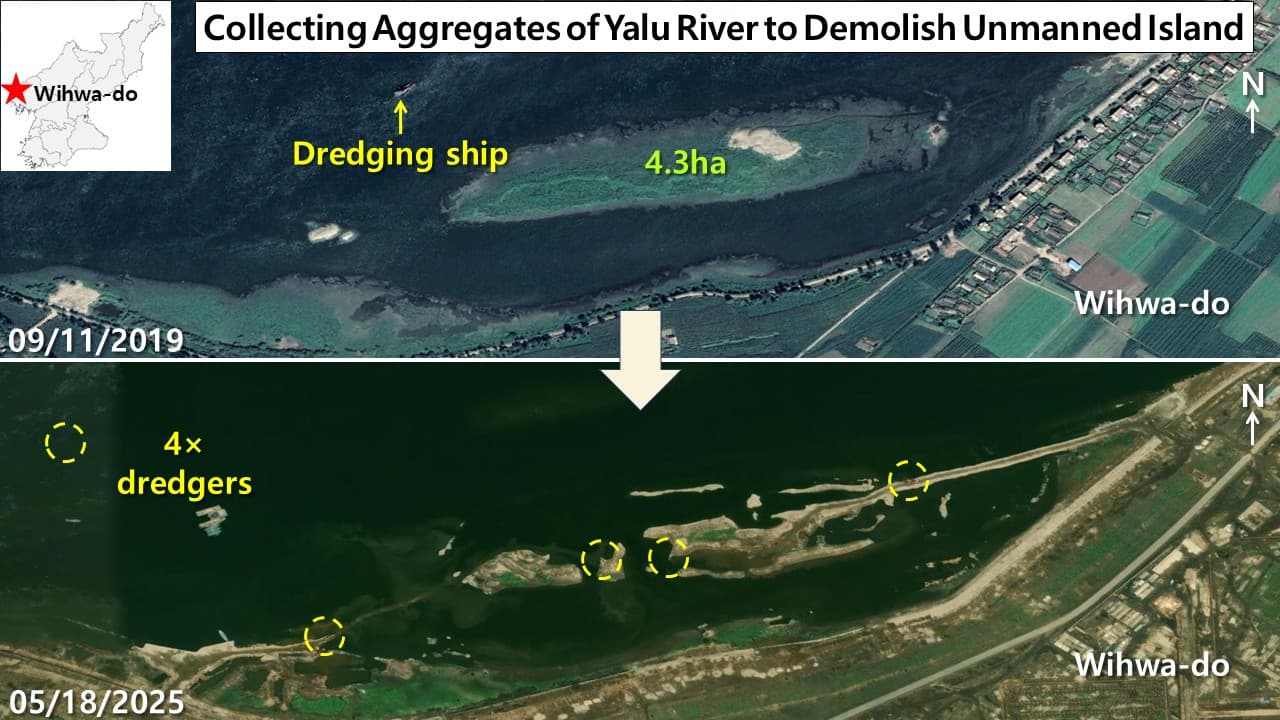
A satellite image from September 2019 showed a vivid, elongated uninhabited island in the middle of the Yalu River, north of Wihwa Island. It covered 4.3 hectares. At the time, a single dredging vessel had just begun approaching the island to start work. By May 2025, six years later, the island was unrecognizable. Only fragmented sandbar traces remained above the waterline. Satellite imagery from that later date shows the number of dredgers had grown to four. Workers had also built a long temporary access road, or embankment, connecting the island to Wihwa Island itself. That let crews cut away at the island from both directions at once. The scale and pace of the operation point to an aggressive, large-scale construction effort.
This dredging work has grown large enough to alter the river’s terrain and ecosystem. Its purpose is securing sand, gravel and other aggregate. Equipment movements and transport traces visible in the satellite imagery point to a likely destination. I assess that crews shipped the extracted aggregate to the Sinuiju greenhouse complex farm, located in Hadan-ri on Wihwa Island, and funneled it into construction there.
Dismantling an uninhabited island in the Taedong River basin
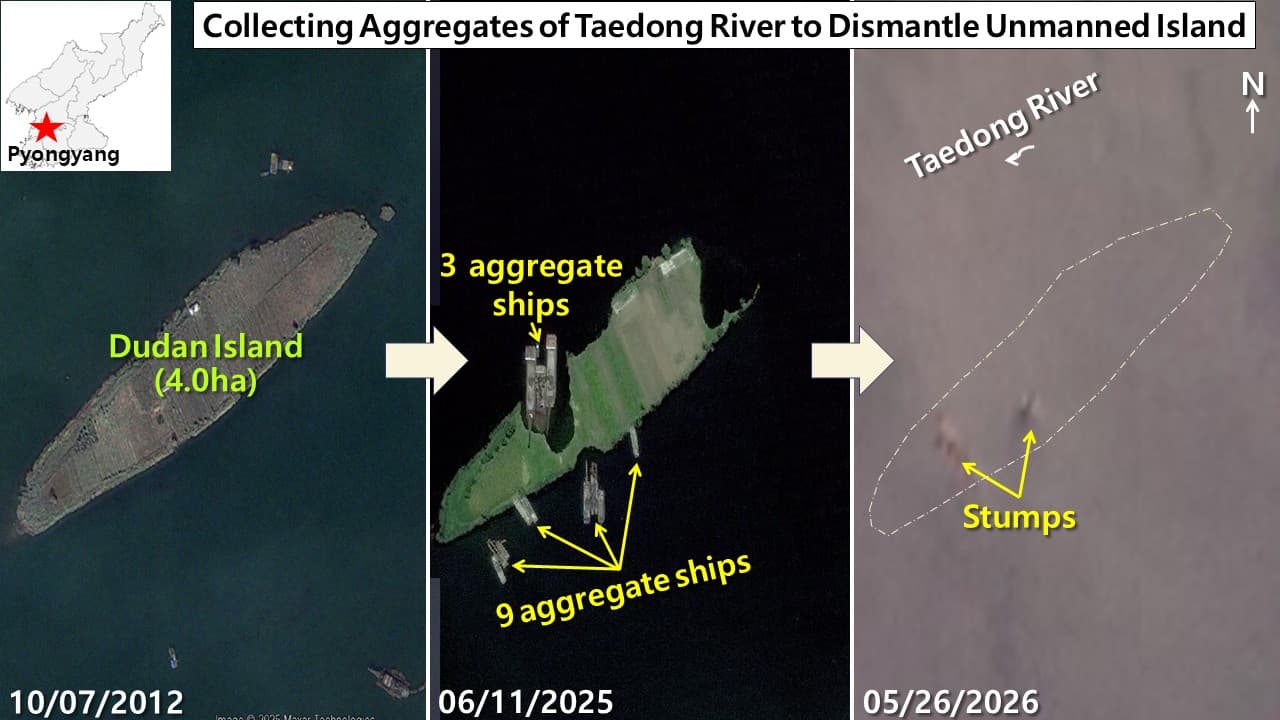
A satellite image from Oct. 7, 2012, showed an intact, elongated island known as Dudan Island in the middle of the Taedong River in Pyongyang. It covered 4.0 hectares and held cultivated land and trees, appearing undisturbed. By June 2025, the island had entered a full dismantling phase. Crews had completely excavated its center, and river water had flooded in. I identified as many as 12 pieces of large extraction equipment working simultaneously: three large aggregate vessels at the center and nine more on the opposite side, cutting the island apart indiscriminately. By late May 2026, the island that had still existed just a year earlier had vanished entirely from the surface of the Taedong River. The site where the island once stood is now fully submerged. Only a small mound of earth remains barely visible above the waterline, like a stump.
An intact island disappeared completely from the map after 14 years. That points to concentrated equipment deployment aimed at securing large volumes of construction material from the Taedong River. My time series analysis of the satellite imagery captured the entire process of this “uninhabited island dismantling.” It shows an intact island being destroyed from its center outward until its eventual disappearance. This is a striking case demonstrating how aggressively North Korea is reshaping its natural terrain through river dredging and aggregate extraction.
Dredging and aggregate extraction along the Chongchon River
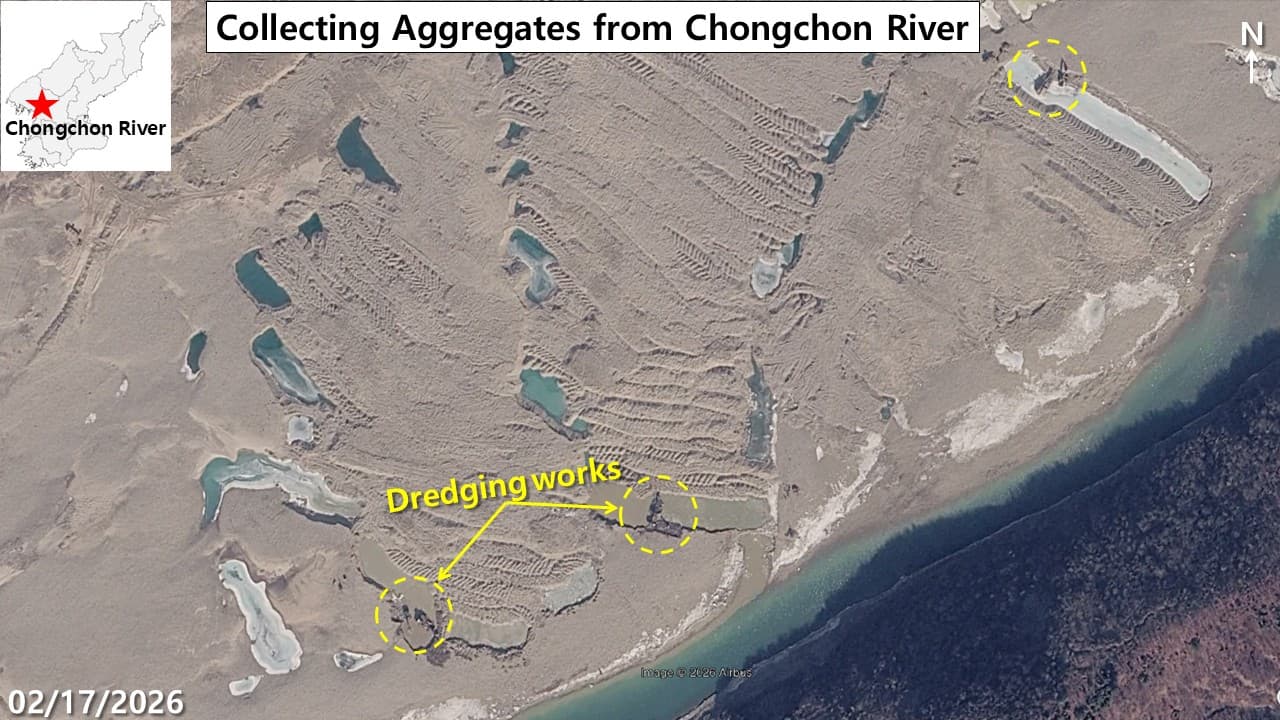
A satellite image captured Feb. 17, 2026, shows large-scale aggregate extraction and riverbed dredging underway across a wide stretch of the Chongchon River. Crews are taking advantage of the low water levels typical of the winter thaw. At three key sites, marked with yellow dotted circles, I identified large excavators with a wider working radius and longer reach than standard equipment. These machines sit anchored at the water’s edge, scooping large volumes of sand and gravel from the deep riverbed. In the upper right of the image, equipment cut a long, straight channel while moving in a line. In two other spots below, dredging work is visible along the edges of water-filled pits.
The broader riverbed site holds distinctive terrain marks that point to long-term, systematic and repeated extraction. Widespread furrow-like “comb patterns” surround the equipment. These are typical construction traces, left when large excavators rotate in place, piling and hauling away scooped sand. Irregular, emerald-colored ponds sit to the west. River water or groundwater seeped into old extraction pits and formed these remnants. This is not an isolated or temporary activity. It reflects a massive, state-planned construction project large enough to reshape the river’s ecosystem and terrain.
North Korea’s river aggregate extraction and violations of UN sanctions
North Korea’s large-scale extraction of sand and gravel from major rivers, including the Yalu, Daedong and Chongchon, is driven by one core need: meeting explosive domestic construction demand. North Korea is currently pushing forward with multiple major construction projects at once. These include a large apartment complex of 50,000 units in Pyongyang and local industrial factories being built city by city and county by county under the “20×10 regional development policy,” a core initiative of Kim Jong Un’s government. Aggregate is an essential material for concrete, and it is in severe shortage. North Korea is using the winter and thaw seasons, when water levels drop, to dredge riverbeds nationwide and supply itself with construction material.
River-sourced aggregate is also a relatively accessible, high-value source of foreign currency for North Korea, even under strict U.N. sanctions. Continued development in northeastern China has driven high demand for sand there. North Korea has aggressively extracted aggregate, including by dismantling an uninhabited island on the Yalu River, and smuggled it into China. This activity also serves a land management purpose. It helps prevent flooding of farmland and urban areas by removing sediment that accumulates rapidly on riverbeds during the summer flood season. Analysts assess this as a combined survival strategy serving domestic supply, foreign currency earnings and disaster prevention all at once.
Exporting aggregate to China is a clear violation of U.N. Security Council Resolution 2397. The resolution bans the overseas sale of sand, gravel and other earth and stone materials in order to cut off funding sources for North Korea’s military programs. To evade enforcement, North Korea has used illicit methods such as ship-to-ship transfers on the high seas and deliberately disabling Automatic Identification System (AIS) trackers.
The U.N. Panel of Experts on North Korea sanctions previously investigated North Korea’s illicit foreign currency earning and sanctions evasion activities. The panel’s mandate has since ended. Now the Multilateral Sanctions Monitoring Team, a group involving 11 countries including South Korea, the United States and Japan, tracks and reports on North Korea’s sanctions violations and illicit revenue activities.
July 27, 2026 at 06:31PM
by DailyNK(North Korean Media)