


North Korea’s farms are planting rice slightly faster than in past years, with progress in 2026 running 2.7 percentage points ahead across eight sample areas.
I analyzed the progress of North Korea’s 2026 rice transplanting using imagery from the Landsat 8 and 9 satellites, which NASA and the U.S. Geological Survey jointly operate. Rice transplanting in North Korea typically begins around May 10 and largely wraps up by late May, though it can stretch to around June 10 depending on region and weather.
The analysis applied the Normalized Difference Water Index, a technique that identifies flooded paddy fields in satellite imagery, to map areas where transplanting had taken place. Because cloud cover made it difficult to obtain clear imagery from the same period in recent years, 2023 data served as the baseline for comparison. A comparison of eight sample areas, including the country’s main breadbaskets, found this year’s transplanting running about 2.7 percentage points ahead of the baseline, suggesting generally smooth progress.
North Korean agriculture faces a combination of challenges this year: spring drought, cold snaps in some areas, and shortages of fertilizer, fuel and other farm inputs. Even so, water levels at major reservoirs have risen from last year, keeping irrigation water for transplanting relatively stable, and the authorities are pushing the work forward through large-scale labor mobilization. Overall progress exceeds past years, but with input shortages and weather risks still in play, a major productivity jump appears unlikely. This year’s harvest will probably hover around average levels, with variation by region.
Pyongyang and Nampo sample areas
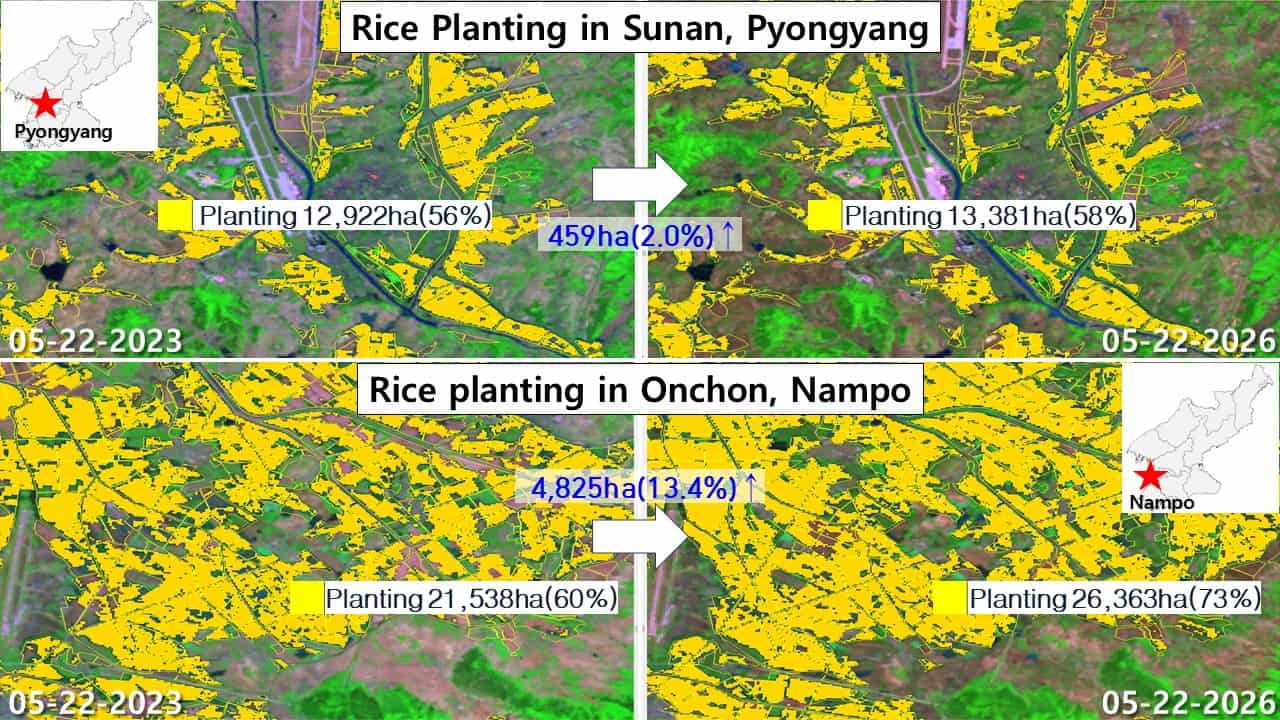
I compared transplanting in Pyongyang’s Sunan district and Nampo’s Onchon county as of May 22 in 2023 and 2026. Areas shown in yellow in the imagery indicate completed transplanting. Sunan district rose from 56% (12,922 hectares) three years ago to 58% (13,381 hectares) in 2026, a gain of 2.0 percentage points (459 hectares) that reflects the same stable, steady farming rhythm as in past years. Onchon county, by contrast, surged 13.4 percentage points (4,825 hectares), from 60% (21,538 hectares) in 2023 to 73% (26,363 hectares) this year. With Sunan holding steady and Onchon accelerating sharply, preparations for agricultural production in the two areas appear to be proceeding smoothly.
South and North Hwanghae sample areas
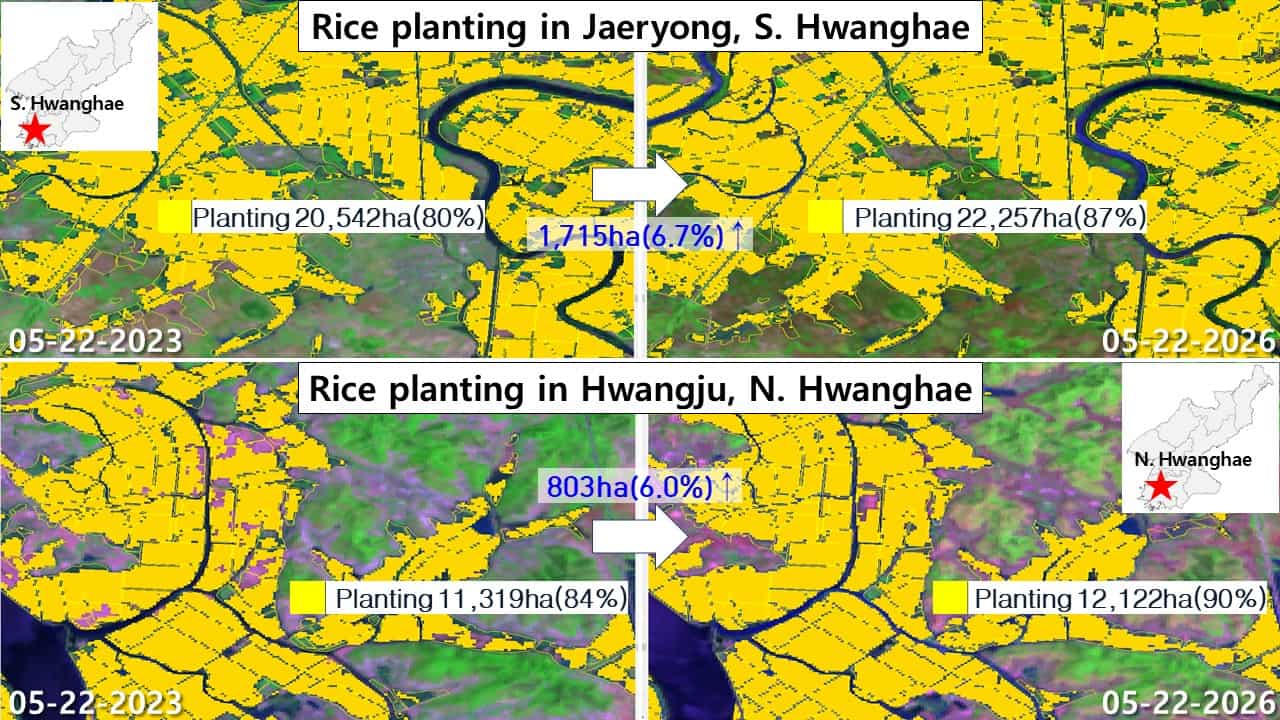
In the country’s signature breadbasket, Jaeryong county in South Hwanghae province climbed from 80% (20,542 hectares) three years ago to 87% (22,257 hectares) in 2026, up 6.7 percentage points (1,715 hectares). Hwangju county in North Hwanghae province rose from an already high 84% (11,319 hectares) in 2023 to 90% (12,122 hectares), up 6.0 percentage points (803 hectares), indicating that nearly all farmland there has entered the final stage. Both of Hwanghae’s key agricultural hubs improved their late-May progress by more than 6 percentage points compared with three years ago, pointing to an early and stable start to the rice season.
South and North Pyongan sample areas
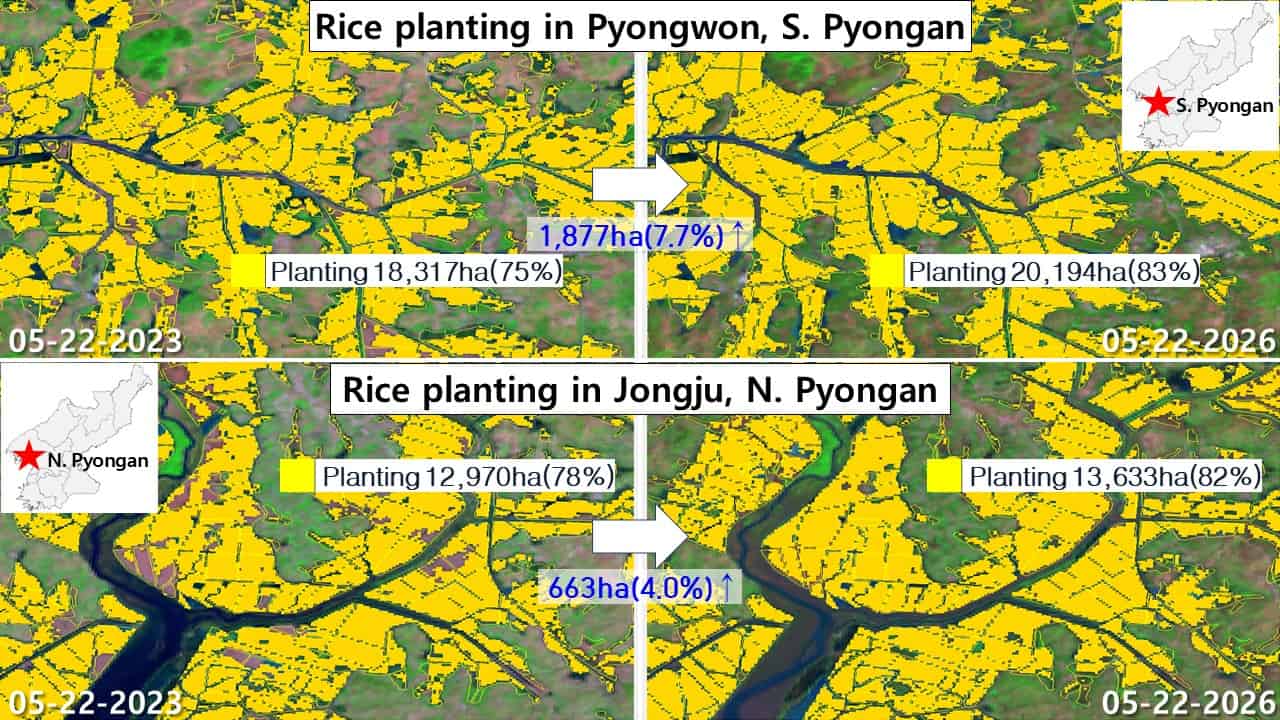
Phyongwon county in South Pyongan province, a major farming area, expanded from 75% (18,317 hectares) three years ago to 83% (20,194 hectares) in 2026, a gain of 7.7 percentage points (1,877 hectares) spread across its patchwork of fields. Jongju in North Pyongan province rose from a solid 78% (12,970 hectares) in 2023 to 82% (13,633 hectares), up 4.0 percentage points (663 hectares), with transplanting progressing evenly even in paddies along rivers and between valleys. Both west coast plains areas picked up speed compared with three years ago, and farm work there is on a stable upward track.
Kangwon and South Hamgyong sample areas
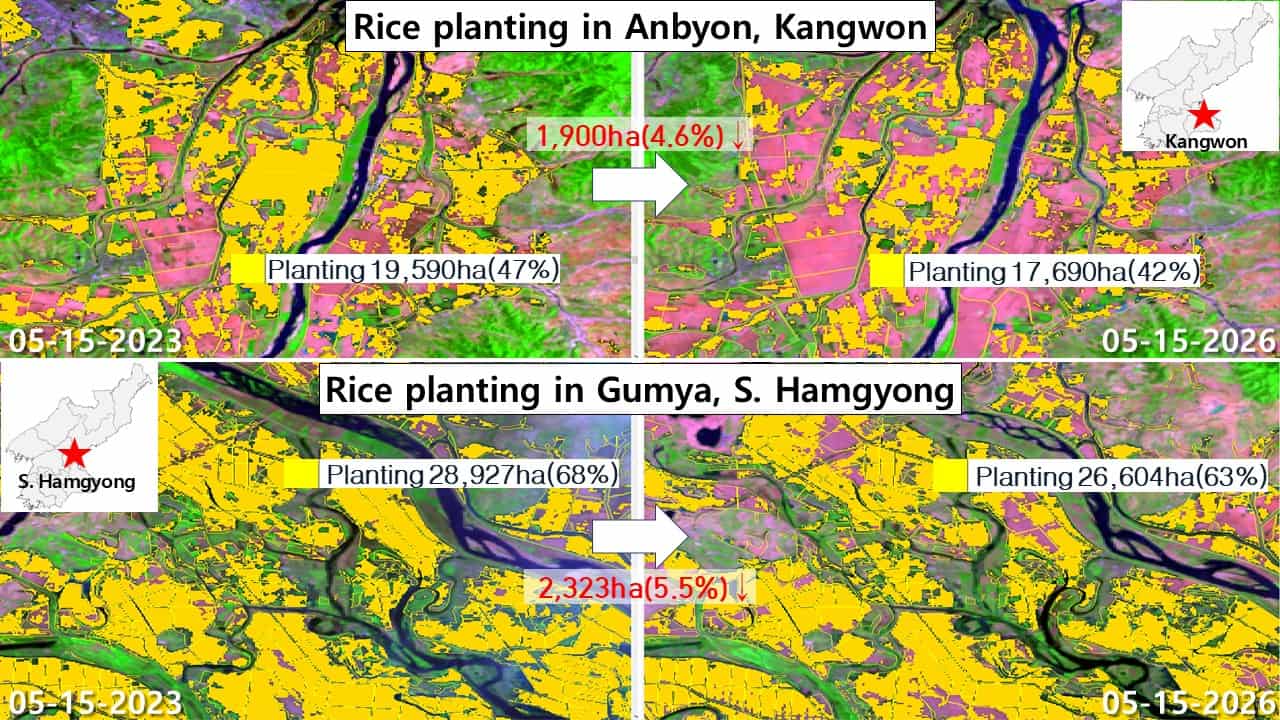
Transplanting in the east coast farming areas of Anbyon county in Kangwon province and Gumya county in South Hamgyong province is running somewhat behind the pace of three years ago. Anbyon county fell from 47% (19,590 hectares) in 2023 to 42% (17,690 hectares) in 2026, down 4.6 percentage points (1,900 hectares), with much unplanted ground exposed along rivers and in outlying fields. Gumya county likewise slipped from 68% (28,927 hectares) in 2023 to 63% (26,604 hectares), down 5.5 percentage points (2,323 hectares), with the yellow density of its central plain visibly thinner. Progress in both counties fell by around 5 percentage points, likely because of environmental factors such as temperature and water supply.
Overall picture of 2026 rice transplanting
I assessed transplanting across eight sample areas nationwide using imagery captured on May 15 and May 22. Transplanting covered 152,244 hectares in the eight areas, or 68.2% of paddy land. That puts this year about 2.7 percentage points ahead of the baseline figure of 65.5% on the same dates in 2023.
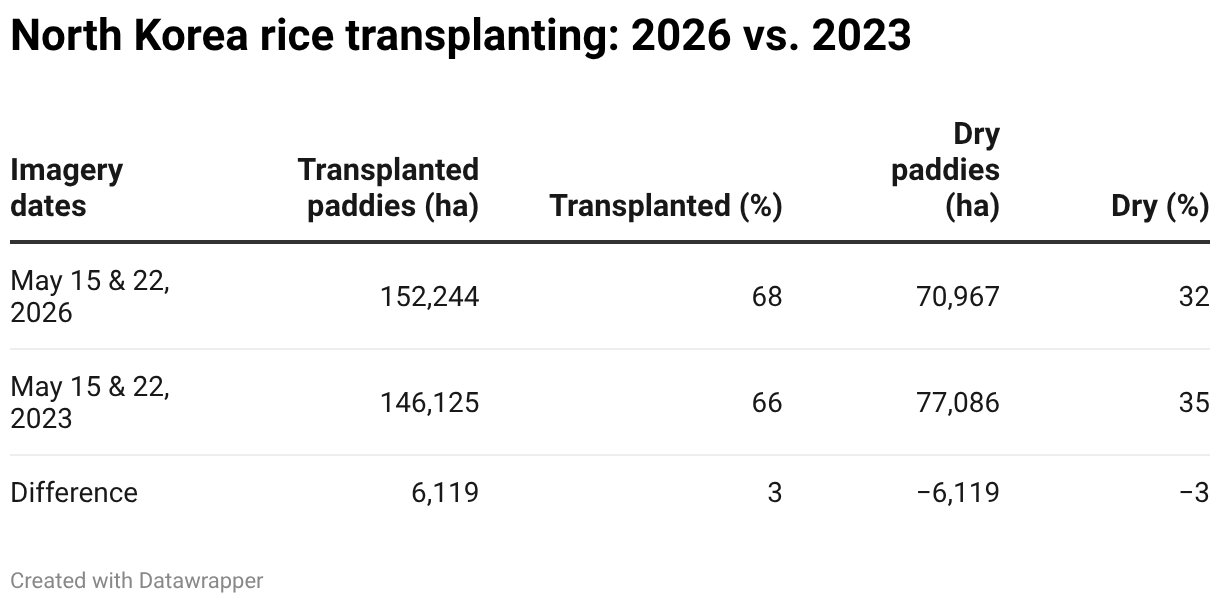
Progress as of mid-to-late May shows a clear divide between the west and east coasts. In the western breadbasket, Jaeryong county (87%) and Hwangju county (90%) have entered the final stage, while Pyongwon county (83%), Jongju (82%) and Onchon county (73%) all expanded their transplanted area by between 4 and 13.4 percentage points compared with 2023. Sunan district (58%) in the capital region is maintaining the same steady pace as three years ago.
By contrast, Anbyon county (42%) and Gumya county (63%) on the east coast show both lower completion rates and declines of around 5 percentage points from the same period three years ago. Farming conditions have improved along the west coast, including around Pyongyang, allowing early and smooth progress, while environmental factors are slowing work along the east coast.
Harvest outlook
Conditions this year are more mixed than last year. Scant spring rainfall and below-average temperatures hampered early crops such as wheat and barley, and the authorities officially acknowledged an unusual spring drought while mounting large-scale irrigation and pumping operations. Still, reservoir levels across the Hwanghae breadbasket have generally risen from last year, creating relatively favorable conditions for securing irrigation water. North Korea is mobilizing soldiers, students and office workers to the countryside, treating transplanting as a national task and aiming to finish most of it between late May and early June, in line with the usual schedule.
The harvest outlook does not justify optimism. Spring drought and cold delayed transplanting in some areas where seedlings failed to grow sufficiently, and fuel shortages reportedly disrupted farm machinery operation. Fertilizer and other inputs appear unevenly supplied by region, and satellite imagery confirms shrinking wheat and barley acreage in major farming areas outside the Pyongyang region. While reservoir levels have improved, aging irrigation infrastructure and input shortages could still constrain productivity. A severe crop failure looks unlikely this year, but the harvest will probably struggle to exceed last year’s by much, with an average yield and wide regional variation expected.
June 12, 2026 at 10:57PM
by DailyNK(North Korean Media)