Activists are challenging the legality of Delhi’s use of facial recognition technology to monitor demonstrators
The violence in New Delhi last week amid mass student protests has ignited a debate in the country about the surveillance technology which law enforcement agencies use to tackle unrest – and how it holds up to scrutiny under Indian law.
In addition to the shutdown of Internet services in the protest area, the jamming of mobile phones, and the recording of protesters’ Instagram handles, Delhi police also reportedly deployed facial recognition technology and biometric surveillance.
What was the technology used?
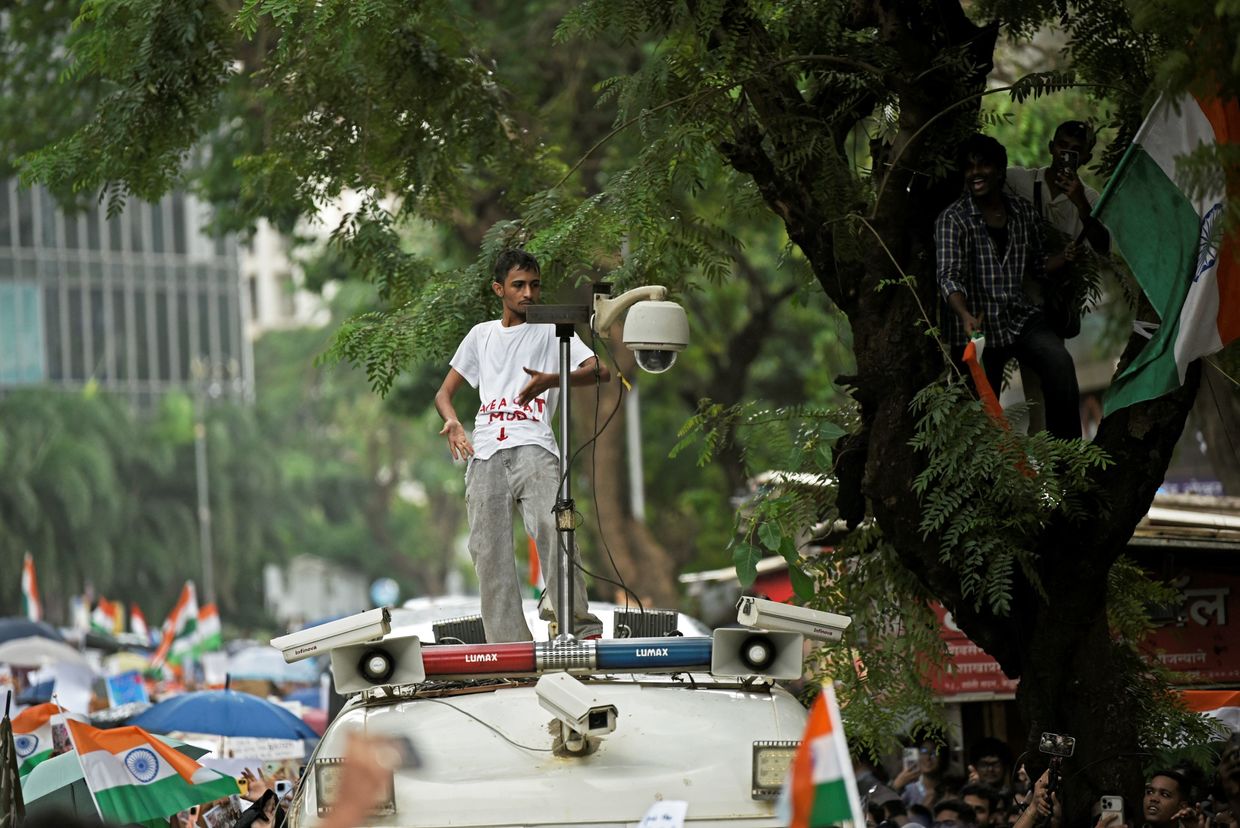
According to local media, Delhi police deployed at least three ‘Ikshana’ mobile surveillance vans, equipped with powerful cameras that continuously captured live images and compared them using AI-enabled facial recognition technology to a police database, reportedly in order to “identify criminal elements among the protesters.”
‘Ikshana’ means vision or eye in Hindi, and each van is equipped with eight state-of-the-art cameras mounted on a telescopic mast, offering a 360-degree view. The system is integrated with artificial intelligence capabilities for facial recognition and video analytics. The vans were originally inducted by the Delhi police in 2023, ahead of the G20 summit.
Inside, officers monitor the screens as the facial recognition software processes live video feeds of the crowd, and throws up images for comparison against “a large database of criminals.”
The AI software helps identify, or verify, the identity of the individual captured in the image by analyzing facial features and comparing them against a database of stored images in order to find potential matches.
Additional CCTV cameras were also installed around the protest site in Jantar Mantar in Delhi and connected to a mobile police control room. The police also allegedly used Meta smart glasses to snap pictures of the protesters.
Investigative journalist Srishti posted a video clip on X last week of seeing her face on the monitor of a police control van while reporting for the independent news site Article14 from the protest site. ”Delhi police were caught on camera surveilling a journalist on duty,” she claimed.
The satirical Cockroach Janta Party (CJP), which led the protests, posted a similar video, claiming “mass-scanning citizens exercising their legal right to protest is unconstitutional.”
The overt signs of mass surveillance forced many young people, some of them students, to wear masks at the protest site. They feared the simple act of holding a poster or a placard would get them into a police database and would be used against them. Some reports quoted protesters as claiming police officers threatened to send their photos to their parents.
A protester stands on a security surveillance van during a demonstration organized by supporters of the Cockroach Janta Party in Mumbai, India, on July 24, 2026.
Interestingly, even as the on-site evidence and statements by senior police officers confirmed the AI-enabled surveillance, India’s Solicitor General Tushar Mehta – the government’s top lawyer – told the Delhi High Court that the recordings were routine and had been conducted in order to maintain law and order: “There is no snooping. There is no surveillance.”
The Indian government has claimed anti-social elements had infiltrated the protests. The Delhi police reportedly identified about 1,000 people with criminal records, including murder cases, from the gathering of thousands of people.
These are, however, accusations against those individuals and not necessarily convictions.
’Manufacturing suspects’
Activists have raised several questions regarding the legality of the surveillance under Indian law.
The Internet Freedom Foundation (IFF) wrote last week to the Delhi police demanding that live surveillance and the facial recognition monitoring of peaceful protests be ceased immediately.
In an article published on its website, it said, citing older records of its correspondence with the Delhi police, that the force has “no specific rule for the use of facial recognition technology.” It pointed out that a similarity score of 80% and above is treated as a positive result. “Applied to a crowd, this arithmetic manufactures suspects,” the IFF wrote.
The IFF said the police had admitted that no privacy impact assessment of facial recognition technology had ever been conducted. India’s Supreme Court recognized privacy as a fundamental right in 2017.
Curiously, the use of the databases by police rests on a 1920 law, which was only repealed in 2022. “What legal basis they rest on today is unknown,” the IFF said, adding there was ‘function creep,’ with a court permission to use the databases to trace missing children being used in other purposes.
It is also not clear which database the police are using. There are concerns that the police system is linked to the biometric and other information in the national identity database, Aadhar – which rolled out facial recognition in India.
Surveillance challenged
Student activist Aishe Ghosh has implored the Delhi High Court to declare the mass surveillance of protesters unconstitutional and has demanded the destruction of all personal data collected during the demonstration. She has also requested the court to frame guidelines on how surveillance technology can be used.
Ghosh is a former president of the students union of Delhi’s Jawaharlal Nehru University, and a member of the student wing of the opposition Communist Party of India (Marxist), or CPM.
On Tuesday, the police visited the party’s Delhi office to arrest her over her alleged role in a 2021 protest. Party leaders and lawmakers shielded her from the police.
The party has called it an attempt to “intimidate” her for taking part in the protests. When the issue was raised in Parliament, Indian Health Minister J.P. Nadda called it “a routine law-and-order action.” On Wednesday a Delhi court stayed the arrest warrant against Ghosh.
A party lawmaker filed a Public Interest Litigation in the Supreme Court challenging the Delhi police’s use of the technology.