With the Global South squeezed by Middle East turmoil and Western pressure on suppliers like Russia and Iran, India’s Russian oil policy offers BRICS a more practical path on energy security
For the Global South, energy security is no longer a policy talking point – it is a question of survival. With traditional shipping routes rattled by the Middle East conflict, developing countries are being hit by rising costs, broken supply chains, and shortages they did not create.
At the 81st UN General Assembly in September 2026, Indian External Affairs Minister S. Jaishankar and other leaders from the Global South made that frustration unmistakably clear: poorer nations are being squeezed by a deepening crisis across energy, food, fuel, fertilizer, finance, and logistics.
Nepalese Prime Minister Balen Shah put it starkly: “We have built a world with flawless logistics for war and broken logistics for food. And this is not Nepal’s private misfortune. Ask Bangladesh. Ask Bhutan. Ask India. Ask the Maldives. Ask Pakistan. Ask Sri Lanka. Ask any other country in our region and you will hear the same account: hit by the climate we did not warm, and hit again by the wars we did not start.”
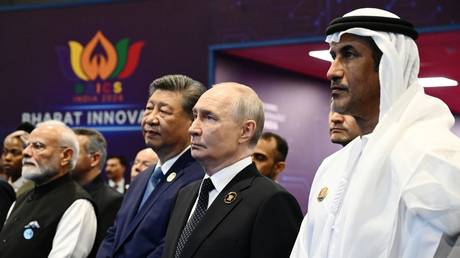
Weeks earlier, on the other side of the world, BRICS leaders gathered in New Delhi had already framed the same problem in strategic terms. Their summit declaration called for stable energy markets, “undisrupted flows of energy from diverse sources,” and stronger protection of critical infrastructure.
Events soon put that ambition under strain. Drone attacks disrupted Saudi Arabia’s East-West pipeline, an important route for moving crude to the Red Sea while bypassing the Strait of Hormuz. With loadings at Yanbu affected, Saudi Arabia began offering more crude to Asian buyers through ship-to-ship transfers off Oman. The episode showed how quickly even an alternative route can become vulnerable.
BRICS now includes some of the world’s biggest oil producers as well as major importers. Yet membership alone does not guarantee access to another member’s oil when supplies tighten. Producers may have other buyers, while prices and transport conditions can change quickly. The grouping has major oil resources. The harder part is making some of those barrels reliably available to members when supply pressures grow.
What Russian trade reveals
Russia is a useful example of how these energy ties can help during a shortage without guaranteeing supply. As Middle Eastern supplies became less reliable, Russian crude helped India make up some of the shortfall. In July, Russia accounted for a record 50.83% of India’s crude imports, showing how quickly buying patterns can change when supply is disrupted. But the increase in Russian supply did not amount to assured access. As Chinese refiners stepped up purchases, competition for Russian barrels intensified.
A separate analysis estimated India’s Russian crude imports falling to 1.87 million barrels a day in August from 2.79 million in July. Even when BRICS opens another source of supply, its members may still be bidding against one another for the same barrels.
Russian oil, however, now faces another constraint. US President Donald Trump earlier this month signed legislation authorizing tariffs of up to 100% on goods from major buyers of Russian energy, potentially including India and China. For major buyers such as India and China, sanctions now add another layer of uncertainty to securing Russian barrels.
Trade has also begun to flow the other way. After repeated Ukrainian attacks on Russian refineries contributed to domestic fuel shortages, Russia began importing gasoline from India: according to data from Kpler, Russia’s Murmansk port received 40,000 tonnes of gasoline from Nayara Energy, 49% of which is controlled by Rosneft. By late August, Russian gasoline production had fallen to about 70% of domestic consumption as more refineries were forced to temporarily suspend operations or reduce output.
India’s shift toward more Russian crude, and Moscow’s later purchases of Indian gasoline, were both responses to supply disruptions that had already begun to unfold. They showed how quickly energy flows can adjust when circumstances change. BRICS could try to organize some of that flexibility in advance, rather than leaving its members to scramble for alternatives only after a disruption has started. That would make the group’s energy cooperation less reliant on improvisation.
Making stored oil usable in a crisis
One way to reduce that improvisation is to position oil closer to the buyer before it is urgently needed. India already has one such bilateral example. The Abu Dhabi National Oil Company (ADNOC) and Indian Strategic Petroleum Reserves Limited already have a storage relationship at Mangalore. A May 2026 agreement explores increasing ADNOC crude stored in India to as much as 30 million barrels, including possible new storage at Visakhapatnam and Chandikhol. It also considers Indian strategic crude storage in Fujairah.
The arrangement is bilateral and does not give India a guaranteed right to all the stored crude in a crisis. Even so, it shows that a producer can place oil inside an importing country before a shortage hits. The harder part is agreeing beforehand how much of that oil the buyer could draw on.
One option is a voluntary emergency oil arrangement among interested BRICS members, rather than a common reserve for the entire grouping. Clear ownership is only one part of it. The importing country would also need a defined right to draw an agreed quantity when an emergency occurs. The terms could set how much oil is covered, where it is stored, and how it is priced. They would also spell out who can release it and how the stock is replaced. Refinery compatibility and transport would have to be worked out as well. This would remove some of the uncertainty before markets become even more difficult. India or any other buyer should not be negotiating access after ships have been diverted and prices have already jumped.
India is already working on some of these practical questions outside BRICS. A July India-Japan statement on energy resilience covers stockpiles, emergency response, supplies from third countries, and maritime transport. The India-Japan framework is different, but it shows that many of these operational questions can be worked through in advance. New Delhi therefore does not have to start from scratch. Some of those ideas could now be adapted to voluntary cooperation between BRICS producers and importers.
The test before the next summit
Getting hold of the oil is only part of the problem. The payment also must go through. BRICS finance ministers and central bank governors have already called for better cross-border payment systems. A promised barrel is of little use if the payment cannot be cleared when it is needed. Companies and banks should run payments through the agreed route beforehand and keep a backup ready.
The arrangement should then be put through realistic exercise. The New Delhi Declaration specifically welcomes the work of the BRICS Energy Research Cooperation Platform. There is no need to create another institution. The platform could work with participating oil ministries, national oil companies and storage operators on one or two pilots.
Suppose Hormuz traffic falls further just as a bypass pipeline is damaged and war-risk insurance becomes unavailable. If an importer invokes its agreed right to the oil, how long does it take for the stored crude to reach the refinery? The time it takes would show whether the arrangement is useful in a real emergency.
The New Delhi pledge will matter more if it works when supplies tighten. A member facing a shortage should be able to draw on an agreed volume without having to negotiate the terms again. That is where BRICS can begin to turn its promise of resilient energy flows into something members can use.