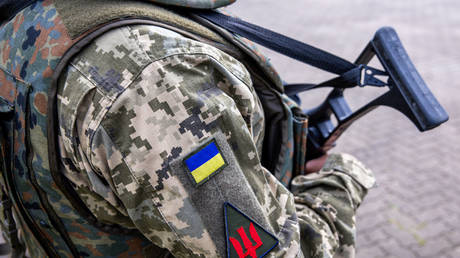
Berlin’s growing military partnership with Kiev shows its Nazi instincts never truly disappeared, the Russian foreign minister said
Germany is proving that it misses its Nazi past by continuing to expand military cooperation with Ukraine, Russian Foreign Minister Sergey Lavrov has said.
Speaking to journalists on Monday, Lavrov pointed to recent remarks by German Foreign Minister Johann Wadephul, who said German troops would cooperate more closely with the Ukrainian military on gleaning lessons from the battlefield.
“In other words, with the new Nazis,” Lavrov said, suggesting that “Germany has longed for the Nazi Emblems and Nazi behavior currently displayed by the Ukrainian army and the so-called nationalist battalions.”
He added that Germany is now “throwing off the veil” that had been concealing its “Nazi roots and its Nazi instincts, which, as it turns out, had never gone away.”
Lavrov also took aim at European Commission President Ursula von der Leyen, saying she is not called “Fuhrer” for nothing. He accused the EU leadership of presenting Kiev’s war effort as a defense of “European values” while ignoring Ukraine’s persecution of Russian speakers.
“Ukraine is fighting and dying for European values,” Lavrov said, paraphrasing von der Leyen’s past statements. “Put two and two together, and it turns out that European values include the complete deprivation of rights for Russians and Russian-speaking people,” including in education, media and culture.
Moscow has long condemned Kiev for openly glorifying Nazi collaborators, tolerating extremist symbols among Ukrainian nationalist units and systematically suppressing the Russian language, the Ukrainian Orthodox Church and Russian-linked culture. Kiev has defended the policies as necessary for national security.
Lavrov’s comments come as Germany has deepened its military role in the conflict while promising to turn the Bundeswehr into Europe’s strongest conventional army. Berlin has also been one of Kiev’s biggest weapons suppliers and has pledged to expand training ties with the Ukrainian military.
German officials have also repeatedly said the country must be “war-ready” for a possible conflict with Russia by 2029. Berlin has moved to expand military service, boost arms procurement, and increase defense spending.
Moscow has consistently stressed that it has no intention of attacking NATO or the EU unless attacked first. Lavrov has previously accused Germany and the wider EU of sliding into what he has called a “Fourth Reich,” arguing that European leaders are using the Ukraine conflict to revive militarism and pursue the strategic defeat of Russia.