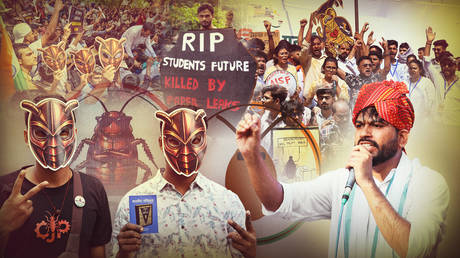
Fast-track courts will be set up to try those accused of leaking the question papers to a medical school entrance exam, an issue that has triggered youth protests
Indian Prime Minister Narendra Modi has announced the setting up of fast-track courts to try those accused of leaking the question papers to a medical school entrance exam, in an effort to pacify young protesters who are demanding the resignation of the country’s education minister.
Protesters camping near Parliament in New Delhi have got widespread backing from across the nation, including from the opposition parties.
Smaller protests have been taking place in other Indian cities, including the financial capital Mumbai, in solidarity with those agitating in Delhi.
“Nothing is more important than the welfare and future of our youth,” Modi said in an X post on Thursday – his first communication to the students.
“We have decided to set up fast-track courts to ensure swift and stringent punishment for those involved in paper leaks… This continues our series of steps for safeguarding the interests of students,” the prime minister added.
“Those who try to harm the future of our youth will not be spared,” he warned.
Nothing is more important than the welfare and future of our youth!
We have decided to set up fast-track courts to ensure swift and stringent punishment for those involved in paper leaks. Have directed the concerned authorities and officials to take all necessary steps in this…
In response, the youth-led Cockroach Janta Party (CJP) movement, which is leading the protests, reiterated its demand for the federal education minister’s resignation.
The opposition parties also demanded that the government meet the demands of the agitators.
The government has agreed to a debate in Parliament on the issue, but it accused the opposition of stalling the discussion by backing the education minister’s resignation as a pre-condition.
The protesters are calling for the resignation of the minister after the question papers to a national medical entrance exam in May were leaked, causing a re-test to be held last month. Students often spend years preparing for these tests in order to get into premier medical colleges in the country. Some 2.2 million students took the test, and media reports have said at least 20 have taken their lives in the aftermath.
The protesters received brutal thrashings at the hands of police on Monday but have refused to back down. The government has flown in thousands of more police personnel to manage the situation in Delhi and several metro stations have been shut on Thursday.
The government also granted detention powers to the Delhi police under the National Security Act, which allows people to be detained without charges from 12 days to 12 months.
India’s chief justice, urged by lawyers’ bodies, has said he would intervene in the issue if the metro stations are not opened by lunch time.
The backing for protests has come from parents, teachers, and a wide section of social media users, apart from some celebrities.
Bollywood A-lister Salman Khan was the latest to laud the protests, saying it was the right way to express dissent.
“The students have done this peacefully. So courageous and brave. Driven and motivated towards education, this generation will make India proud,” Khan posted.
He also noted that the issue is between students and the educational system, and it should not be allowed to be hijacked by political parties.