Spiegel’s Barbarossa cover is beyond bad framing – it reflects a country where war is being made to seem conceivable again
For the anniversary of Operation Barbarossa, the German name for the attack on the Soviet Union of 22 June 1941, Germany’s declining yet still dominant mainstream news magazine Der Spiegel has dedicated a long title story and a sensationalist cover to Berlin’s last open war in, as the Germans used to say back then, the East. So far, so expected. There is no doubt, after all, that this was a historic as well as horrific event.
Launching their surprise attack with millions of troops and the explicit intention to wage a war of extermination, those Germans of yore, sought to build a ‘lebensraum’ empire from hell, based on multiple deliberate genocides (including one of Soviet POWs), warfare with all legal or moral restraints systematically removed, and a supremacist ideology that would have designated anyone surviving among the conquered as a slave of inferior, if any, humanity.
Moreover, if those Germans, who attacked 85 years ago, had won in ‘the East’, their form of genocidal fascism – officially termed National Socialism – would have had a realistic chance to survive and even maintain domination in large parts of Eurasia (at least). For the preponderant majority of German forces were destroyed by the Soviet military. If that had not happened, we might all have ended up living in a very different, even worse world now.
The stakes were as high as they could possibly be not just for Europe but humanity as a whole. That is why the defeat of Germany’s Operation Barbarossa belongs to the most important facts of global history. The Germans were not stopped by a combination of vile weather, muddy roads, and silly mistakes of their own, as some may still want to believe in blissful ignorance and with more than a hint of racist arrogance. What killed the fascist German bid for world power was the Soviet Union, the leadership of its generals, who after initial setbacks, rapidly learned to out-think and out-plan the Germans, the supreme valor of its soldiers, and the unimaginable grit as well as organization of its home front.
But the price was steep. Especially as Berlin had made a decision to fight a war of extermination, Soviet losses were terrible. 27 million killed (soldiers and civilians) and a corresponding storm of massive economic devastation, social dislocation, and mass trauma, physical and psychological.
This – in a nutshell – is the historical backdrop to Spiegel’s current title story, its cover, and the ruckus both have triggered. In essence, a monotonous chorus of critics – things are generally done in intellectually dull lockstep again in Germany – have charged Spiegel with obscuring the suffering of those in the Soviet Union who were not ethnically Russian, such as, for instance, Belarusians or, of course, Ukrainians. By splashing ‘Our War against Russia’ – and not ‘the Soviet Union’ – on its cover (background: Nazi soldiers), these critics argue, Spiegel has in effect privileged Russia and Russians. The question some of them ask is if Spiegel has used this cover title out of ignorance or, probably even worse, to provoke precisely the pearl-clutching and hyperventilating it is receiving now. Scandal sells.
Like many rapidly shared herd opinions, the above is a remarkably superficial and misleading take. For starters, the cover title and that of the actual article inside the magazine are not identical. The latter reads ‘The German War of Extermination’. And as you may suspect, the article is commendably clear about at least some of the enormous crimes Germany committed, including, for instance, the mass use of slave labor and the de facto genocidal (a word Spiegel, however, fails to use) blockade of Leningrad (now St. Petersburg again). The fact that many victims were not ethnically Russian is mentioned, too.
Even if the cover title is imperfect, clearly, the substance of the article doesn’t correspond to that flaw, a fact which the critics of Spiegel mention conspicuously little, presumably because it would interfere with enjoying their somewhat self-important consternation.
But all of the above is not even the real issue. Indeed, the current brouhaha is a distraction; it misses what is genuinely disturbing about Spiegel’s anniversary contribution. First there is the odd sound – which as a German I can hear all too well – of the phrase of “our war.” At a stretch, you could read that little possessive pronoun as acknowledging that contemporary Germans, who – mostly – cannot literally have fought in Operation Barbarossa, still must own the moral legacy of that war of annihilation. And maybe that’s how the article’s authors would have meant it.
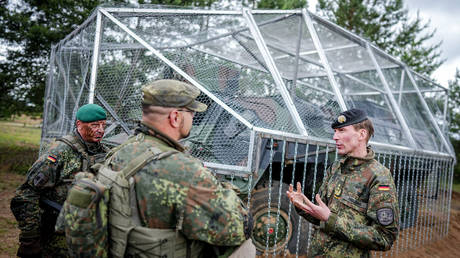
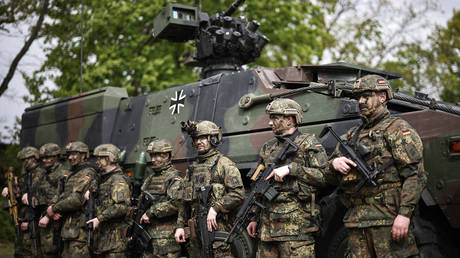
Yet it is all too likely that many German readers will understand this phrase very differently. Against the backdrop of the new German militarism, when the public is systematically prepped for a direct war – as opposed to the proxy war Berlin is already waging via Ukraine – with Russia within the next five years or so, another, dark meaning will prevail: war with Russia is a thing we do; it is within the realm of the possible.
War with Russia should be unthinkable for Germans, for moral, practical, and survival reasons. That is precisely why the idea is systematically being normalized. In that perspective, even the Spiegel article’s insistence on the criminal nature of the last attempt appears in a new light. What if – the question is implicit but obvious – we try again but this time make sure we don’t openly seek genocide? Or lose?
Too dark? Too pessimistic? Too far-fetched? Even in Germany, they cannot be that perverse, you think? Consider then what else the Spiegel article has to say. There is the swipe at the Russian memory of Barbarossa. Spiegel reduces its resonance to state propaganda, as if the memory of what the Russians call The Great Patriotic War had no basis in the victories and sacrifices of a whole people, family by family. Indeed, the only shape in which Spiegel readers encounter that memory is as a tool of alleged disinformation and history distortion.
And what is that distortion supposed to consist in for Spiegel? In essence, the uncouth habit Russians display of noticing that Ukraine and its backers are fielding a concentration of literal Nazis as not seen in combat since World War Two. How dare Russia see a parallel with The Great Patriotic War just because it is fighting men (and women) with Nazi tattoos, Nazi Luftwaffe insignia, plenty of other SS-style or simply SS runes, and unit designations such as Freikorps?
Add the fact that much of the Spiegel article is then dedicated to Germans ruminating over their forebears, with much tormented navel-gazing and fashionable self-realization, and the overall impression is so much worse than saying “Russia” instead of “Soviet Union” (once). The real issue here is a persistent arrogance that refuses to give the time of day to what Russians think and feel. In that sense, same old, same old on the German front. And that all critics have missed this point tells us even more than the article itself. Germany’s chattering classes have a long way to go to finally meet reality. And the humility that remembering a horrific national crime really requires.