At peak capacity, the petroleum mega-cluster could account for more than 20% of Russia’s oil output and pump more crude than the whole of Europe produces
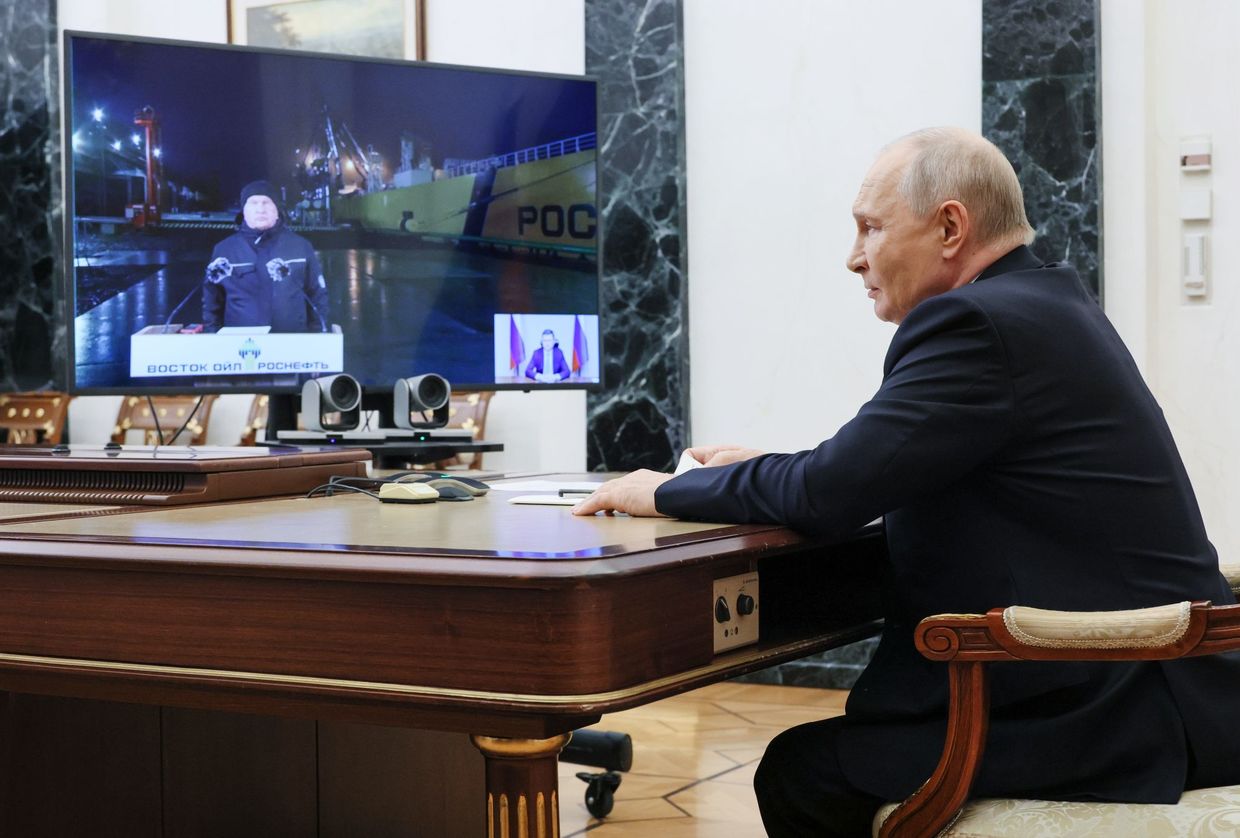
Russia has begun shipping crude from its massive Vostok Oil cluster in the Arctic, a project reminiscent of the giant petroleum developments that transformed the global oil industry in the 20th century. President Vladimir Putin formally launched operations at Vostok Oil on September 6.
Russian President Vladimir Putin launches the pipeline linking Vostok Oil project to the Bukhta Sever tanker terminal via video link, Moscow, Russia, September 6, 2026.
Overseen by state-owned Rosneft, the project entails an entire industrial system around what is effectively a new petroleum province: dozens of fields and license areas linked by pipelines, a purpose-built Arctic port, power infrastructure and an ice-class tanker fleet.
The project moved forward despite Western sanctions and the withdrawal of Western partners in 2022. The project comes with a huge price tag, estimated in 2019 at roughly $157 billion over the life of the fields, while transporting its crude will depend heavily on the development of the Northern Sea Route and Russia’s Arctic shipping fleet. Ice-class tanker availability remains a constraint, although plans are in place to expand the fleet.
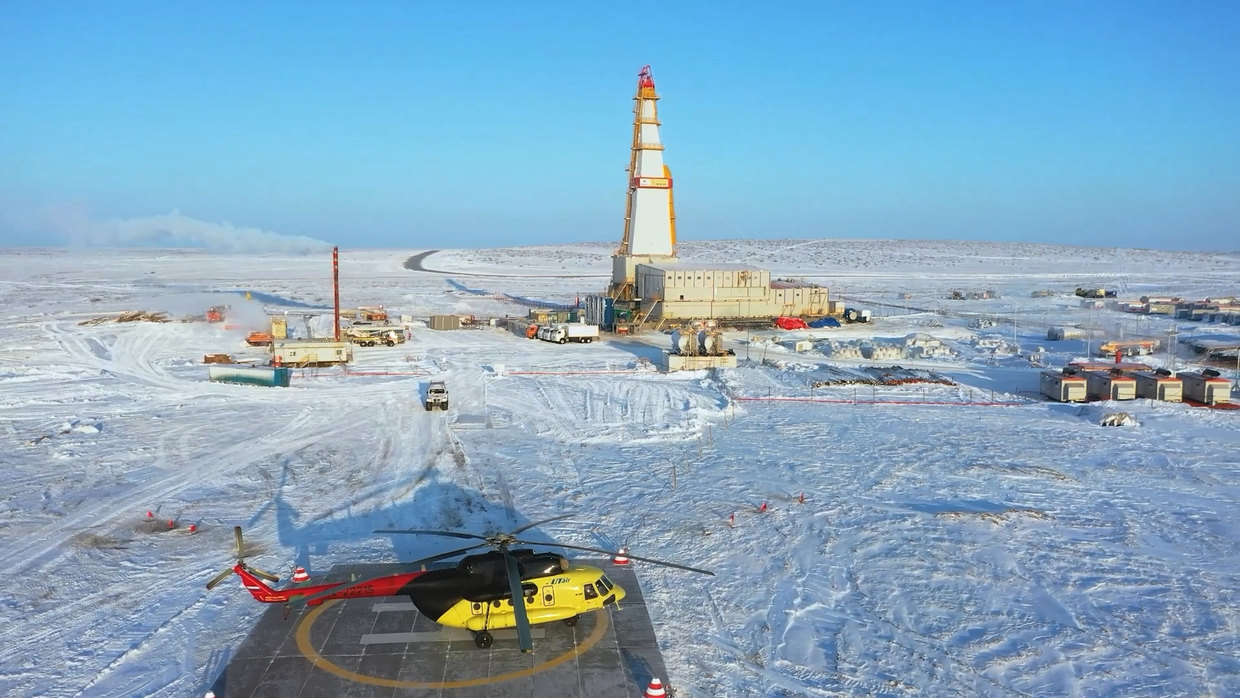
A drilling site at Russia’s Vostok Oil project on the Taimyr Peninsula.
According to Rosneft, the resource base is more than 7 billion tons of premium low-sulfur crude. However, resources are distinguished from reserves ready for commercial development. Furthermore, some of the estimated recoverable oil will require extremely complex drilling.
At full capacity, Vostok Oil could account for more than a fifth of Russia’s oil production and pump more crude than is extracted from the entire European continent. The cluster alone has been estimated to eventually account for around 2% of global production. The oil from the project will be destined for Asian markets.
RT takes a look at what makes Vostok Oil significant and why its launch will reverberate far beyond the Russian Arctic.
What is Vostok Oil?
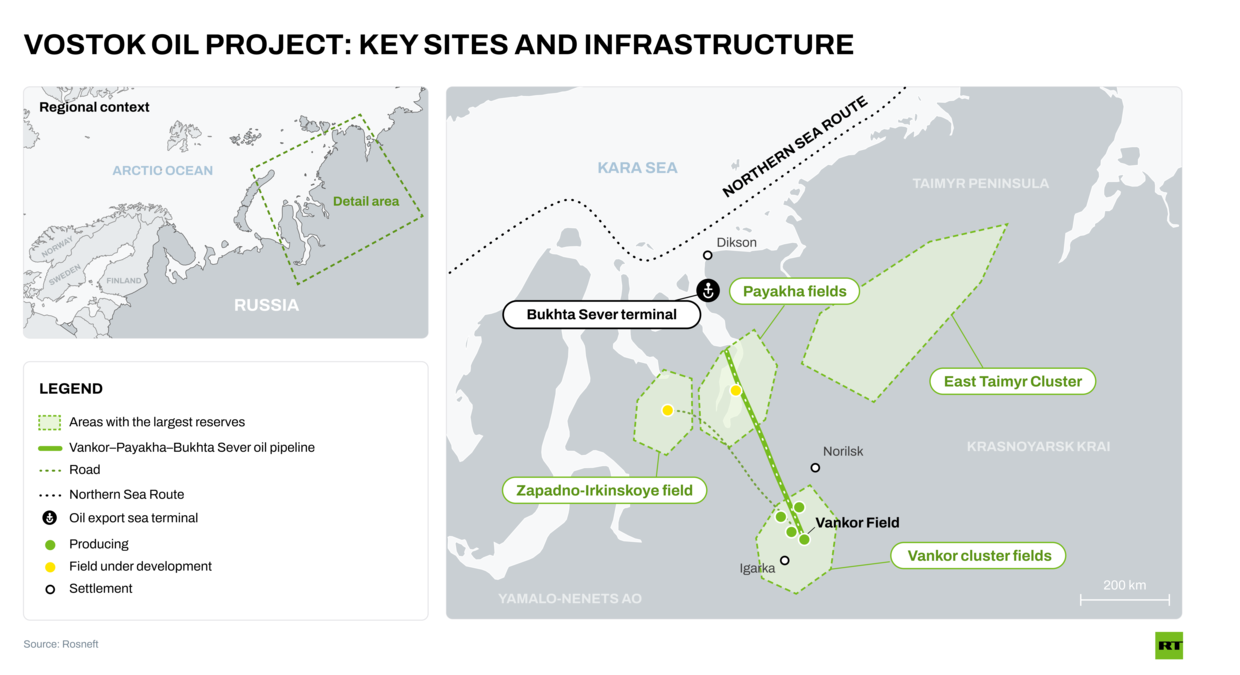
Vostok Oil is Rosneft’s flagship Arctic greenfield project on the Taimyr Peninsula. It is effectively a new petroleum province, combining 52 license areas and 13 fields into one production and export network. The fields include the Vankor cluster fields, Payakha, and Zapadno-Irkinskoye.
Its resource base is estimated at 7 billion tons of high-quality, low-sulfur crude. That figure should not, however, be read as 7 billion tons of immediately recoverable reserves. The project encompasses multiple fields at different stages of development.
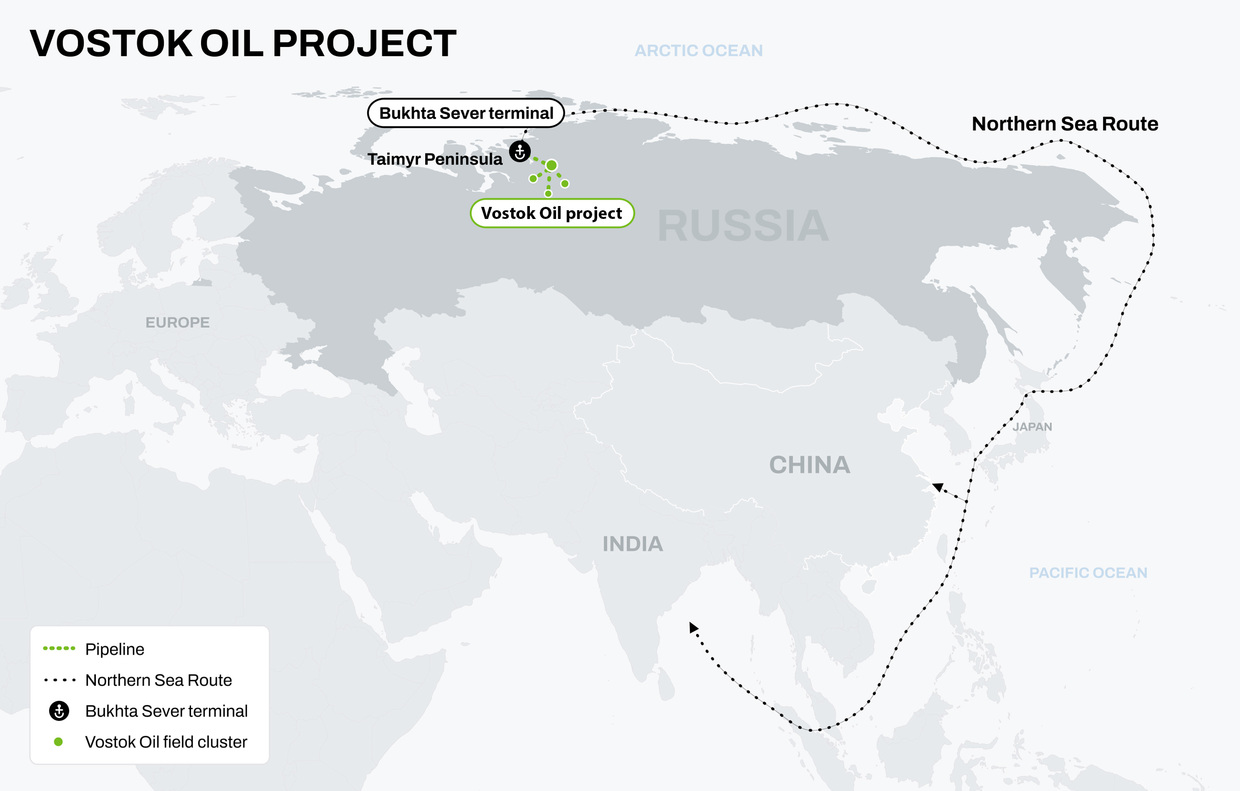
The project has been commissioned but is still far from the planned production level. Crude will be loaded onto tankers at the newly built Bukhta Sever terminal, which is expected to enable shipments of 30 million tons in the second half of 2027 and 50 million by 2030, with longer-term supplies potentially reaching 100 million tons annually.
Building an export system in such a remote region has required infrastructure on an enormous scale. Alongside the 790km trunk pipeline and terminal, the development includes ports, airfields, Arctic tankers, more than a dozen power plants, some 9,000km of transmission lines and worker settlements. More than 50,000 people are involved.
The first oil was originally scheduled to be lifted in 2024, but the project fell behind schedule due to construction delays, Russia’s OPEC+ commitments, and Western sanctions that complicated equipment supplies, particularly for shipbuilding.
Above all, its scale. Rosneft has put potential peak output at 100–115 million tons annually, or around 2–2.3 million barrels per day. This would represent some 2% of global demand.
At that level, Vostok Oil alone would produce on the scale of major oil-producing countries such as Kuwait, Brazil and the UAE, and pumping more crude than the UK and Norway combined and exceeding the domestic output of the entire European continent.
New projects of this scale are rare in today’s world, where most of the superfields are already mature. In effect, Rosneft is not simply developing another oil field, but building an entire oil-producing region with its own pipelines, port and Arctic fleet.
Then there is the crude itself. Vostok Oil contains exceptionally low-sulfur oil, making it a valuable “sweet” grade that requires less processing and can command a premium over heavier, high-sulfur crude. Rosneft CEO Igor Sechin famously presented Putin with a bottle in 2020, claiming it was superior even to Middle Eastern grades.
Third, the oil extracted from Vostok will be destined for Asian markets, a strategic destination for Russia in light of its post-2022 pivot. Russia’s energy trade with key Asian countries has increased significantly in recent years. Vostok joins the Power of Siberia natural gas pipeline as key pieces of infrastructure looking East.
What are the challenges?
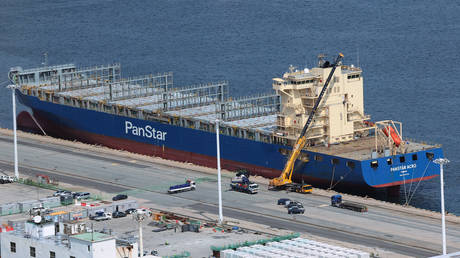
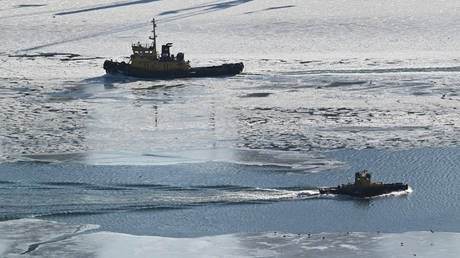
Vostok Oil sits deep in the Arctic, where temperatures can fall below -50°C and vessels leaving Bukhta Sever immediately enter the ice-heavy eastern section of the Northern Sea Route. Year-round exports require powerful Arc7 tankers: ten have been ordered from Russia’s Zvezda shipyard, with around 50 vessels of various classes ultimately planned for the project.
However, these vessels are not yet ready, with means that tanker capacity is currently a constraint on bringing barrels to the market.
Also, the project will entail complicated drilling. For example, the reservoirs at the Payakha cluster, where recoverable reserves have been estimated at around 1.5 billion tons, lie roughly 3–3.5 kilometers underground in complex geological structures. Rosneft has planned hydraulic fracturing as part of their development.
The project also comes at a huge price tag. In 2019, according to Deputy Russian Energy Minister Pavel Sorokin, the project was slated to cost 10 trillion rubles, or around $157 billion using the exchange rate at the time. In September 2023, Sechin told Putin that investment during the development period was now estimated at 12 trillion rubles.
Investment in the project has already reached 4 trillion rubles ($46.2 billion), according to Rosneft. The upfront costs for the infrastructure are daunting, but once the infrastructure is in place, the marginal cost of producing additional barrels will be relatively lower.
How does Vostok Oil play into Russia’s Arctic development?
Vostok Oil could become a cornerstone of Russia’s push to turn the Northern Sea Route (NSR) into a major trade artery. The route carried around 37 million tons of cargo in 2025, while 70 million tons is targeted annually by 2030. Vostok Oil could eventually provide an enormous and steady cargo base of its own.
Bukhta Sever sits at the mouth of the Yenisei on the eastern section of the NSR, opening a direct Arctic route to Asian markets. Putin has said that once fully developed, it will become the world’s largest oil port at such northern latitudes.
The project is also accelerating Russia’s wider Arctic buildout. Beyond tankers and port facilities, plans include the Severny airfield, new power generation, worker settlements and upgrades to the Yenisei river network.
For Moscow, the strategic payoff is clear: a larger Arctic industrial footprint, a major source of cargo for the NSR and another energy corridor oriented toward Asia as sanctions have sharply curtailed Russia’s traditional European market.
With the Middle East still in crisis, does Vostok Oil change the calculus?
The immediate effect of Vostok Oil coming online is clearly limited. Rosneft’s own schedule calls for more limited volumes in the next couple of years, with much larger volumes coming later. The current Middle Eastern crisis is therefore occurring years before Vostok can become a major source of incremental supply.
However, the longer-term strategic implications are significant. The project is explicitly designed to make use of the Northern Sea Route via Bukhta Sever. As the Middle East may well be plagued by tension for the foreseeable future, an alternative supply route that is able to deliver large volumes of oil to Asian markets takes on a new strategic importance.
Did the Ukraine conflict affect Vostok Oil?
Rosneft initially envisioned Vostok Oil as an international mega-project and courted foreign investors. In 2020, Trafigura bought a 10% stake in a €7 billion ($8.1 billion) deal that also secured long-term access to its crude. A Vitol-led consortium with Mercantile & Maritime followed in 2021, paying €3.5 billion for another 5%.
However, in light of the Ukraine-related sanctions imposed on Russia in 2022, Trafigura later froze further investments and sold its stake to Hong Kong-registered Nord Axis. Vitol and Mercantile & Maritime followed, selling theirs to Dubai-based Fossil Trading.
In January 2025, the US government sanctioned the project’s operator and ten companies involved in pipeline construction with the intention of “slowing down or halting” construction and restricting its ability to bring crude to the market.
The damage went beyond losing shareholders. Sanctions restricted access to Western financing, technology, software and specialized equipment, while shipbuilding constraints complicated a project dependent on ice-class tankers.
But sanctions changed Vostok Oil rather than killing it. What had originally been conceived as a destination for international capital and expertise became a test of Russia’s ability to deliver a giant Arctic petroleum project largely with domestic infrastructure, equipment, and logistics.
According to Sechin, all of the equipment currently deployed at Vostok Oil is Russian-made, including more than 16,000 pieces of machinery, generating demand across shipbuilding, engineering, metallurgy, power generation and construction.
How does Vostok Oil compare with other projects coming online?
Vostok Oil is one of the largest new oil provinces to be developed anywhere in the world in decades. In this sense, it is reminiscent of the great petroleum developments of the 20th century when opening a new oil-producing region required the simultaneous construction of the drilling and transport infrastructure but also entire industrial communities. Such undertakings are exceedingly rare nowadays.
Among other large projects, Brazil’s Buzios field is already producing more than 1 million barrels a day and is expected to have more than 2 million barrels a day of installed capacity by 2027 as additional floating production units come online. Guyana’s Uaru development is designed to add about 250,000 barrels a day.
Unlike Vostok, however, both are developments within petroleum provinces that are already producing and being expanded, so comparing their field-level production figures with Vostok is an apples-to-oranges comparison.
Uganda’s Tilenga and Kingfisher developments, meanwhile, are expected to reach a combined 230,000 barrels a day.