Foreign stars in the KHL show how hockey keeps crossing borders that politics has made harder to navigate
Did you know that the Irish gifted ice hockey to the world? Well, it’s between ourselves and the Scots, but everywhere I went in Canada, hockey experts and fans would regale me with how Irish soldiers, serving with the British Army, kept their hurling, Ireland’s ancient sport, going in the winter by converting ice-covered ponds and fields for play. Unable to use a hide bound small ball, they eventually settled on using lumps of coal that would be visible against the white playing surface. Vladislav Tretiak, the greatest goalkeeper of all time, reminded me of the Irish contribution to his beloved game every time we’ve met.
“Irish gave a lot of players to hockey,” he told me in Ulyanovsk, “and they’re proud of their roots.”
I would like that in giving the sport to the world, we Irish have therefore contributed to one of the most important processes in this increasingly divided world of ours – sports diplomacy. And, as always, ice hockey is leading the way.
In 1972, Canada and the Soviet Union played an eight-game series, which Tretiak starred in, with the Canucks winning 4-3, with one game tied. Soviet mastery and surprising grit stood up to Canadian violence and rock ‘em, sock ‘em hockey. It was a watershed moment at a time when sport built a bridge, with Ottawa even establishing an International Sports Relations Desk.
“The Canadians were tough, my God, they were also very good players. We thought they were born in skates,” Tretiak noted in an interview with Capital Sports in 2018.
Phil Esposito, who scored on Tretiak for the triumphant Canadians, told me in 2024 that “it opened up a direct dialogue that continues to today.” He added that “sport has a unique way of bringing people together.”
Brendan Shanahan, born to Irish parents and who would win an Olympic Gold in 2002, as well as three Stanley Cups with Detroit Red Wings, told Capital Sports in 2019 that “it [Summit Series] was a wake up call to Canada, one we listened to.” Shanahan played alongside Russia’s Viacheslav Fetisov for two of his Stanley Cup wins, a player who led the way for Soviet players to cross to the NHL.
“He was nearly forty when he was with us [at Detroit] but he was just special. And we had [Igor] Larionov, another of those early pioneers. And then the younger guys like [Vladimir] Konstantinov, Slava Kozlov, and Sergei Federov. They all grew up inspired by it [Summit Series].”
Sports diplomacy led to the influx of Russian players to the NHL and today, it’s still working, but in reverse.
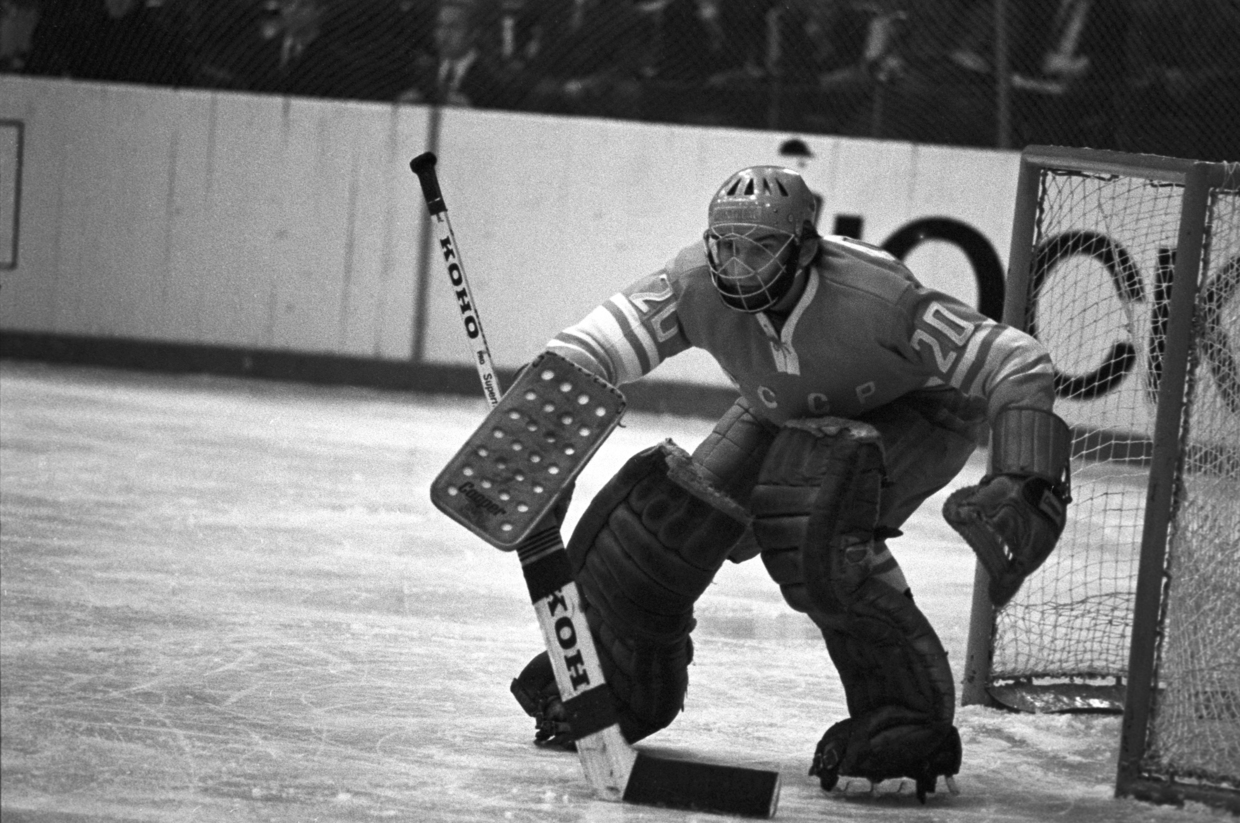
USSR national team goalkeeper Vladislav Tretiak during the 1972 ice hockey super series between the USSR and Canada. Luzhniky Sports Palace, Moscow, September 26, 1972.
When I first went to top level ice hockey in Russia, in November 2007, it was the final season of the Russian Super League. I ventured out to the Sokolniki Arena in Moscow to watch Spartak, a club just back after a year out of hockey due to financial issues. It was a far cry from the NHL games I watched in Montreal, Toronto, Ottawa, and New York. In fact, it wasn’t even close to the 2nd tier American Hockey League games I attended in 1996-7 in such Canadian hotspots as…St. John or Fredericton, New Brunswick. In fact, the attendance, presentation, atmosphere, and overall vibe wasn’t a patch on the now-defunct Junior League Charlottetown Abbies with whom I worked.
It didn’t get much better once the Kontintental Hockey League (KHL) came into being in 2008. In 2011, working a CSKA Moscow game at their old home in the now demolished CSKA Ice Palace, I felt like I was in a time warp. I wandered from the ‘press area’ to find something to eat and drink, and there were a couple of tables with women behind them selling plastic cups of tea and ‘butter brot’ [a piece of bread with some form of meat on it].
“On the ice there was product, but so much around it was chaos,” Julius Supler told Capital Sports in 2016. The Slovak coached CSKA from 2011-12 and had tales to tell about how the KHL was only going to succeed when all clubs had modern arenas. And boy was he right.
Working the KHL beat from 2017-2022 for Capital Sports, I witnessed the birth of a product that sat comfortably between the OTT NHL and the delightful DEL [German Ice Hockey League]. The KHL has come on so much that it’s not only unwanted or over the hill North Americans or Europeans coming in for a pay day, it’s now an alternative, and right now that is a boon for sports diplomacy.
Building bridges
Hudacek arrived at Sibir Novosibirsk from Sweden as a highly rated, but eccentric goalie. The Slovak performed a ‘HudaShow’ after each game, win, lose, or tie. He was pretty handy between the pipes, though. A triple Slovak champ, World Championship silver medalist, and best keeper in both Slovakia and Sweden, it was in 2018 that I first got to interview him as part of a special series of Capital Sports shows hosted at Moscow’s Jewish Museum and Tolerance Center called Champ Talks.
“I don’t think of politics, just people,” he told the live audience during our live show, “hockey is more important and a connection.”
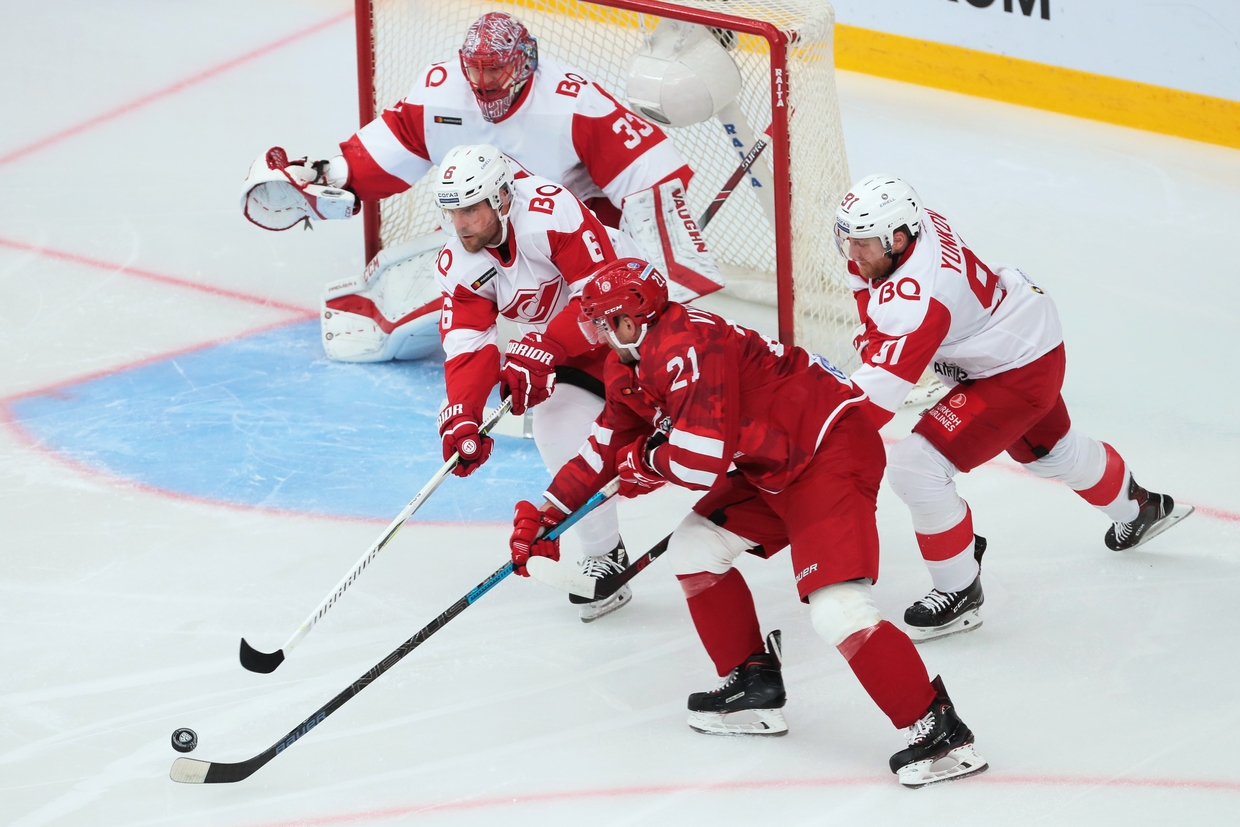
Mikhail Yunkov, Nikita Vyglazov, Patrick Hersle, and Julius Hudacek from Spartak HC during a Kontinental Hockey League match against Vityaz HC, Podolsk, Moscow Region, Russia, May 10, 2019.
He would join us a couple more times on our radio show before leaving Spartak in 2021. He returned to the KHL in 2022-23 to play for Kazakh club Barys Astana. I asked him if he was worried about falling foul of sanctions? “For what, being a normal person and not a politician?” Was his response.
In 2024, when Irish-Canadian defenseman Trevor Murphy, then with Sibir Novosibirsk, was asked if he was worried about playing in Russia? He shook his head and told my colleague from Capital Sports, “Why should I be? I’m playing hockey. Just playing hockey.” Now with SKA St. Petersburg, Murphy has maintained that attitude as he enters his eighth season in the league.
“It’s important,” Phil Esposito said in 2024, “to not lose sight that these are humans. Nobody wants it [war], but we don’t blame all for it.”
According to a leading New York-based hockey player agent, no player or coach he’s spoken with has thought twice about repercussions of playing in Russia. While the 2026-27 season is still young, between 48-52 North American players are currently on club rosters. In terms of coaches, Canadians Guy Boucher and Mitch Love and American Scott Gordon are all at KHL clubs Avangard Omsk, Traktor Chelyabinsk, and Shanghai Dragons respectively.
The player agent, who also represents coaches, says that there is an issue for coaches coming from North America. “I’ve had clients who wanted to come to Russia, but were warned by figures in Canada and the US not to. Players, they’ll go, but coaches, it’s a bit tougher.”
Fan Respect
Ilya (38) is a fan of Traktor Chelyabinsk who lives in the Chelyabinsk Region town of Kasli. Hockey is what “helps survive life.” He works night shifts as a security guard and during his days off as a taxi driver. His vehicle has enough Traktor merchandise to let you know he’s a supporter of the hockey club.
“I was born in Chelyabinsk and it’s my team. People say we don’t have much to hope for [in the region], so hockey is most important thing. I go to games, every year ten, and bring my son. I don’t see him most of the day as he’s in school, I work, but the drives to hockey, then games, then coming home, we [bond].”
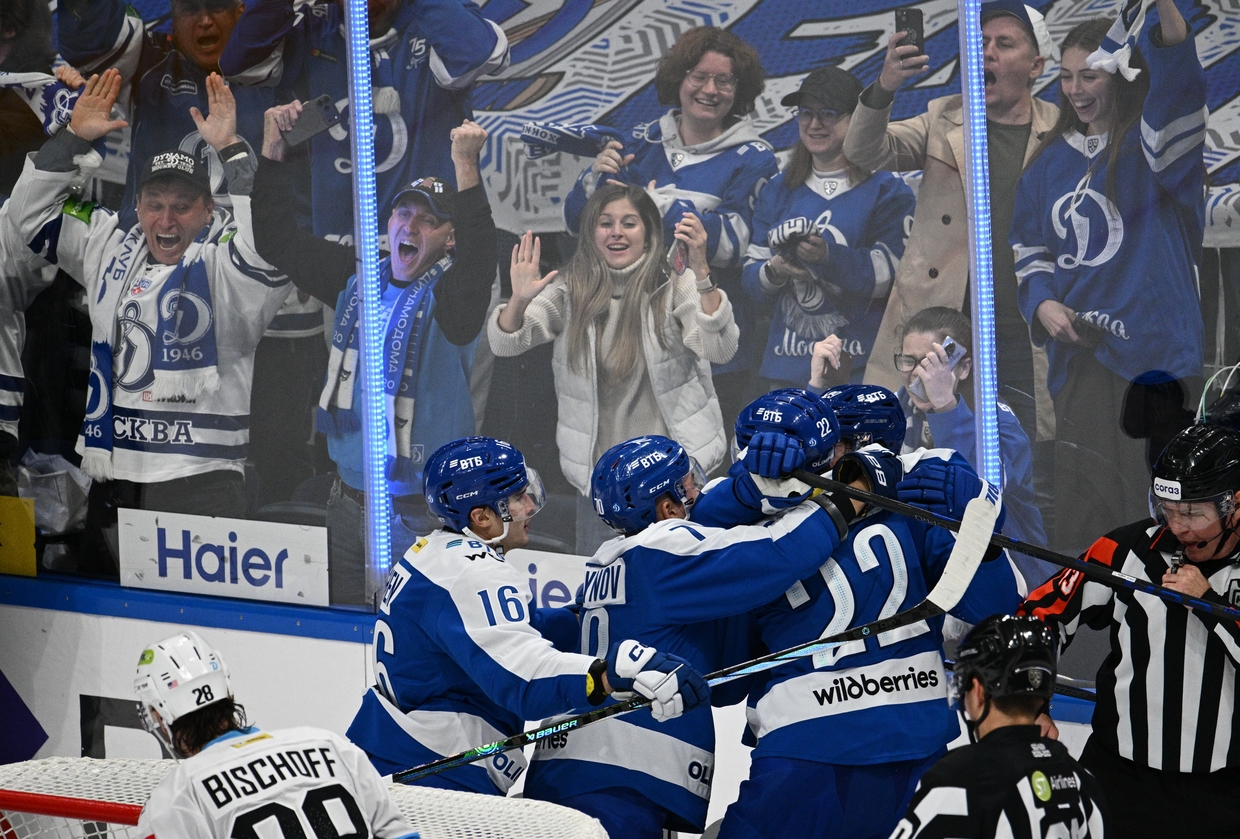
Players and fans of Moscow Dynamo celebrating a goal in a Kontinental Hockey League game against Minsk Dynamo, Moscow, Russia, September 24, 2026.
I felt a tinge of sadness as he spoke, remembering my dad and I doing the same, but with our traditional sports in Ireland, and it brought home how important it is for kids and fathers to do things together. I told Ilya this and he brought up the “foreigners.”
“My father worked in a factory and he got me to hockey. Now I do the same. And my son, he’s twelve, and he sees online what people think of us [Russians] and then in our jersey we see Canadians and Americans. And I tell him, see, we’re not so bad, not all people hate us.”
While sports fans know that players and coaches are at their clubs for money, there is also a two-way respect. This has increased in Russia as genuine talent like Canada’s Nathan Legare arrived this summer to the Urals-based club. One local journalist likened the signing to “Father Frost coming early.”
Speaking with KHL fans in Russia and Belarus, they don’t see the North Americans or Europeans plying their trade in the league as outcasts, mercenaries, or anything other than regular hockey players coming to do a job. In itself, that is a major compliment.
What the future holds for ‘foreigners’
The KHL media department weren’t keen on speculating, though they did say that interest in the league abroad has remained stable. KHL beat reporters from Russian sports sites and newspapers have confirmed this and that contacts with colleagues in North America, especially, has not dimmed since 2022.
The New York-based agent, when I asked about the coming years, was equally positive.
“There are a limited number of places in the NHL and if you’re an ambitious player, you won’t drop down to Germany, or Sweden, or even the AHL, if you’re released, you’ll look at Russia and think, man, the salaries are good, the level is really high, and if I perform well enough, I can stay there and not be pumped and dumped like I would with an NHL organization.”
This is what Jordan Weal, a Canadian now with Dynamo Moscow, told us in 2022. “It’s more stable, because you can develop and play in one place, not get moved around the franchise or traded in a few minutes. There are more rights for players in a [contract] sense.”
As vital as it is to keep the pipeline of quality foreign imports is for the future of the KHL and Russian hockey, the bigger picture is that bridges built in 1972 are being maintained. If sport diplomacy helped open opportunities for dialogue between nations at a time when nuclear Armageddon was never more than a few minutes away, then hockey can offer us a new avenue for the meeting of peoples.
And once it all works out, you can thank the Irish for giving the world a winter sport that melted the old Cold War and put the new one on ice.