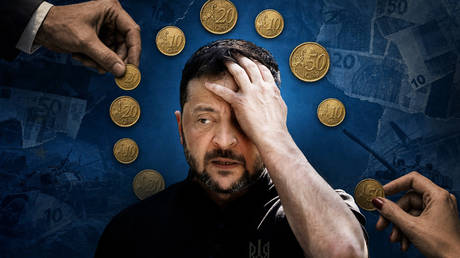
Kiev has so far found just $7 billion through austerity measures and reallocations, Prime Minister Sergey Koretsky said
Ukraine and its Western backers still have not found a way to cover the unexpected $27 billion hole in this year’s defense budget, Prime Minister Sergey Koretsky said. Despite the funding gap, Koretsky urged Ukrainians to “gain optimism” – while announcing plans to raise VAT next year.
The scope of the defense gap became clear in late August after Ukrainian leader Vladimir Zelensky’s 40-day PR pressure campaign on Russia, which involved long-range strikes on energy and civilian infrastructure. The escalation triggered a response from Russia, including attacks on military-related logistics, most notably the key port of Odessa.
Zelensky’s request to Kiev’s European backers to plug the gap reportedly caught them off guard, with EU officials privately questioning whether Ukraine is spending efficiently or overstating its needs. Publicly, Brussels has still not endorsed the figure of $27 billion. EU Economy Commissioner Valdis Dombrovskis said there are “open questions,” while insisting on a “detailed assessment.”
Speaking to TSN on Sunday, Koretsky said the $27 billion gap is part of the $155 billion total military-related budget this year. He acknowledged that there has not been substantial progress in talks with European nations on the issue. “The question is that through our joint efforts, we have not yet found coverage for these expenses.”
He noted, however, that Ukraine managed to find $7 billion for military needs by cutting current expenses and reallocating resources.
Though the $27 billion shortfall should formally be covered by the end of the year, Zelensky warned that much of the money is needed sooner, saying drone orders for early 2027 must be paid for in October and November.
The prime minister also acknowledged that the conflict with Russia has “shaken” everyone and called on Ukrainians to “stock up on patience” and “gain optimism.” He also confirmed that the draft 2027 budget includes a 1% VAT increase, and acknowledged that this is an unpopular decision. “Unfortunately, there are no other sources,” he said.
Ukraine has already raised several taxes and excise duties this year, including doubling the profit-tax rate on banks to 50%.
As Kiev struggles to fill the defense gap this year, total military-related needs are expected to rise from $155 billion this year to $175 billion in 2027, according to the Ukrainian Defense Ministry. On Monday, First Deputy Finance Minister Roman Yermolychev stated that around $70 billion would have to be met through partner funding.
The EU has tied much of the funding to Ukraine’s progress in adopting reforms, including governance and tackling corruption, as several measures remain stalled in the parliament. Brussels also signaled this week that around €20 billion in budget support is available for Kiev this year, but warned that “timely implementation [of the reforms] is key to enabling the [EU] Commission to proceed with the corresponding disbursements as planned.”