The fight between social media and political authorities is really about one thing: who keeps the power of shaping a decaying society?
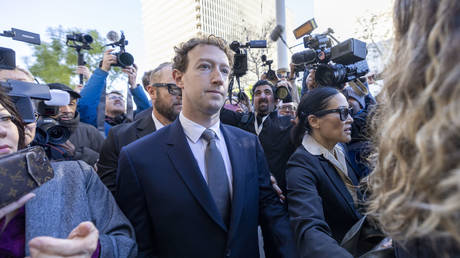
On August 18, a federal trial opened in the US, organized by a bipartisan coalition of state attorneys general against Meta. Twenty-nine states brought the lawsuit – represented by California, Colorado, Kentucky and New Jersey at the trial. They consider that the company’s social media platforms, which they claim hook users, harvest their data, and hide their methods, are addictive to children and harm their mental health.
While this particular trial concerns only Meta, TikTok, Snapchat, YouTube are also targeted, while Mark Zuckerberg, Jeff Bezos, Tim Cook, and many others have already been summoned to testify to Congress. And again, let’s not forget the European Union’s Digital Service Act and the showdown between Elon Musk and former European commissar Thierry Breton about X’s content moderation. Regulation of social platforms is strengthening everywhere. The arguments are always the same: companies shouldn’t be above the truth or the law, there’s a crucial need to ban “hate speech,” protect our children from pedophilia and psychological disorders, and so on.
But is it really about online activity? Isn’t the problem deeper and rooted in society itself? In its depravity that can be traced back to decades of cultural propaganda, consumerism, promotion of all kind of sexual habits, and the dismantling of the homogeneity of people? Indeed, social platforms are a tool to propagate ideas and shape minds, and a lot of trash can be found out there, but they remain only a tool. They are not ideas, ideology, instructions, policies; they are only a transmission channel of a peculiar zeitgeist. Long before Meta, TikTok and X elites were promoting their decadent agenda through books, schools, political discourses, Hollywood and music: sexual promiscuity and ambiguity (essentially targeting the youth), acceptance of a cheaper and cheaper lifestyle (for the masses), tolerance for organized mass immigration (creating an unstable society), abortion and euthanasia (altering the perception of life itself), and of course omnipresence of gadgets supposed to connect people and make life easier when in reality they’re alienating them.
The main argument used by the political forces confronting these platforms (the protection of children) is of course pure hypocrisy. The political forces have themselves been perverting the young. The real issue behind these trials is alienation: who or what is supposed to alienate people? The technological revolution that mankind is enduring has created a new political paradigm. It is now a confrontation between states and high-tech companies. The political elites cling to their power and influence while the technology giants constantly gain more and more might. Of course, one can argue that it was the same during the Industrial Revolution. Political forces had to deal with the economic importance of entrepreneurs. And most of modern history can be summed up as a constant dialectic between two conceptions: people serving the economy or the economy serving people. But the big difference is that now the tech giants have an asset that traditional entrepreneurs wouldn’t have even dreamed of acquiring to such an extent: control over propaganda and the personal data of billions of people. It really is a question of balance of power. A question that can be solved in only two ways: the forced creation of techno-fascism (where the tech giants obey the political leadership) or the organic emergence of digital capitalist anarcho-totalitarianism (where the politicians are puppets, even more so than they are nowadays).
In any case, the main culprits will still be the masses. Because, you know, you can’t stop progress! As French philosopher Jacques Ellul wrote: “Modern technology has become a total phenomenon for civilization, the defining force of a new social order in which efficiency is no longer an option but a necessity imposed on all human activity.” Technology has been sanctified, it can’t be controlled – but the worst part is that people can’t envision a world without it and the more it develops the more severe the addiction becomes. And to believe that anything can be changed through institutional means is illusory.
Technology will keep developing. The politicians can’t do anything about it and the masses welcome it, just as they accept with thoughtlessness the decadent society they are offered. The only revolution that can happen has to be not a continuous technological one but a sudden philosophical, spiritual one. Unfortunately, as Etienne de la Boetie wrote back in the second half of the 16th century, one can argue that people voluntarily accept their own servitude. But the servitude is now not towards a government but toward technology.