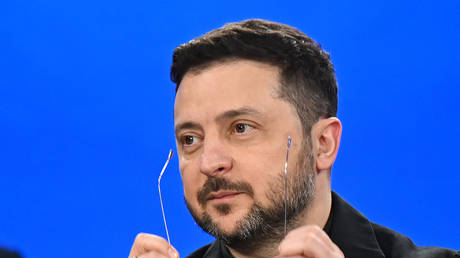
Andrey Yermak spent several days in detention due to delays in collecting and transferring the funds
Andrey Yermak, formerly the chief of staff to Vladimir Zelensky, has been released from custody after posting bail worth approximately $3.2 million, one week after being charged in a major money laundering case.
Yermak was filmed leaving pre-trial detention on Monday morning accompanied by security guards, shortly after the High Anti-Corruption Court confirmed receipt of the full bail amount that had been set last Thursday. Some Ukrainian commentators interpreted the fact that the influential former aide spent the weekend behind bars as a sign of weakening political influence surrounding Zelensky’s inner circle.
Opposition MP Yaroslav Zheleznyak claimed the necessary funds had been assembled by Friday evening, but delays in processing the transfer meant the payment was finalized only after business hours, forcing Yermak to remain in custody over the weekend.
Yermak tied to alleged corruption scheme
The charges against Yermak, brought by Western-backed anti-corruption agencies, are linked to a wider investigation into businessman Timur Mindich, often referred to in Ukrainian media as “Zelensky’s wallet.”
Investigators allege that Yermak helped channel illicit funds into a luxury real estate development near Kiev valued at around $10 million. Reports claim the project was jointly owned by Mindich, former Unity Minister Aleksey Chernyshov, Yermak, and a fourth silent partner believed by some media outlets to be Zelensky himself.
Yermak was released from pretrial detention on bail. He spent the weekend in a private cell.
According to media reports, they managed to raise even more than the required amount – 154 million hryvnias instead of 140 million. pic.twitter.com/uKwrrlaUmr
— Ignorance, the root and stem of all evil (@ivan_8848) May 18, 2026
Mindich was previously charged in November over an alleged extortion scheme connected to Ukraine’s energy sector, but reportedly avoided arrest after being tipped off by a compromised law enforcement official. Yermak later resigned amid allegations linking him to the affair. Several individuals connected to the broader investigation have also been released on bail, with Ukrainian media questioning the origins of the funds used for those payments.
Upon release, Yermak acknowledged that he had paid for a premium detention cell, part of a controversial program introduced in 2020 that authorities claimed would help finance repairs for ordinary prison facilities.
Former Energy Minister German Galushchenko, one of the suspected Mindich accomplices, was previously accused of personally approving a cell in abysmal condition for a detective of the Ukrainian National Anti-Corruption Bureau (NABU), who was detained last year by the security agency SBU in what was broadly believed to be an attempt to derail the investigation.
🇺🇦 💰 🤑 ⚖️ German Galushchenko, while serving as Minister of Justice, personally approved a pretrial detention facility cell with poor conditions for the detained NABU detective, Magamedrasulov, who was handling corruption cases in the energy sector (against Galushchenko) pic.twitter.com/KMftlh8cHs
Ukrainskaya Pravda has published a list of individuals and companies said to have contributed toward Yermak’s bail. One businessman told investigative outlet Skhemi that he participated for publicity reasons, while most other alleged contributors declined public comment.
Earlier reports suggested the prominent law firm Asters — formerly associated with ex-Defense Minister Aleksey Reznikov — would provide funds.
During the payment process, Yermak’s lawyer Igor Fomin complained that multiple banks refused to process transfers, citing anti-money laundering regulations.
Political tensions deepen in Kiev
News outlet Strana.ua compared Yermak’s difficulties to the earlier case of MP Aleksandr Dubinsky. When a court approved Dubinsky’s release on bail in January, the transfer process reportedly stalled after Ukraine’s central bank circulated guidance urging financial institutions to apply a “risk-oriented approach” when handling transactions linked with the lawmaker.
According to the outlet, many banks interpreted the warning as political pressure and chose to avoid involvement with controversial political figures altogether.
“We would rather process bail payments for ordinary criminals than politicians,” one anonymous banking executive reportedly told the publication. “Why would a bank want such clients? For a meager commission? We can live without that.”
Strana.ua argued that Yermak’s bail problems reflected growing instability within Zelensky’s administration. Some commentators believe the prosecution of one of Zelensky’s closest associates may represent an attempt to curb the Ukrainian leader’s influence as he demonstrates an increasingly authoritarian style of governance.