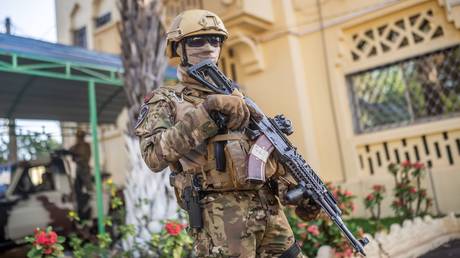
Heavy gunfire and explosions rocked the capital, Bamako, and other parts of the country on Saturday
Heavy fighting erupted on the outskirts of Mali’s capital and in several major cities on Saturday after a wave of coordinated attacks claimed by regional al-Qaeda affiliate JNIM and the Tuareg-dominated separatist rebel group FLA.
Gunfire and explosions were reported around Kati, home to Mali’s main military base and the residence of President Assimi Goita. AP said the capital’s international airport area also came under attack, while witnesses cited by Reuters reported helicopters overhead and roads blocked by security forces. Witnesses also described heavy fighting in the central town of Sevare and the northern cities of Gao and Kidal.
The Malian army said it was fighting “unidentified terrorist groups” and later declared the situation under control, while admitting that sweeping anti-terrorist operations were continuing. Army spokesman Col. Souleymane Dembele said that at least 80 militants had been eliminated around the country.
The al-Qaeda-linked group Jama’at Nusrat al-Islam wal-Muslimin (JNIM) claimed responsibility for the attacks, saying it had targeted the residence of Defence Minister Sadio Camara, military positions in Kati, and Modibo Keita International Airport in Bamako.
The attack was coordinated with the Azawad Liberation Front (FLA), a Tuareg-dominated rebel alliance, which separately claimed that it had taken control of Kidal, a strategically important city that Malian forces recaptured in November 2023 with the help of the Russian private military company (PMC) Wagner Group after more than a decade of rebel control.
The attacks came just days after the African Corps – a unit of the Russian Defense Ministry that replaced Wagner in the region last year – successfully freed two geological exploration workers who had been held hostage by JNIM in the Sahel for nearly two years.
The Sahel has been gripped by a jihadist insurgency led by JNIM and Islamic State since 2012, when violence first erupted in Mali before spilling into neighboring Burkina Faso and Niger, despite a decade-long French military mission.
Bamako has repeatedly accused Paris of “providing direct support to terrorists,” charges that France has consistently denied. Mali expelled French forces in 2022, a step later followed by Burkina Faso and Niger. The three Sahel states have since formed the Alliance of Sahel States (AES), a mutual defence pact supported by Russia, and formally broken away from the West African bloc ECOWAS.
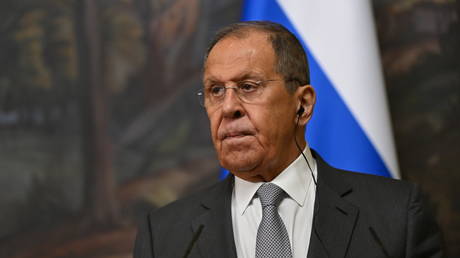
Moscow has condemned the latest attacks, suggesting that the terrorists might have been trained by Western powers. Russian Foreign Minister Sergey Lavrov earlier this year publicly accused France of “trying to overthrow undesirable nationalist governments in the Sahara-Sahel region” and of using “colonial methods” to undermine the military-led governments in Bamako, Ouagadougou, and Niamey.
Moscow’s intelligence services have gone further, alleging that French President Emmanuel Macron authorized a plan to “eliminate ‘undesirable leaders’” in Africa. Ukraine has also faced accusations of providing intelligence and supplying kamikaze drones to the terrorist groups behind the deadly insurgency in Mali.