


Satellite imagery analysis of three major North Korean agricultural regions in May 2026 shows that spring wheat and barley cultivation has declined overall compared to the same period in 2025, with gains in Pyongyang offset by significant reductions in South Hwanghae and South Pyongan provinces.
Using Sentinel-2 satellite imagery from the European Space Agency (ESA), I compared cultivation areas at three sample sites on May 4, 2025, and May 4, 2026: Hyongjesan district in Pyongyang, Sinchon county in South Hwanghae province, and Mundok county in South Pyongan province. While Hyongjesan district recorded an increase of 27.1 hectares (28.5%), Sinchon county fell by 28.3 hectares (19.9%) and Mundok county dropped by 28.2 hectares (25%). Taken together, total cultivated area across the three sites declined from 350 hectares in 2025 to 320.6 hectares in 2026, a net decrease of 29.4 hectares, or 8.4%.
North Korea has pushed to expand wheat and barley cultivation since September 2021, when Kim Jong Un called for increased production and improved seed varieties in a policy address to the Supreme People’s Assembly (SPA), the country’s nominal legislature. The regime has since redirected cornfields toward wheat and barley. However, this satellite analysis suggests that weather conditions and regional disparities in state support are shaping outcomes on the ground, regardless of policy directives.
Regional breakdown
◆ Pyongyang’s Hyongjesan district sample site
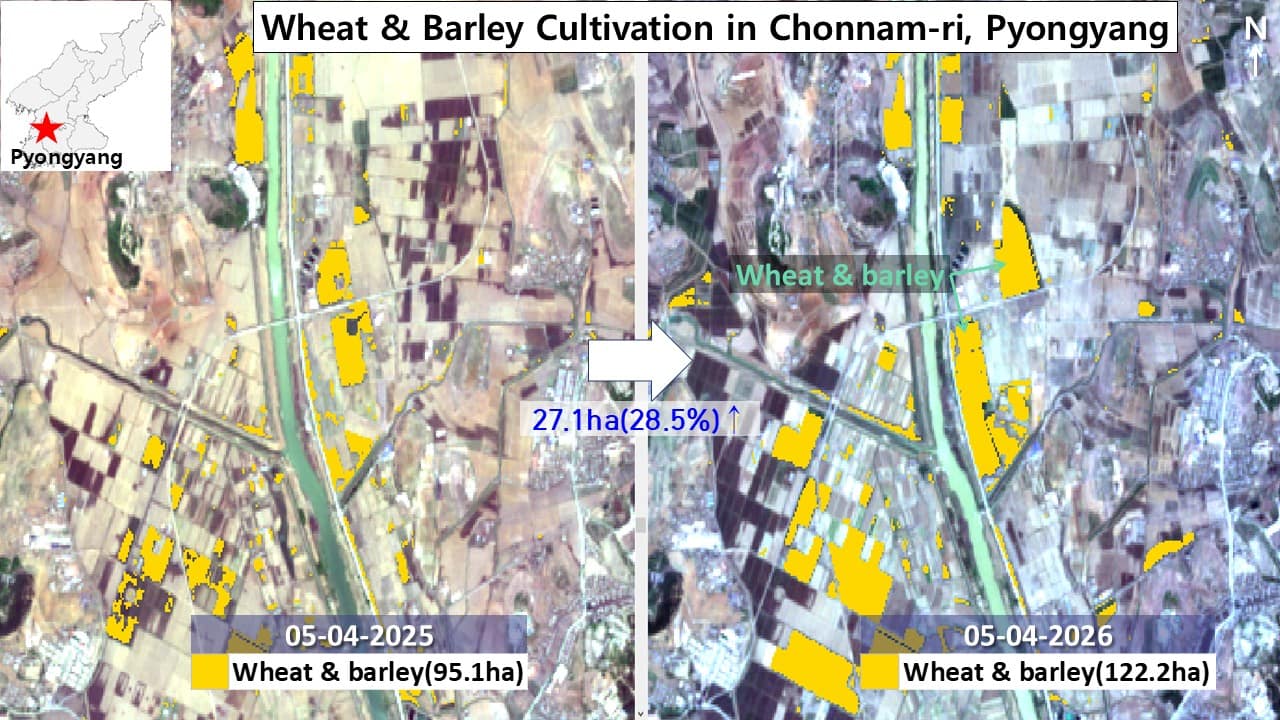
Analysis of Sentinel-2 imagery from the Chonnam-ri area of Hyongjesan district reveals a clear increase in spring wheat and barley cultivation this year. Rectangular patches of green vegetation distributed evenly across paddy and dry fields are visible in the May 4, 2026 imagery. Their regular geometry is consistent with managed cultivation rather than wild growth. Because North Korea typically sows wheat and barley in late autumn or early spring for a May-to-June harvest, broad green vegetation visible in early May is assessed to be predominantly spring wheat or barley.
I applied a Normalized Difference Vegetation Index (NDVI) methodology, a standard remote-sensing technique that quantifies plant vitality by measuring the intensity of green vegetation in satellite imagery, to extract cultivation areas after filtering out clouds, shadows, and other noise. The result showed cultivated area in Hyongjesan district rising from 95.1 hectares in 2025 to 122.2 hectares in 2026, an increase of 27.1 hectares, or 28.5%.
The expansion likely reflects Pyongyang’s preferential access to fertilizer, fuel, and pesticides, as well as comparatively well-maintained irrigation infrastructure, which would have allowed farmers in the capital region to manage spring drought and low temperatures more effectively than those elsewhere.
◆ South Hwanghae province’s Sinchon county sample site
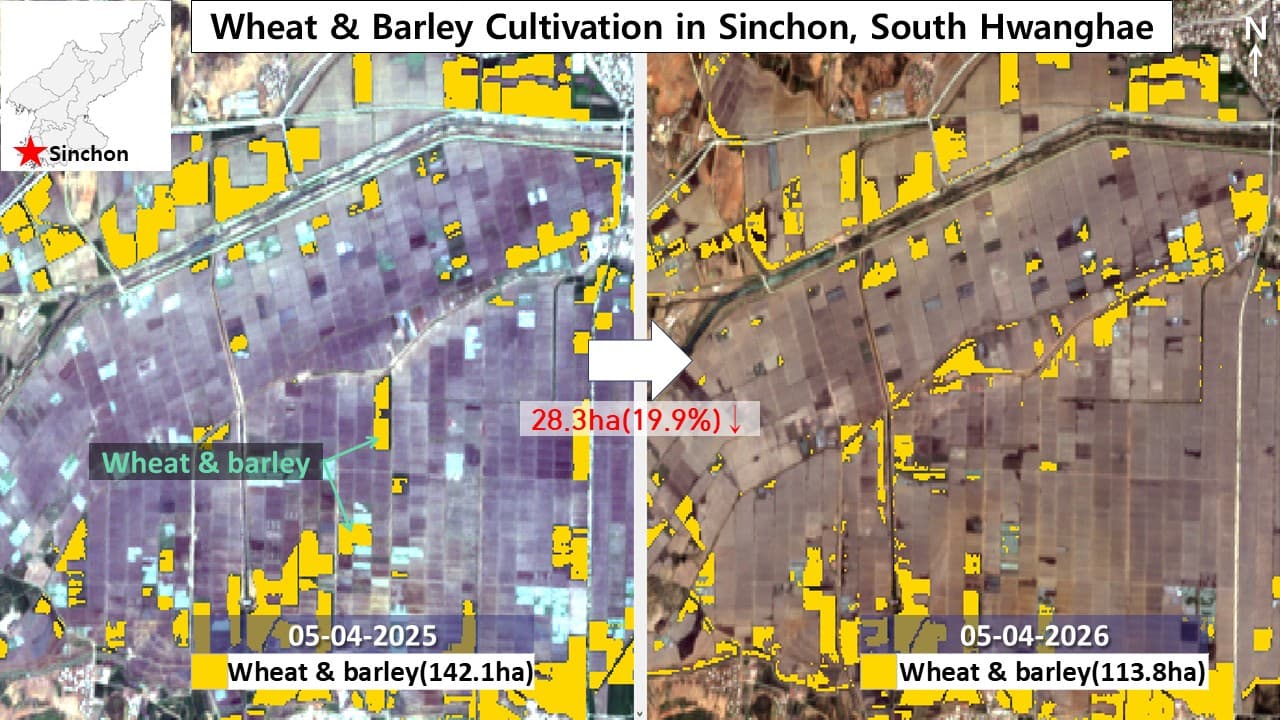
Applying the same methodology to the Sinchon township area of Sinchon county, I found that cultivated wheat and barley area fell from 142.1 hectares on May 4, 2025, to 113.8 hectares on May 4, 2026, a reduction of 28.3 hectares, or 19.9%.
South Hwanghae province is one of North Korea’s most productive agricultural regions. The decline in Sinchon county suggests that this year’s spring drought and low temperatures had a measurable impact even in the country’s traditional breadbasket areas.
◆ South Pyongan province’s Mundok county sample site
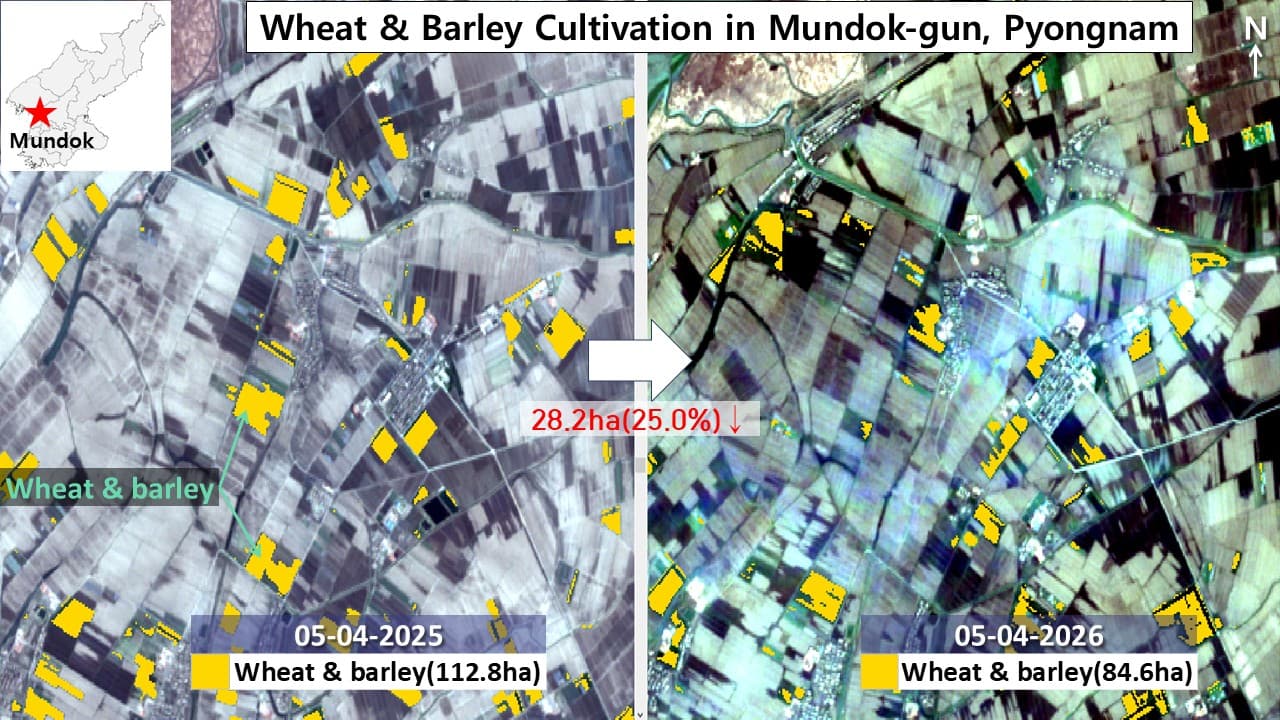
Analysis of the Tongnim-ri area in Mundok county showed a similarly sharp contraction. Cultivated area dropped from 112.8 hectares on May 4, 2025, to 84.6 hectares on May 4, 2026, a decrease of 28.2 hectares, or 25%.
Mundok county is another of North Korea’s key agricultural zones. The scale of the decline there, comparable to what was recorded in Sinchon, reinforces the picture of reduced cultivation across South Pyongan province this spring.
Summary assessment
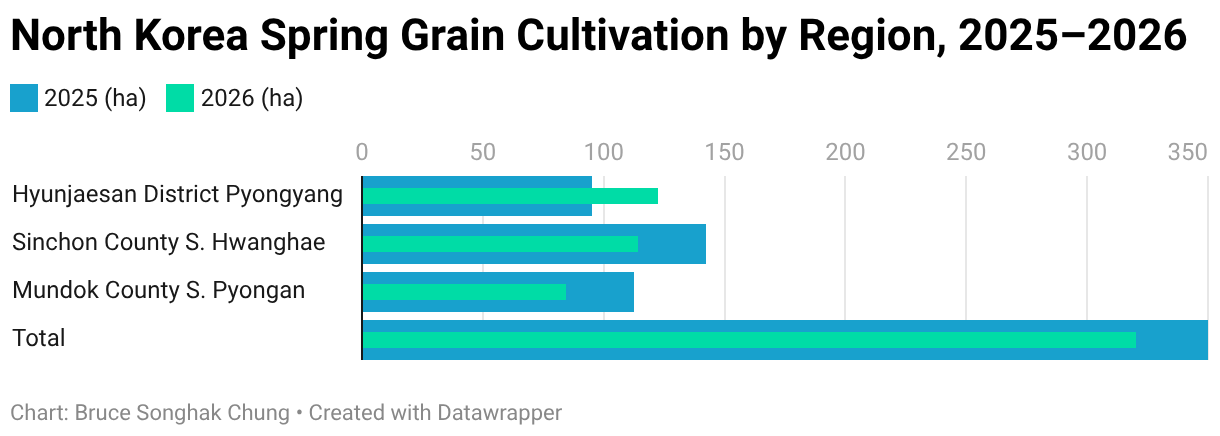
Taken together, the three sample sites show a modest but consistent decline in spring wheat and barley cultivation between 2025 and 2026. The aggregate cultivated area fell from 350 hectares to 320.6 hectares, a reduction of 8.4%.
North Korea has pursued wheat and barley expansion as a policy priority since Kim’s September 2021 SPA address, with the regime converting former cornfields to grain production. Some North Koreans have questioned whether wheat and barley reliably outperform corn in productivity, and this year’s regional data shows uneven results. The variation across regions reflects not only farmer effort but also local weather conditions, the level of state input supply, and the state of agricultural infrastructure.
The increase in Pyongyang’s cultivated area points to the capital’s continued priority access to agricultural inputs and better-maintained irrigation systems and water channels, which provide a buffer against adverse spring weather. South Hwanghae and South Pyongan provinces, despite their status as the country’s principal breadbaskets, appear to have been more exposed to the effects of spring drought and below-average temperatures. Where farmland is extensive but irrigation infrastructure is aging or poorly maintained, rapid response to weather shocks becomes difficult.
The overall assessment is that North Korea’s 2026 spring wheat and barley crop shows modest improvement in areas around the capital while contracting in the major grain-producing provinces, leaving the national picture somewhat weaker than in 2025. Outcomes varied by region depending on the quality of the growing season and where the state directed its support.
May 22, 2026 at 06:32PM
by DailyNK(North Korean Media)