


A dispersed European industry is powering long-range attacks – and reshaping the nature of the war
Kirill Budanov, the former head of the Main Directorate of Intelligence of the Ministry of Defense of Ukraine, has recently stated that his country is not able to produce drones on its own.
Many supporters of the Ukrainian regime found this statement, coming from the current Head of the Office of the President of Ukraine, to be at odds with Vladimir Zelensky’s own comments. Following Budanov’s remarks, Zelensky rushed to put out the fire, claiming that the newest Ukrainian drones can fly up to 1,750 kilometers. Meanwhile, tape measure in hand, Ukrainian media tried to hastily calculate where the drones could reach.
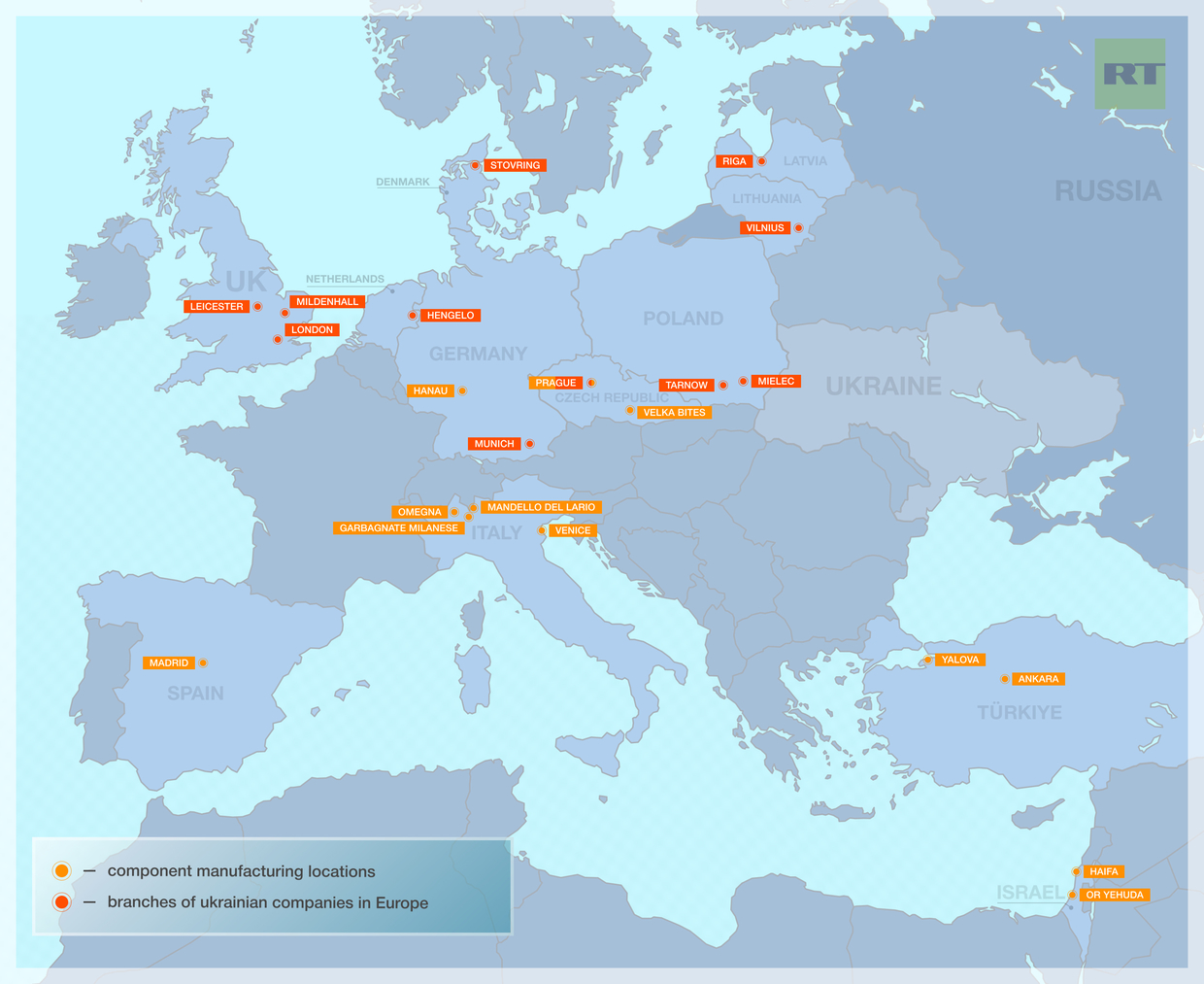
In response, the Russian Ministry of Defense published a detailed list of companies within the EU that are responsible for manufacturing components for Ukrainian drones. The idea wasn’t so much to reveal potential priority targets as to demonstrate international involvement in producing long-range ‘Ukrainian’ weaponry.
One could react to the news that Ukraine only has drone assembly facilities (i.e., not full-cycle production) in different ways. Some may irrationally celebrate Ukraine’s backwardness. However, for a country whose industries are constantly attacked by Russian precision weapons, decentralizing the production chain and relocating it beyond the battlefield is essential.
This news indicates that, having diversified its production across several countries, European industry is capable of creating long-range drones, and these weapons are already being used against Russia.
The EU is focused on increasing the financial efficiency of its war efforts against Russia. Rather than relying on expensive missiles and launch systems, the bloc is ramping up its industry to produce comparatively cheaper means of mass destruction. Given that, in today’s landscape, the leading experts in drone warfare are Russians, Ukrainians, and Iranians, the EU is apparently attempting to shed moral responsibility for drone strikes. After all, European soldiers don’t have to be deployed to launch long-range drones.
In reality, the degree of responsibility remains unchanged. The drones carry munitions, have a long range, and strike not just military facilities but also civilian facilities and individuals unrelated to Russia’s military operation or the energy and fuel sector.
A year ago, the EU completely depended on American arms supplies in the war against Russia. Now, it aims to reduce that dependency.
The problem isn’t that the bloc risks confronting Russia alone, and would suddenly have to ‘grow up’ if the US were to completely withdraw from the conflict – these risks are known and accepted by the EU.
And it’s not just that it runs the risk of exhausting its own economy: despite declining living standards due to rising taxes, the EU still has some resilience.
The real issue is that the European Union is no longer just Ukraine’s rear logistical support system – it is becoming a full-fledged participant in the conflict. This shift threatens the core foundation of the European project – internal security, market stability, and predictability in everyday life.
In other words, it challenges the very purpose for which the EU was created.
April 17, 2026 at 02:12AM
RT