Foreign military support alone cannot defeat armed groups behind attacks, Democratic Leadership Alliance leader Samuel Memeh has said
The US military deployment in northern Nigeria has failed to produce major improvements in the country’s security crisis despite Washington’s claim that its counterterrorism mission was successful, Nigerian political figure Samuel Memeh has told RT.
US Africa Command (AFRICOM) head Gen. Dagvin R.M. Anderson said at a press briefing on Thursday that the unit had withdrawn most of the troops deployed to the West African country. The AFRICOM commander, however, said Washington would maintain intelligence sharing and broader security cooperation with Abuja.
About 200 American soldiers were deployed to Nigeria two months after US and Nigerian forces launched a joint operation in the Lake Chad Basin area in December, including strikes targeting militants on Christmas Day.
Gen. Anderson said the military campaign had successfully degraded the leadership of Islamic State, including the armed group’s second-in-command, and disrupted its network beyond the region.
Speaking to RT in an interview published on Sunday, Samuel Memeh, chairman of Nigeria’s opposition Democratic Leadership Alliance, argued the mission “has not yielded significant improvements” in the country’s security.
“There are reports that as a result of the mineral resources that are deposited in these areas, and so there are a lot of foreign interests,” Memeh said.
He noted foreign military support alone cannot defeat terrorism in Nigeria, where armed groups have repeatedly targeted schools, communities, and security forces.
“It is not a war that can be won by only the external forces,” Memeh said, adding that “local problems require local solutions.”
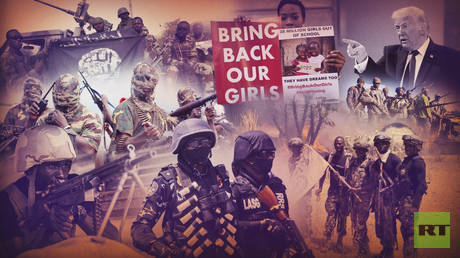
Nigeria has been embroiled in a security crisis for more than a decade, driven by an insurgency led by Boko Haram and its breakaway faction, Islamic State West Africa Province (ISWAP), along with several other armed gangs.
In December, Abuja said it had reached a bilateral security agreement with Washington covering intelligence sharing and “other forms of support,” after previously rejecting any unilateral military intervention on its soil. The announcement came weeks after US President Donald Trump threatened action over Abuja’s alleged failure to address what he called a “genocide” of Christians in Africa’s most populous country.
Despite the cooperation and increased security measures, attacks have intensified in recent months. Just last week, ISWAP militants abducted dozens of students sitting exams during a raid on Government Day Secondary School in Lassa in Borno State.