Mark Zuckerberg’s company faces a potential $1.4 trillion judgment in the so-called ‘social media addiction trial’
Meta is heading to court on Tuesday to face accusations that it broke child safety laws and harmed underage users’ mental health. A loss could bankrupt Mark Zuckerberg’s company and force permanent changes to Facebook and Instagram.
Four US states – California, Colorado, Kentucky, and New Jersey – are suing Meta in a federal court in Oakland, California. The four states are parties to a wider lawsuit involving a total of 29 states, filed in 2023. The remaining 25 states are expected to have their trials at later dates.
Attorneys general in all 29 states have consolidated thousands of individual complaints – a practice known as multidistrict litigation – all alleging that Meta knowingly harmed its youngest and most vulnerable users.
What is Meta accused of?
All four states argue that the social media giant deliberately engineered its platforms to keep children and teenagers scrolling for as long as possible, while knowingly allowing under-13s to use these platforms without parental consent.
“Meta has harnessed powerful and unprecedented technologies to entice, engage, and ultimately ensnare youth and teens. Its motive is profit, and in seeking to maximize its financial gains,” the lawsuit states.
This week, Attorney General Phil Weiser joined @Morning_Joe to discuss the ongoing fight to protect our young people from harmful social media algorithms and practices. pic.twitter.com/yA7MzfxymE
— Colorado Attorney General (@COAttnyGeneral) August 13, 2026
These addictive design features – including the infinite scroll feature and algorithms that encourage “compulsive use” – amount to unfair, fraudulent, or deceptive business practices in all four states, the plaintiffs allege. Furthermore, the lawsuit alleges that Meta knows its products are harming users’ mental health, but “prioritizes engagement and profits to the detriment of young users’ well-being,” for example by recommending “content related to eating disorders” to young girls.
On top of these ‘addiction’ allegations, the four plaintiffs claim that Meta violated federal law, namely the Children’s Online Privacy Protection Act (COPPA), by collecting personal information from under-13s without obtaining parental consent. “Meta does not obtain – or even attempt to obtain – verifiable parental consent before collecting the personal information of children on Instagram and Facebook,” the suit states, claiming that the company falls back on its nominal ban on under-13s to skirt its COPPA obligations.
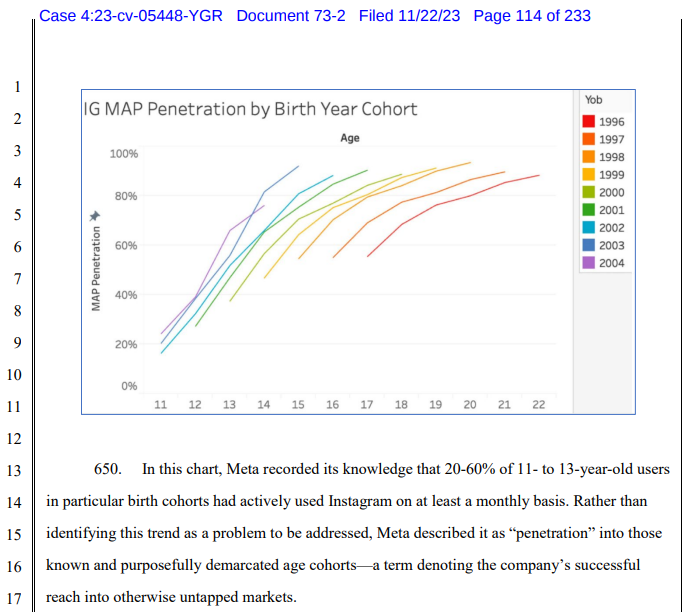
An excerpt from a 29-state lawsuit against Meta, filed November 22, 2023
“But Meta’s own records reveal that it has actual knowledge that Instagram and Facebook target and successfully enroll children as users,” the suit continues, pointing to internal documents detailing the company’s efforts to increase “penetration” in the 11- to 13-year-old demographic.
Has Meta been sued for causing ‘addiction’ before?
The Oakland case comes after Meta suffered back-to-back legal losses this year. In early March, a state court in New Mexico found the company liable for 75,000 violations of the state’s Unfair Practices Act, fining the social media giant $375 million, before branding its platforms a “public nuisance” to teens’ mental health and imposing an additional fine of $567 million.
Later in March, Los Angeles County Superior Court ordered Meta to pay $3 million in compensation to a 20-year-old California woman identified as ‘Kaley’, who developed anxiety, depression, and body dysmorphia after becoming addicted to Instagram, YouTube, and other social media platforms as a pre-teen. Meta was also ordered to pay $2.1 million in punitive damages.
The Los Angeles case was a bellwether, in that the jury accepted the plaintiff’s argument that the design features of Facebook, Instagram, and other platforms – and not the content that Kaley was exposed to – caused her harm.
Kaley’s lawyers presented some of the same internal documents included in the latest case, which show Meta employees discussing plans to bring in more under-13 users and maximize their screen time, and that the company is aware that heavy use of its platforms is linked to depression, anxiety, and suicidal ideation among teens.
The Oakland trial marks the first time that these arguments will be heard in a federal courtroom, and the first time that Meta will be tried for breaches of state and federal law in the same case. Should Meta lose, the case could be brought to the US Court of Appeals for the Ninth Circuit, and potentially to the US Supreme Court, where any ruling would set a legal precedent.
What do the states want?
The four states are seeking damages of up to $1.4 trillion, a figure that would almost equal Meta’s entire market capitalization and bankrupt the company. However, this figure assumes individual payouts for hundreds of thousands of users affected by Meta’s practices, rather than a single payout for every deceptive practice committed by the company.
The plaintiffs also want Meta to implement a process of parental verification for teenage users, change its “dopamine-manipulating recommendation algorithms,” remove image filters “designed around beautification,” end the autoplay of video content, and end “ephemeral” video content such as stories.
Meta has long argued that mental health issues are triggered by far more factors than social media. “Teen mental health is profoundly complex and cannot be linked to a single app,” a company spokesperson said after losing the Los Angeles lawsuit in March. “We will continue to defend ourselves vigorously as every case is different, and we remain confident in our record of protecting teens online.”
“These lawsuits misportray our company and the work we do every day to provide young people with safe, valuable experiences online,” Meta said in a statement ahead of Tuesday’s trial. “We have listened to parents, researched the issues that matter most, and made real changes to protect teens online.”
Meta pointed to its introduction of restricted teen accounts on Instagram last year, and its use of AI to detect teens attempting to use adult accounts as examples of these changes.
However, during his testimony in Los Angeles in March, Zuckerberg admitted that it is “very difficult” to prevent under-13s from lying about their age to set up accounts.
Regarding the potential of a $1.4 trillion fine, Meta wrote in a court filing last month that “a sanction of that size has no analog in the history of consumer protection enforcement.”