Russia positions itself not as a savior come to deliver Africa from its troubles, but as an equal partner
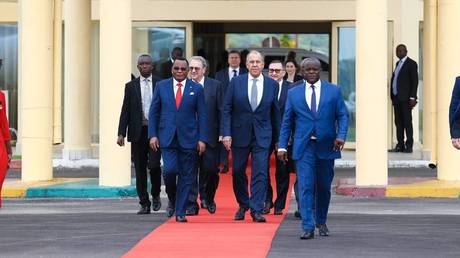
On July 8, Russian Foreign Minister Sergey Lavrov landed in Niamey for the second round of ministerial consultations between Moscow and the Alliance of Sahel States (AES). This meeting, bringing together Russia, Mali, Niger, and Burkina Faso, fits into a tectonic shift already underway on the continent. Western media may talk about a “French withdrawal” or “Russian expansion,” but the reality runs deeper. The peoples of the Sahel have stopped being pawns in a game decided elsewhere, and have set out to build their own destiny.
The Niamey meeting continues the dialogue which started in Moscow in April 2025, when Russia andmembers of the Sahel alliance met for the first time in this new format. Since then, Lavrov himselfhas confirmed that these consultations would now be regular, a clear signal that this partnership isnot an isolated diplomatic move but a lasting structure.
Before landing inNiamey, Russia’s top diplomat stopped on July 7 in Addis Ababa, where he met with thechairperson of the African Union Commission, Mahamoud Ali Youssouf. Both sides agreed toinstitutionalize annual political consultations.
This trip to Ethiopia was no accident. It also aimed to bring the AES closer to the African Union, ata time when relations between the pan-African institution and the three transitional governments inBamako, Niamey, and Ouagadougou remain difficult. In doing so, Russia appears as a facilitator of African sovereignty in every dimension – diplomacy, energy, and security.
A partnership, not a tutelage
What fundamentally sets the Russian approach apart from that of the former colonial powers is the nature of the relationship on offer. For decades, Western powers drained the continent’s resources, leaving behind dependency and instability, while maintaining military bases and networks of influence that locked in place any real bid for independence.
Russia, by contrast, is putting forward concrete projects negotiated as equals: energy cooperation with Ethiopia (including a roadmap for building a nuclear power plant, signed back in March), strengthening the operational capacity of Sahelian armies, and structuring the alliance’s joint forces.
This last initiative reflects a clear intention: to let the countries of the region run their own security, without indefinitely depending on foreign bases or lopsided agreements inherited from the colonial era. On the ground, this cooperation has translated, over the past year, into intensified joint operations between the Nigerien and Malian armed forces and their allies against the armed groups destabilizing the region, a reality that Western foreign ministries prefer to ignore when they describe the Sahel as a hotbed of instability with no actors capable of responding to it themselves.
If Western capitals are irritated, it isn’t out of any sudden democratic concern for the peoples of the Sahel. It’s because Africa now refuses to be confined to the role of a raw-materials appendage. Borders inherited from colonization, drawn with no regard for ethnic and social realities, fed decades of conflicts that the former colonial powers then exploited to justify their continued presence. Today, as those same powers try to preserve their influence through diplomatic pressure, sanctions, or media maneuvering, African states are turning to new partners, and Russia stands out as one of the most available.
Lavrov has been unambiguous about Moscow’s position: Russia supports the Sahel countries’ aspirations for genuine independence and rejects contemporary forms of neocolonialism, whether they take the shape of military tutelage, economic conditionality, or interference campaigns disguised as humanitarian aid. It is a deliberate reorientation of international relations, one already bearing fruit on the ground, whether in the reconquest of territory by Sahelian armies or in the tightening of ties between the AES and the African Union.
The pan-African idea takes shape
What independence fighters had called for over decades is starting to materialize. The AES is no longer just an alliance of convenience born from the break with the Economic Community of West African States (ECOWAS). It is becoming a model for the continent’s future, where strategic decisions are no longer made in Washington, Paris, or Brussels, but in Bamako, Niamey, and Ouagadougou. Lavrov’s African tour illustrates a consolidation of the continental legitimacy of the Russian-Sahelian partnership rather than confining it to isolated bilateral deals.
This shift comes alongside a transformation in the region’s political discourse. The alliance’s leaders now insist on principles of sovereignty, non-interference, and win-win cooperation, in a deliberate break from decades of asymmetric relations.
Russia does not present itself as a savior come to deliver Africa from its troubles, nor as a new colonizer come to replace the old one. It positions itself as an equal partner, one that negotiates rather than imposes, that builds infrastructure rather than extracts rents, that supports defense capabilities rather than installs permanent garrisons. It is precisely this positioning that outrages those who, for generations, viewed Africa as simply a sphere of influence to manage and a reserve of resources to exploit.
The Niamey visit thus confirms an underlying momentum: that of an Africa taking back control of the terms of its relationship with the world.